
Spain's December bridge holiday sparks debate on work-life balance
In Spain, the long December weekend divides those working and resting. Freelancers, healthcare staff, and retailers explain why they keep going while others enjoy the break.
English · Original discussion in Spanish · Published
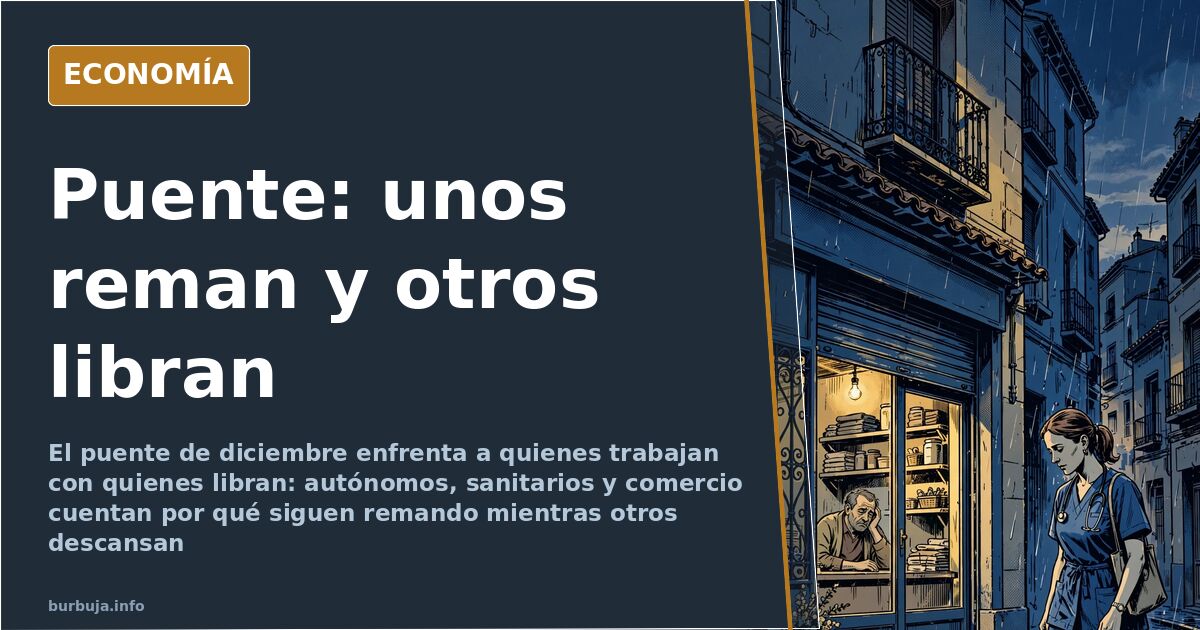
The December bridge: who works and who rests
Are you working these days or taking a break? This question echoes through the December period when millions hit the road while others stay at their posts. At the heart of the matter is a discussion that goes beyond the calendar: the perception that a few sustain the rest of many with their labor, and the suspicion that effort is not always distributed as claimed.
The starting point is a message encouraging workers to keep rowing while politicians, civil servants, top-tier pensioners, and public aid recipients enjoy the long weekend. The image of the rower, taken from popular language, names those who work while others rest. The debate quickly shifted to the distribution of effort and whether the system rewards those who contribute least.
Who says they are working during the bridge
Not everyone works out of vocation. A self-employed shop owner explains he can only close for two afternoons because otherwise he cannot afford basic necessities. A retail worker notes that the Christmas campaign does not spare holidays and that this is the hardest situation for a "rower." Another volunteers to work six hours for €150, without emails or calls, and enjoys it precisely because he does not do so on other days.
Healthcare also appears. A temporary staff member recounts working on Thursday after finishing a shift, having attended to five patients throughout the night. The anecdote illustrates that some shifts ignore bridges and calendars.
Frustration with the calendar and those who enjoy it
Much of the discontent is not against others' rest, but against the feeling that the distribution is unfair. Critics target those who travel for the long weekend and complain about traffic, mocking how the country fills with cars and queues while some remain in guard booths coughing and eating sandwiches. Complaints extend to media accused of hammering images of airports and stations to feed a narrative.
Some argue people behave like sheep by massing on roads, while others respond that an affluent country fills its highways and malls because it can. The discussion moves between criticism of mass consumption and the realization that most work to afford such lifestyles.
The argument of those who no longer work
Opposing the complainers is the voice of someone who stopped working temporarily because they can afford it and claims it feels great. This position argues that days no longer have names and one realizes it is the weekend only upon leaving the house. The underlying idea is that complaints about the bridge hide poorly concealed envy toward those who have organized life differently.
The response trinc quickly: those boasting about not working are accused of wasting time mocking those who do, and reminded that a full life is measured not by free time quantity, but by what one does with it. The exchange leaves an uncomfortable conclusion: the problem is not resting or working, but turning the calendar into a marker of sarracena superiority.
What happens during the bridge beyond work
The conversation turns to everyday economics. There is debate over whether fuel costs are as high as claimed, with responses stating jerrycans are not expensive and not everyone spends over €100 monthly on gas. Agricultural campaigns are mentioned, with olive pickers working daily until visibility fails, beating upper branches and sweeping lower ones, considering this true "rowing."
Comparisons arise with those who have always lived better than the complainers, and barbs directed at critics judging others' dating lives from frustration. The discussion tangles in judgments about others' lives, clarifying the bridge is just an excuse.
The background: who pays for the welfare state
The core issue is burden sharing. It is stated that the welfare state, especially healthcare and education, must be maintained, warning that next year the whip will not stop for those in the galleys. The metaphor of the foreman beating the drum to combat huge debt summarizes the feeling that effort always falls on the same shoulders.
The discussion reaches no agreement on whether the problem is public spending, tax structure, or the idea itself that some rest while others sustain the system. What remains is the confirmation that the bridge distributes blame alongside free days.
Eventually, the bridge ends and everyone returns to their place. Those who worked will continue, and those who rested will find another bridge. The only unresolved doubt is if next year anyone will remember those left in the guard booth. Probably not.
Summary of a discussion on Burbuja.info - Foro de economía, actualidad y política., translated from Spanish and reviewed before publication. Read the full discussion (132 replies).
More summaries
-
Muface: The battle over public vs. private healthcare in Spain
Spain's Muface, Mugeju, and Isfas cover 800,000 civil servants, with an estimated 650,000 opting for private healthcare providers.
-
Benidorm viral video sparks debate on British tourism and housing
A viral clip of a mechanical bull in Benidorm reignites discussions on British mass tourism, gentrification, and rising rental prices.
-
Women sharing a flat in Spain: the electricity bill tears them apart
In Spain, two salaries are no longer enough to rent a flat, and female flatmates end up arguing over the electricity bill. The problem is not who cleans: it's the price.
-
The Roma community in Ceuta, Spain: an economic overview
How does the Roma community affect the economy of Ceuta, Spain? An analysis of data and context.
-
Is Spain's tourism boom a bubble waiting to burst?
**Aena** handled almost 35 million passengers in August 2023, an all-time record. We look at whether this is a bubble or sustainable growth.
-
Brutal - big clash brewing over this CUP antifascist speech
An analysis of the CUP's speech on Catalanism and antifascism. What does it mean for the economy and politics? Discover the key points.