
Spain's 'Curse' Theory: Forum Claims Link Franco Exhumation to Crises
A pandemic, volcanic eruption, blackout, and perceived systemic corruption in under a decade fuel online theories blaming the exhumation of Francisco Franco.
English · Original discussion in Spanish · Published
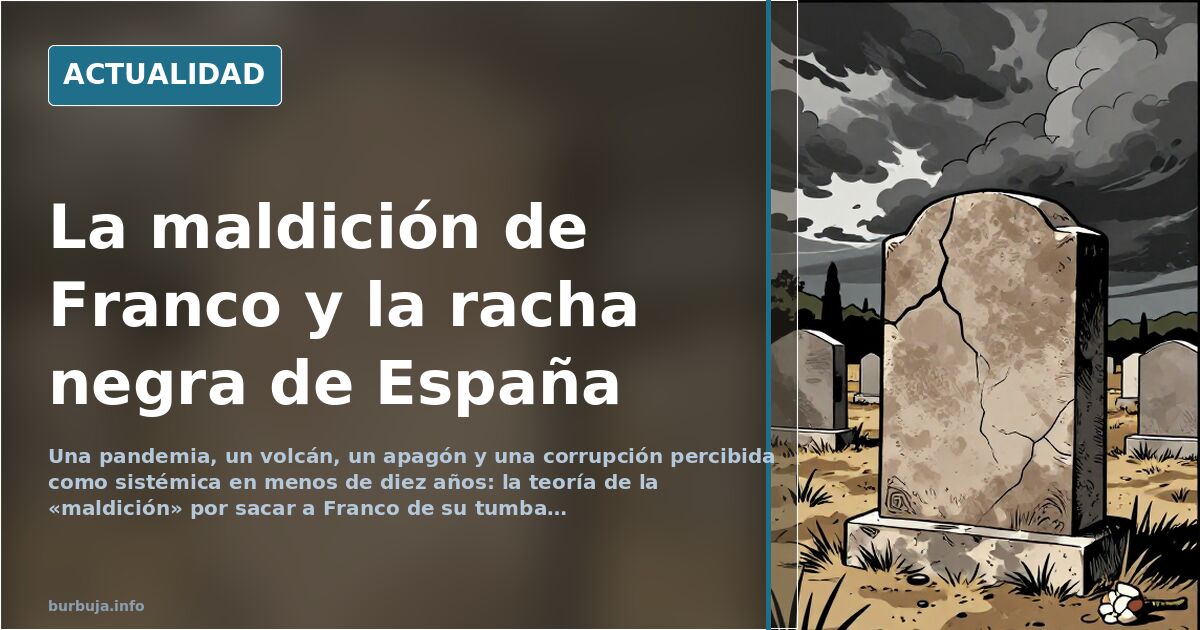
Spain's 'Curse' Theory: Forum Claims Link Franco Exhumation to Crises
A global pandemic, months of lockdown, an erupting volcano, historic snowstorms, devastating floods, a nationwide blackout, fires ravaging half of Spain, and corruption perceived as systemic. All within less than ten years. The coincidence is so grotesque that part of public discourse has stopped seeking rational explanations and resorted to something much older: a curse. According to this reading, the trigger was the exhumation of Francisco Franco from the Valley of the Fallen.
The thesis circulates strongly in current affairs forums and on social media, where sarcasm mixes with conviction. "If this is true, the curse for removing Franco from his tomb is massive," summarizes the argument. The idea is not new: in Spanish popular culture, desecrating a grave brings misfortune. Some argue that the Decree Law allowing the exhumation—labeled in debate as one of "desecration"—will have consequences for its signatory. "In all civilizations, there is a belief that the dead must be left to rest in peace," they claim.
What the Franco Curse Theory Says
The narrative is built by accumulation. It is not a single argument but a list of catastrophes which, lined up, seem to draw a pattern. The pandemic, state of alarm, volcano, snowstorm, floods, blackout, fires, and corruption are presented as links in the same chain. The lingering question is simple: how many coincidences does it take before it stops being a coincidence?
Some respond with irony: "Only fools believe in such coincidences." Others go further, claiming that whoever sanctioned the exhumation "will go into exile," because "here, the excuse of being forced doesn't work." The mix of folk belief, historical memory, and political discontent makes the theory function as a sounding board for broader unease.
The Economic Narrative Behind the Curse
The curse theory does not travel alone. It is attached to an economic diagnosis that reinforces it. Against official growth data, some analysis argues that the economy grows only in appearance: "Paying everything with unlimited credit, I too can pretend to be rich, but my children will pay for my excesses," summarizes one intervention. Debt, inflation, housing prices, and street insecurity appear as counterweights that macroeconomic headlines ignore.
The argument relies on a historical comparison repeated insistently: in the 1970s, Spain was the eighth industrial power, there was no income tax (IRPF) or value-added tax (IVA), debt was below 40%, and an unskilled salary supported a family of five. Today, they argue, an engineer shares a flat and gets around by scooter. "Sure, they say we live better now because you have Netflix," one voice mocks. The conclusion drawn is that pogre measured in GDP does not translate into material well-being.
Data Cited For and Against
Counterpoints come from those who recall that the economy is cyclical: "The economy is volatile; today it's good, tomorrow it's down." And from those who defend that the country has improved: "Families have a standard of living like never before, enjoy multiple properties, and can afford vacations and monthly savings." The discussion becomes a tug-of-war between macro indicators and everyday perception.
Defenders of the official narrative cite risk premiums at lows and the Ibex flirting with historic highs. The reply is immediate: "Risk premiums are low because the ECB has been buying our debt for 15 years and because German bonds pay higher interest." They add that GDP grows based on public spending, population growth, and statistical makeup. The disagreement is not about the figures, but about what they miccionan.
The Gap Between Macro Data and the Shopping Basket
The most repeated friction point is daily life. "It grows hellishly, the supermarket bill grows every weekend," summarizes an intervention condensing the general feeling. Public services are described as deteriorated, salaries as insufficient to rent a room, and insecurity as a growing phenomenon. Comparisons with past decades are used as proof: there were robberies before, but not daily stabbings or machete attacks, they claim.
The discussion shifts to the housing market, noting that those wanting independence only aspire to rent a room. And to employment, arguing that growth does not translate into livable wages. The recurring data point is an engineer sharing a flat, symbolizing a generation with more education than their parents but less purchasing power.
Political Context: From November 20th to Exhumation
The conversation is framed in a political climate where Pedro Sánchez appears as the axis of all criticism. He is accused of holding the country hostage for ten years, turning the State into a network of interests, and governing with parliamentary support rejected by part of the electorate. In this context, Franco's exhumation is read as just another symbolic act of a policy perceived as vengeful.
Some introduce an unsettling temporal element: "If he dies on November 20th, the jokes about reservoirs and counting apartments will end in less time than it took for the blackout." This reference mixes the political calendar with the curse theory, adding a layer of tension. The exhumation, the blackout, and the president's health intertwine in the same narrative.
The President's Health and Debate Limits
Part of the interventions cross a line rational analysis should not: wishing harm upon the president's health. Against this, other voices ask for distance: "Indifference, that's what this person's health status produces in me. It's better to stay away from this kind of festive sentiment, which damages the spiritual aura." The discussion on the curse ends up becoming a conscience check on how far it is legitimate to go.
Ultimately, the curse theory functions as a mechanism to explain the inexplicable. When the succession of catastrophes exceeds comprehension capacity, the mind seeks patterns. And the oldest pattern of all is divine punishment for a fault. Was the exhumation of Franco that fault? The answer depends on which Spain one believes in.
The list of misfortunes is so long that nobody dares to rule anything out anymore. Not even those who don't believe in curses.
A global pandemic, months of lockdown, an erupting volcano, historic snowstorms, devastating floods, a nationwide blackout, fires ravaging half of Spain, and corruption perceived as systemic. All within less than ten years. The coincidence is so grotesque that part of public discourse has stopped seeking rational explanations and resorted to something much older: a curse. According to this reading, the trigger was the exhumation of Francisco Franco from the Valley of the Fallen.
The thesis circulates strongly in current affairs forums and on social media, where sarcasm mixes with conviction. "If this is true, the curse for removing Franco from his tomb is massive," summarizes the argument. The idea is not new: in Spanish popular culture, desecrating a grave brings misfortune. Some argue that the Decree Law allowing the exhumation—labeled in debate as one of "desecration"—will have consequences for its signatory. "In all civilizations, there is a belief that the dead must be left to rest in peace," they claim.
What the Franco Curse Theory Says
The narrative is built by accumulation. It is not a single argument but a list of catastrophes which, lined up, seem to draw a pattern. The pandemic, state of alarm, volcano, snowstorm, floods, blackout, fires, and corruption are presented as links in the same chain. The lingering question is simple: how many coincidences does it take before it stops being a coincidence?
Some respond with irony: "Only fools believe in such coincidences." Others go further, claiming that whoever sanctioned the exhumation "will go into exile," because "here, the excuse of being forced doesn't work." The mix of folk belief, historical memory, and political discontent makes the theory function as a sounding board for broader unease.
The Economic Narrative Behind the Curse
The curse theory does not travel alone. It is attached to an economic diagnosis that reinforces it. Against official growth data, some analysis argues that the economy grows only in appearance: "Paying everything with unlimited credit, I too can pretend to be rich, but my children will pay for my excesses," summarizes one intervention. Debt, inflation, housing prices, and street insecurity appear as counterweights that macroeconomic headlines ignore.
The argument relies on a historical comparison repeated insistently: in the 1970s, Spain was the eighth industrial power, there was no income tax (IRPF) or value-added tax (IVA), debt was below 40%, and an unskilled salary supported a family of five. Today, they argue, an engineer shares a flat and gets around by scooter. "Sure, they say we live better now because you have Netflix," one voice mocks. The conclusion drawn is that pogre measured in GDP does not translate into material well-being.
Data Cited For and Against
Counterpoints come from those who recall that the economy is cyclical: "The economy is volatile; today it's good, tomorrow it's down." And from those who defend that the country has improved: "Families have a standard of living like never before, enjoy multiple properties, and can afford vacations and monthly savings." The discussion becomes a tug-of-war between macro indicators and everyday perception.
Defenders of the official narrative cite risk premiums at lows and the Ibex flirting with historic highs. The reply is immediate: "Risk premiums are low because the ECB has been buying our debt for 15 years and because German bonds pay higher interest." They add that GDP grows based on public spending, population growth, and statistical makeup. The disagreement is not about the figures, but about what they miccionan.
The Gap Between Macro Data and the Shopping Basket
The most repeated friction point is daily life. "It grows hellishly, the supermarket bill grows every weekend," summarizes an intervention condensing the general feeling. Public services are described as deteriorated, salaries as insufficient to rent a room, and insecurity as a growing phenomenon. Comparisons with past decades are used as proof: there were robberies before, but not daily stabbings or machete attacks, they claim.
The discussion shifts to the housing market, noting that those wanting independence only aspire to rent a room. And to employment, arguing that growth does not translate into livable wages. The recurring data point is an engineer sharing a flat, symbolizing a generation with more education than their parents but less purchasing power.
Political Context: From November 20th to Exhumation
The conversation is framed in a political climate where Pedro Sánchez appears as the axis of all criticism. He is accused of holding the country hostage for ten years, turning the State into a network of interests, and governing with parliamentary support rejected by part of the electorate. In this context, Franco's exhumation is read as just another symbolic act of a policy perceived as vengeful.
Some introduce an unsettling temporal element: "If he dies on November 20th, the jokes about reservoirs and counting apartments will end in less time than it took for the blackout." This reference mixes the political calendar with the curse theory, adding a layer of tension. The exhumation, the blackout, and the president's health intertwine in the same narrative.
The President's Health and Debate Limits
Part of the interventions cross a line rational analysis should not: wishing harm upon the president's health. Against this, other voices ask for distance: "Indifference, that's what this person's health status produces in me. It's better to stay away from this kind of festive sentiment, which damages the spiritual aura." The discussion on the curse ends up becoming a conscience check on how far it is legitimate to go.
Ultimately, the curse theory functions as a mechanism to explain the inexplicable. When the succession of catastrophes exceeds comprehension capacity, the mind seeks patterns. And the oldest pattern of all is divine punishment for a fault. Was the exhumation of Franco that fault? The answer depends on which Spain one believes in.
The list of misfortunes is so long that nobody dares to rule anything out anymore. Not even those who don't believe in curses.
Also available in: Deutsch
Summary of a discussion on Burbuja.info - Foro de economía, actualidad y política., translated from Spanish and reviewed before publication. Read the full discussion (111 replies).
More summaries
-
Gomesende Wedding: €40,000 and a Brawl Broadcast by TVG
A wedding in Gomesende ends in a fight, with an alleged infidelity in the bathroom and €40,000 at stake. TVG broadcasts videos of the ceremony.
-
Car theft insurance covers damage, not stolen radio
A €20 radio and spare wheel were stolen from a car in Spain. Insurance covered vehicle damage but excluded items taken from inside.
-
Madrid Sauna Linked to Begoña Gómez's Father: Reviews, Prices, License
Reviews describe a male brothel with rent boys for €50, while the official license lists it as a gym sauna with bar.
-
Murcia rape livestream: three arrested, two released
A man was drugged with fentanyl and morphine in Murcia before being raped on a live stream watched by 30 people. Three suspects have been detained.
-
Spain's assisted suicide debate: patient autonomy vs. state control
A man helping his wife with multiple sclerosis die reignites the conflict between personal sovereignty and state regulation of end-of-life choices.
-
Who pays for extreme mukbang health costs?
A viral video of someone eating 80 Oreos sparks debate on who bears the healthcare and social costs of morbid obesity.