
Car theft insurance covers damage, not stolen radio
A €20 radio and spare wheel were stolen from a car in Spain. Insurance covered vehicle damage but excluded items taken from inside.
English · Original discussion in Spanish · Published
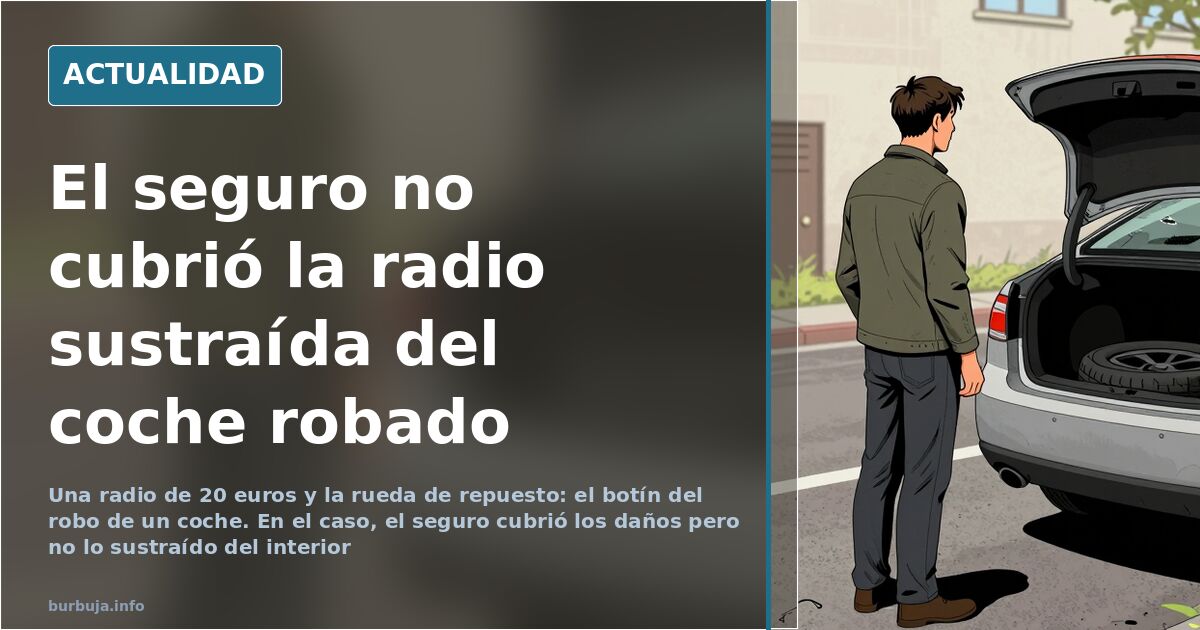
Car theft: insurance covers damages, not the radio
Vehicle theft is debated as a low-risk, high-impunity business. Estimates circulating among car enthusiasts suggest around one hundred thousand cars are stolen annually in Spain, a figure that remains stable because the incentive persists: getting caught is rare, and penalties are minimal. The incident reopening this issue is financially trivial —a twenty-euro radio, the spare wheel, jack, and lug wrench— yet representative of petty thefts.
What thieves take from parked cars
The pattern repeats with frustrating monotony. Forced windows yield loot barely covering the crime's cost. In the case sparking discussion, thieves took a cheap CD/USB radio, the spare wheel, jack, and wrench. They left a cigarette butt and fled on foot.
The most stinging detail isn't the value of stolen goods, but that officers did not collect fingerprints despite traces left by intruders. The theft occurred in August in a rural area; the owner rules out Eastern European gangs in his account. "Everything can be fixed," he consoles himself. But not everything is fixed equally.
What does insurance cover when your car is robbed?
The policy replaced the broken window, spare wheel, jack, and wrench. The radio, valued at twenty euros, was excluded. Here, insurance covered vehicle damages, not interior items.
Several participants agree filing reports has little effect: "Police don't search for stolen objects," one summarizes. While costs fall on individuals, impunity solidifies for incivil.
Cars found months later across the country
Recovery isn't swift either. A forum user recounts a car stolen in a Valencia town reappeared six months later, abandoned at San Esteban fountain in Salamanca. During the first two months, its owner received parking fines from Barcelona and Palencia without anyone linking them to the stolen vehicle.
The explanation given is technical: in the early nineties nothing was computerized, so a stolen car could drive and park across half of Spain without raising suspicion. Another user says his brother's car appeared abandoned at a gas station on the other side of the country, identified only when a newly assigned Civil Guard recognized a town sticker. In both stories, data matches late and by chance.
Another anecdote illustrates the business differently: a second-hand car contained hidden surprises. During an anti-drug operation at a highway entrance, with armed guards and dogs, the dog alerted on the vehicle, and occupants ended up separated from it with hands raised.
Who steals cars and why suspicion varies
The ridiculous loot —twenty-euro radio— leads one user to suspect quick-consumption profiles needing cash, selling stolen goods at flea markets. Conversely, others argue organized gangs operate differently: stealing for specific jobs or exporting vehicles. Both narratives coexist as distinct phenomena.
Prejudice surfaces too, as it always does regarding crime. Some attribute these thefts to specific groups based on stereotypes without data. No reported case allows attributing theft to a specific group: facts must be separated from stereotypes.
Current status of the issue
The cited estimate points to about one hundred thousand cars yearly. Institutional response appears scarce: dormant reports, uncollected prints, and cars found by chance. This episode's victim has identified who he believes responsible, though his revenge, he confesses, would be borrowing their car.
In the debate-opening case, insurance replaced the window, yes, but excluded stolen items.
Vehicle theft is debated as a low-risk, high-impunity business. Estimates circulating among car enthusiasts suggest around one hundred thousand cars are stolen annually in Spain, a figure that remains stable because the incentive persists: getting caught is rare, and penalties are minimal. The incident reopening this issue is financially trivial —a twenty-euro radio, the spare wheel, jack, and lug wrench— yet representative of petty thefts.
What thieves take from parked cars
The pattern repeats with frustrating monotony. Forced windows yield loot barely covering the crime's cost. In the case sparking discussion, thieves took a cheap CD/USB radio, the spare wheel, jack, and wrench. They left a cigarette butt and fled on foot.
The most stinging detail isn't the value of stolen goods, but that officers did not collect fingerprints despite traces left by intruders. The theft occurred in August in a rural area; the owner rules out Eastern European gangs in his account. "Everything can be fixed," he consoles himself. But not everything is fixed equally.
What does insurance cover when your car is robbed?
The policy replaced the broken window, spare wheel, jack, and wrench. The radio, valued at twenty euros, was excluded. Here, insurance covered vehicle damages, not interior items.
Several participants agree filing reports has little effect: "Police don't search for stolen objects," one summarizes. While costs fall on individuals, impunity solidifies for incivil.
Cars found months later across the country
Recovery isn't swift either. A forum user recounts a car stolen in a Valencia town reappeared six months later, abandoned at San Esteban fountain in Salamanca. During the first two months, its owner received parking fines from Barcelona and Palencia without anyone linking them to the stolen vehicle.
The explanation given is technical: in the early nineties nothing was computerized, so a stolen car could drive and park across half of Spain without raising suspicion. Another user says his brother's car appeared abandoned at a gas station on the other side of the country, identified only when a newly assigned Civil Guard recognized a town sticker. In both stories, data matches late and by chance.
Another anecdote illustrates the business differently: a second-hand car contained hidden surprises. During an anti-drug operation at a highway entrance, with armed guards and dogs, the dog alerted on the vehicle, and occupants ended up separated from it with hands raised.
Who steals cars and why suspicion varies
The ridiculous loot —twenty-euro radio— leads one user to suspect quick-consumption profiles needing cash, selling stolen goods at flea markets. Conversely, others argue organized gangs operate differently: stealing for specific jobs or exporting vehicles. Both narratives coexist as distinct phenomena.
Prejudice surfaces too, as it always does regarding crime. Some attribute these thefts to specific groups based on stereotypes without data. No reported case allows attributing theft to a specific group: facts must be separated from stereotypes.
Current status of the issue
The cited estimate points to about one hundred thousand cars yearly. Institutional response appears scarce: dormant reports, uncollected prints, and cars found by chance. This episode's victim has identified who he believes responsible, though his revenge, he confesses, would be borrowing their car.
In the debate-opening case, insurance replaced the window, yes, but excluded stolen items.
Also available in: Deutsch
Summary of a discussion on Burbuja.info - Foro de economía, actualidad y política., translated from Spanish and reviewed before publication. Read the full discussion (111 replies).
More summaries
-
Guardia Civil officer arrested in Oliva for assaulting handcuffed woman
A Guardia Civil officer is arrested in Oliva (Valencia) after a video of a brutal intervention against a handcuffed woman goes viral, sparking outrage and reopening the debate on police abuse.
-
PNV Bilbao Candidate Mikel Hidalgo Marries His Partner
Mikel Hidalgo, the PNV candidate for mayor of Bilbao, marries his partner at 33 and announces it on social media.
-
Journalist Vito Quiles assaulted during protest coverage
Vito Quiles was attacked while covering a demonstration. Viral video shows shoving and water thrown, sparking debate on press freedom.
-
Irregular Migrant Kills 18-Year-Old Girl on Berlin Train Tracks
An 18-year-old girl was murdered in Berlin by an irregular migrant. The debate on immigration, media coverage, and politics intensifies.
-
Spain's long-term care delays ruin families
In Spain, a €1,350 salary and mortgage guarantee expose families to ruin while waiting for delayed state aid.
-
Father fined for hate speech after defending daughter in Alcorcón pool
A father was assaulted and then fined for racism in Alcorcón, Spain, after confronting youths photographing minors.