
Spain's Cost of Resisting Napoleon: The Bourbon Restoration
Six years of war and one million deaths expelled Napoleon but restored Ferdinand VII, a strategic blunder analyzed in this history.
English · Original discussion in Spanish · Published
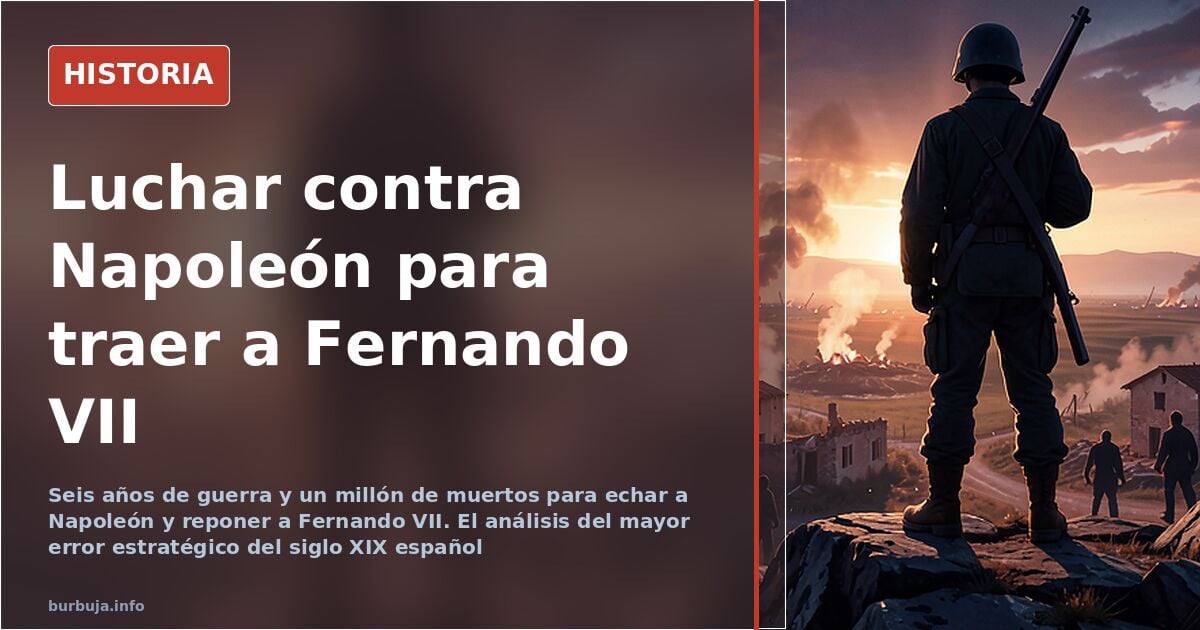
Spain spent six years and one million lives to expel one Frenchman and restore another
There is a scene that summarizes the Spanish nineteenth century better than any textbook: in 1814, a ruined country welcomed with applause the king who had spent six years in a French castle while his people bled for him. Ferdinand VII returned to the throne, annulled the Constitution of Cádiz, and peine the door to a century of coups, Carlist wars, and imperial loss. The uncomfortable question hovering over the debate is: was the Peninsular War worth it if the result was restoring the Bourbons?
The original premise is harsh: they fought the most powerful army on earth to restore a dynasty that had sold the country in Bayonne. Charles IV and Ferdinand VII, father and son, competed for Napoleon's favor in a corrupt court dominated by Godoy. The result was the cession of the throne and a war that devastated the country, left American viceroyalties in rebellion, and enthroned a king who turned out to be a disaster.
Was failing to submit to Napoleon a strategic error?
The majority answer is no. Napoleonic rule was not an alliance; it was an occupation with systematic plundering. French armies looted Italy, Germany, the Netherlands, and Spain regardless of resistance, and peace treaties often involved paying large sums to Paris and maintaining French garrisons. Napoleon executed thousands of prisoners who had formally surrendered in Syria, cited as proof that his system respected no rights of allied peoples.
Some add the geopolitical argument: if Spain had not risen, France could have controlled the peninsula with few troops and freed forces for other campaigns. The objection is that more men in Russia would only have meant more casualties. And the Napoleonic system, according to this reading, was doomed: all powers rose when they had the chance, and coalitions eventually learned the military lesson.
The nobility who swam and kept their clothes dry
A little-known detail: much of the high nobility collaborated with Joseph I while the regime seemed stable. Majordomos, chamberlains, and equerries of the Josephine court were Spanish titles. After the French defeat at Bailén, many switched sides naturally. Treason did not sink them; miscalculation of timing did. Official purges were selective, and most returned home without consequences.
This explains why Ferdinand VII's return did not scandalize elites. To the people, he was the prince who defied hated Godoy; to liberals, the young man who seemed reformist; to absolutists, the heir against the corrupt favorite. His public image could not have been better. Yet he made a disaster of it all.
The counterfactual scenario: Ferdinand VII with a Bonaparte bride
The most repeated exercise posits what would have peine if Napoleon had confirmed Ferdinand VII on the throne, married him to an imperial relative, and left Portugal and Gibraltar under Spanish supervision. With the "Desired One" reigning, legitimacy would have fallen to the Francophile side, and Charles IV and Godoy would have been sidelined. The problem is that this scenario requires a Napoleon who did not underestimate Spanish national sentiment, which did not happen.
Comparison with France serves as a counterweight: the neighboring country tried both the Napoleonic model and Louis XVIII's, failing with both. The French nineteenth century also accumulated revolutions and defeats. The thesis that Spain would have prospered under French direction is, at best, debatable.
The ally who sacked San Sebastián
The other face of the war was British. Great Britain, Spain's traditional enemy for a century, exploited the conflict to sell weapons to American rebels and sacked San Sebastián to its foundations. The empire was largely lost due to this double game. The final irony: the country that helped expel the French was the same one that had spent decades trying to undermine Spanish colonial trade.
And the uncomfortable closing: the question of why a people applauded Ferdinand VII has an answer. They did not know what was coming. Common people did not know the king, would never see him, and did not know he would be absolute, vengeful, and sterile. They fought the French who burned their homes, not for a dynastic project. The problem is that the result of that resistance was precisely the dark century they wanted to avoid.
Also available in: Deutsch
Summary of a discussion on Burbuja.info - Foro de economía, actualidad y política., translated from Spanish and reviewed before publication. Read the full discussion (49 replies).
More summaries
-
Spain's Ferdinand VII: Historical revision challenges traditional narrative
Historians reassess the reign of Spain's Ferdinand VII, questioning his caricatured image as a traitor and incompetent monarch.
-
The royalist anthem that reopens the Habsburg-Bourbon feud
Charles II fares better than Ferdinand VII in the dynastic dispute reopened by a French royalist anthem. The paternity of Alfonso XII is questioned.
-
Napoleon's Top Generals: The Seven He Chose
Napoleon ranked seven ancient and modern commanders, excluding himself. The debate on who was truly the greatest remains open.
-
ETA and GAL: two arms of the same Gladio network in Spain
Investigation linking ETA and GAL as arms of the same NATO Gladio network, with drug trafficking funding and CIA control.
-
Spain's Forgotten Scientists Whose Work Was Credited to Others
Julio Cervera patented radio in 1902, eleven years before Marconi. A review of 43 Spanish scientists and the controversy over list padding.
-
Latin Mass: From Common Tongue to Incomprehensible Ritual
Liturgical Latin began as the people's language in the 4th century but became a barrier. Trent entrenched it against Protestants, while 20th-century reforms dismantled its use.