
Latin Mass: From Common Tongue to Incomprehensible Ritual
Liturgical Latin began as the people's language in the 4th century but became a barrier. Trent entrenched it against Protestants, while 20th-century reforms dismantled its use.
English · Original discussion in Spanish · Published
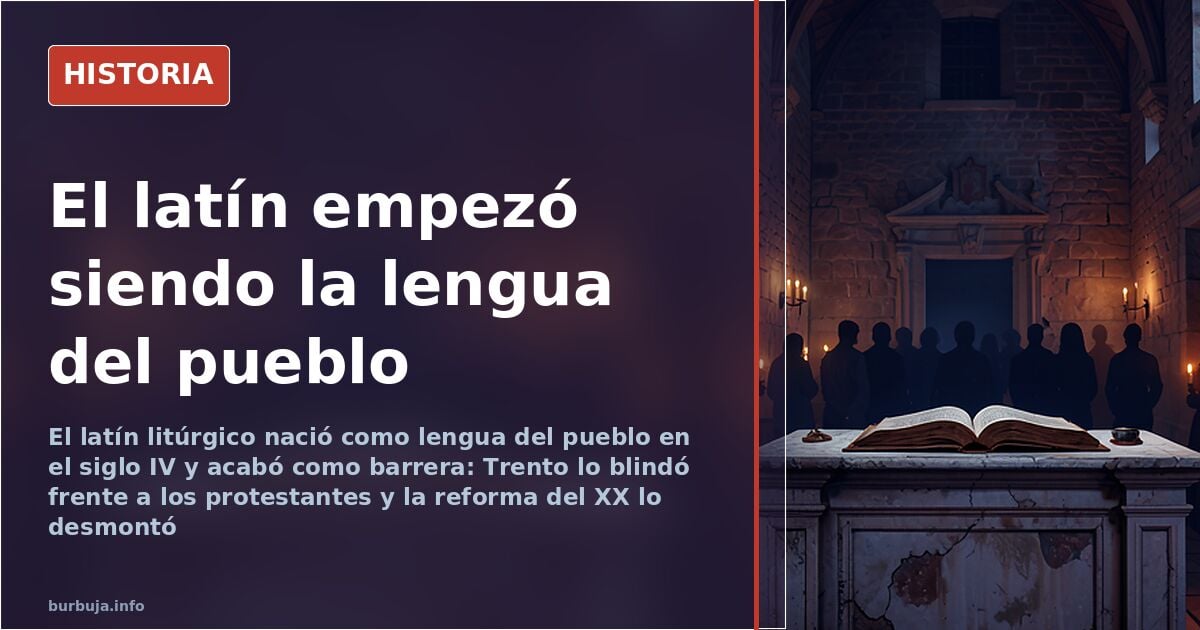
The Latin of the Mass started as the common tongue
Rome originally prayed in Greek. Around the 4th century, Christian liturgy switched to Latin for a mundane reason: it was what people spoke on the streets of the West. It was simply the vernacular. Centuries later, Spanish, French, and Italian evolved, but the Mass remained frozen in its original language. What began as closeness ended as distance.
This is the crux of the matter. Latin liturgy did not start as an esoteric mystery, but as a concession to the laity; it became the opposite when the laity changed languages while the Church did not. The Council of Trent, in the 16th century, reaffirmed Latin against Protestants who celebrated in local tongues. At that point, the language ceased to be a communication tool and became a banner.
Why maintain a language no one spoke anymore?
The official answer has two pillars: unity and stability. The same Mass in Toledo, Krakow, or Manila, with identical formulas, unaffected by translation. A strong argument for an institution obsessed with orthodoxy. The problem was that this unity came at the cost of the faithful understanding almost nothing said at the altar.
Some argue this was precisely the goal: to make attendees feel small, awestruck, part of a magical and mysterious ritual. The Mass as a stunning spectacle, not catechesis. From that logic, incomprehension was not a system failure, but a antiestéticature.
The priest facing away and the understandable parts
The traditional rite had another peculiarity that strikes us today: the priest stood facing the altar, with his back to the congregation, for much of the celebration. The assembly watched the celebrant's neck. The theological explanation is that the Mass is a sacrifice directed to God, not a performance for an audience; ritual formulas are recited, not explained. Like chanting a magic word without needing to know its meaning.
The only element designed for the people was the sermon, addressed to the faithful and not to the divine. There, they spoke in the popular language. The rest was low-voiced Latin that many trinc like watching a train pass by.
What changed with the Mass in the vernacular?
The shift came with the 20th-century liturgical reform: the priest turned toward the assembly and the formulas moved into common languages. On paper, participation. In practice, a side effect some highlight with irony: since nonsense is now spoken in plain language, attendance has plummeted. Correlation does not prove causation, but the data stings.
A stronghold remains: there are places where the traditional rite is still celebrated, with its Latin and priest facing away. And not just in rural parishes. Interest in the ancient rite survives in developed countries, suggesting that Latin was never just a comprehension issue.
The disorienting fact
The paradox is subtle: the Church adopted Latin so the people could understand the Mass, and kept it for centuries so they wouldn't. Few institutional decisions have reversed their own purpose with such elegance.
Also available in: Deutsch
Summary of a discussion on Burbuja.info - Foro de economía, actualidad y política., translated from Spanish and reviewed before publication. Read the full discussion (46 replies).
More summaries
-
Luther, Calvin and capitalism: sin or progress?
Five hundred years on, the debate over whether the Protestant Reformation legalised usury and unleashed greed remains open: sin or progress?
-
Catholics and Orthodox: a thousand-year schism in five differences
The 1054 schism explained: filioque, papal primacy, the Orthodox Bible and three of the four Marian dogmas. What still separates Rome from Constantinople.
-
Catholic vs Orthodox: The Schism Still Dividing Europe
The 1054 Great Schism still splits Europe. Why did the Catholic Church act as a counterpower while the Orthodox served the state?
-
ETA and GAL: two arms of the same Gladio network in Spain
Investigation linking ETA and GAL as arms of the same NATO Gladio network, with drug trafficking funding and CIA control.
-
Spain's Forgotten Scientists Whose Work Was Credited to Others
Julio Cervera patented radio in 1902, eleven years before Marconi. A review of 43 Spanish scientists and the controversy over list padding.
-
Hitler's Second Book: The Plan He Never Published
Hitler's unpublished Second Book, revealed in 1961, details his plans for a British alliance and Eastern conquest.