
Spain's Correos takes office keys away from cleaning staff
According to the CGT union, Correos, Spain's postal service, has ordered office keys to be kept in a safe and removed from cleaning staff, who suspect it is linked to postal voting.
English · Original discussion in Spanish · Published
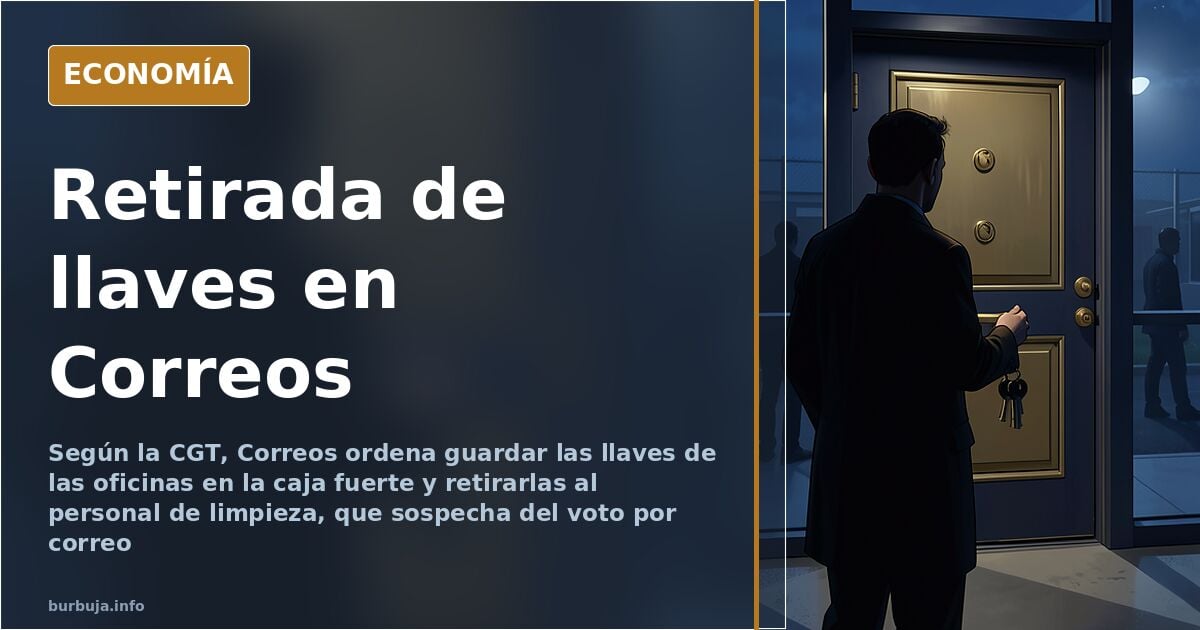
Spain's Correos takes office keys away from cleaning staff
A set of keys. That is the object that lit the fuse. The company has ordered that office keys be kept in a safe and that only the person in charge of each office can access them. Cleaning staff no longer have them. The CGT union claims that at the company it seems «they think the cleaners could tamper with the ballots», because they were the ones who sent «that request to the cleaning company». Prudence or less visibility, depending on how you look at it.
What the order on the keys actually says
The instruction is specific: in all offices, keys must be left in the safe and only the heads of those offices will be able to access them. The union reads the move as a direct suspicion of the people who do the cleaning. The official logic would be the opposite: fewer hands, less risk. The logic that emerges from the union's account is more uncomfortable: if a set of keys makes it possible to tamper with ballots, the problem is not the keys.
There is a paradox that stands on its own. If a cleaner could tamper with ballots with a simple set of keys, imagine what a senior Correos employee could do. The remark is not an accusation: it is an exercise in scale. And scale is what nobody wants to look at straight on.
The black box of postal voting
The heart of the matter is not the cleaning. It is traceability. Some argue there is no guarantee of custody and that a citizen cannot verify that their vote was counted correctly. Those who want to check, cannot. Those who want to audit, cannot either. The system runs on trust, and trust is exactly what is wearing thin.
On top of that comes the electoral roll. The CERA vote (the postal vote for Spaniards living abroad) and the debate over an inflated electoral register travel down the same lane: the feeling that the perimeter of the overseas vote and postal voting is more opaque than that of in-person voting. Do we need to draw a diagram? Probably not. It is enough to try to trinc the path of a ballot paper from the moment it leaves someone's home until it is counted.
From the staff canteen to the safe: the political climate
The issue lands on already fertile ground. Some claim that if certain parties encourage people to vote by post it is because there is a scam, while others respond that distrust is precisely the intended goal. Two currents that do not listen to each other. And in between, one uncomfortable fact: distrust in the system is not invented by a union, it is fed by every opaque decision.
The withdrawal of the keys looks small and means a great deal. A company that suspects its own cleaning staff is admitting, unintentionally, that the mechanism is fragile. If the integrity of the vote depends on who holds a key, the design has a flaw at its root.
How many more keys will have to change hands before someone explains how a postal vote can be verified?
Also available in: Deutsch
Summary of a discussion on Burbuja.info - Foro de economía, actualidad y política., translated from Spanish and reviewed before publication. Read the full discussion (20 replies).
More summaries
-
Spain's electoral roll under scrutiny: Grandchildren Law and untraceable mail-in votes
Spain's Grandchildren Law and the lack of traceability in mail-in voting are fueling suspicions of electoral manipulation, in a context of technological opacity.
-
Electoral storm in Andalusia, Spain: fraud claims and postal voting
Fraud allegations in Spain's 2026 Andalusian elections: anomalous postal voting, electoral roll tampering and the role of Indra and Correos. Could the vote be repeated?
-
Spain's grandchildren law and the electoral roll: the dispute shaping 2027
Spain's grandchildren law and the mass granting of Spanish citizenship have sparked a debate over the electoral roll and postal voting ahead of the 2027 elections.
-
La Vanguardia fires columnist over article accusing PSOE of seeking civil conflict
La Vanguardia suspends Lacasta for criticising the PSOE's drift. A reflection on the limits of journalism.
-
Fátima Báñez dies in Spain train crash: from controversial tweet to labour reform
The death of Fátima Báñez in the train accident reopens the debate over her labour reform, severance pay and her later role at Spain's employers' association CEOE.
-
Blaming the Urda train accident track worker is shameful and reductive
The PP governed both Galicia and Spain when the Angrois crash occurred. Blaming the driver reopens the debate on rail safety.