
Spain's Correos stockpiles millions of parcels, returning them in just two days
Correos is holding over a million packages and returning shipments within two business days, despite regulations allowing 15 days for collection.
English · Original discussion in Spanish · Published
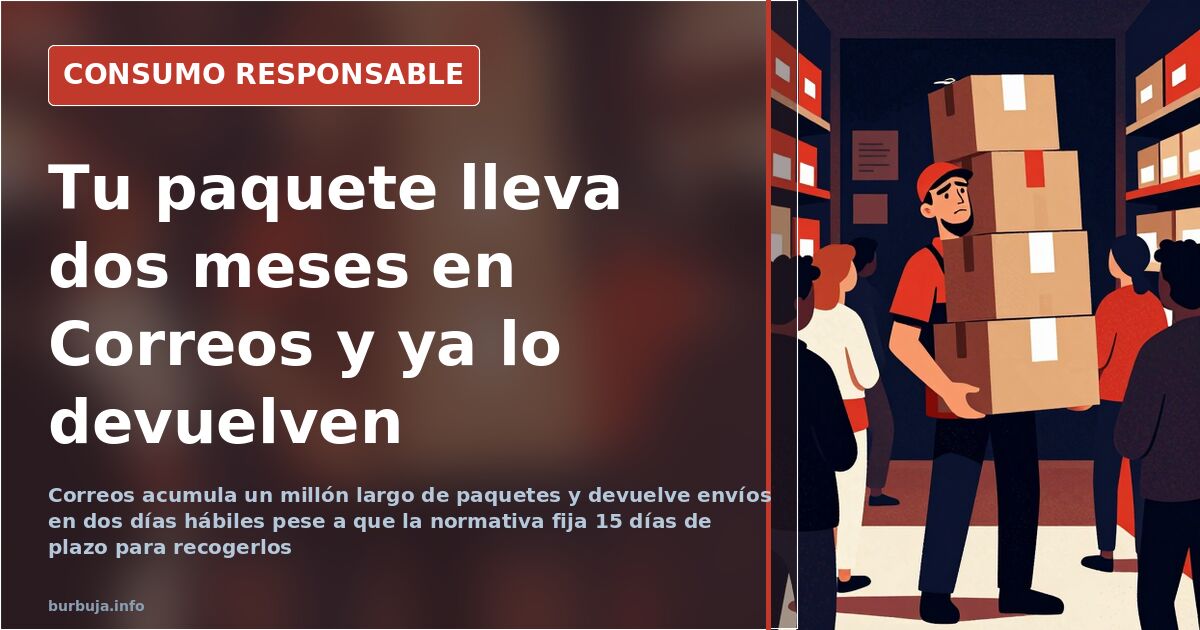
Correos returns parcels in two days while accumulating undelivered shipments
A delivery notice left at 13:00 in a mailbox after the office closed at 12:30. A public holiday intervening. And by Monday, when the recipient finally goes to collect it, the package is already on its way back to the seller. The notice allowed until the 5th. Reality allowed only two business days. This type of detail turns a logistical incident into a consumer problem: the shipment exists, has tracking, is in Spain, yet gets lost between the counter and the desk.
The pattern repeats in dozens of cases. International shipments with tracking numbers enter the country, pass customs, and remain frozen for weeks in a "reclassification" process from which they do not emerge. Ordinary packages, without tracking, pile up without a delivery date because no one prioritizes them. And a figure that summarizes the bottleneck: over a million stored parcels in Correos logistics centers, according to the de-escalation plan launched by the company to clear them out.
What is happening with Correos shipments
The sequence is always the same. The package arrives in Spain, is recorded as admitted at the international logistics center, and stays there. A shipment from Nicosia admitted on March 12 was still unmoved on April 23, when tracking showed it had been returned to the seller. Another from Cyprus spent 40 days in the international office before meeting the same fate. A third, cleared through customs on March 18, did not reach the delivery office until May 6: almost seven weeks later.
Some argue the collapse was a decision, not an accident: part of the staff allegedly stayed home and only resumed moving cargo when Amazon and Alibaba threatened to terminate contracts. This is an unproven hypothesis circulating without documentary evidence and should be treated as such, a suspicion. What is confirmed is the result: Correos urgently reactivated deliveries facing the risk of losing clients like Amazon or Alibaba.
Untracked ordinary parcels: weeks of waiting
Ordinary shipping is the weakest link. Without a tracking number, there is no delivery date, and without a delivery date, there is no priority. Industry workers summarize it thus: untracked packages can accumulate for weeks because nothing forces their distribution. Those with codes are distributed sparingly, and some are being sent via Correos Express instead of the standard network.
Recovery figures trickle in slowly. Aliexpress orders placed in early February began appearing late last week. A package sitting in the local office since March 13 ended up in the mailbox after successive extensions of the protection period. Another from early March, classified in customs, arrived this week. The trend is positive but slow and uneven: some receive two mid-February orders in the same week, while others are still waiting for one from March.
Customs and the unmeasured bottleneck
Spanish customs acts as a second jam within the first. There are shipments held for more than a month in the process, and the operator managing procedures, ADT Postales, accumulates user reviews describing months of silence. The paradox is that a package can take longer from Madrid to the destination city than from China to Madrid.
The problem extends to shipments originating in the United States. Several cases describe packages leaving the US, appearing in the Correos Spain system, and not pogre. The same situation does not occur with destinations like France, Germany, or Portugal. Senders from the US to those countries do not report equivalent blockages. The asymmetry points to a bottleneck in Spanish management, not at the origin.
Disputes, refunds, and expiring deadlines
The buyer's route is the dispute. On eBay, the deadline to open a claim for an item not received is 30 days from the last day of the estimated delivery window. An order with estimated delivery between May 7 and 11 would have until June 10. On Aliexpress, the system complicates claims: there are cases where the platform marks the order as delivered because the local carrier considers it received, while Correos tracking shows the package stalled for two months. The dispute is denied on the grounds that it appears delivered.
Advice circulating among buyers is to contact the seller to extend the protection period before the order closes. It doesn't always work, but it is the only lever available when the carrier is unresponsive.
Delivery notices and the ignored 15-day rule
Correos regulations are explicit: in ordinary mode, there is an obligation to leave a delivery notice, and the collection period is 15 days. Practice differs. There are notices left after office closing times, with periods practically reduced to two business days before returning the shipment to the sender. And there are couriers from other companies who mark absence without ringing the doorbell, a practice corrected when the recipient calls headquarters and announces a complaint.
The result is a system where errors are not shared: the buyer pays, waits, and at best recovers money weeks later. The seller loses the product. And the carrier, meanwhile, continues accumulating packages in warehouses that are already overwhelmed.
With over a million shipments backed up and delivery capacity advancing sparingly, the question is no longer when the package will arrive. It is how many of those in these warehouses will expire in the system before anyone touches them.
A delivery notice left at 13:00 in a mailbox after the office closed at 12:30. A public holiday intervening. And by Monday, when the recipient finally goes to collect it, the package is already on its way back to the seller. The notice allowed until the 5th. Reality allowed only two business days. This type of detail turns a logistical incident into a consumer problem: the shipment exists, has tracking, is in Spain, yet gets lost between the counter and the desk.
The pattern repeats in dozens of cases. International shipments with tracking numbers enter the country, pass customs, and remain frozen for weeks in a "reclassification" process from which they do not emerge. Ordinary packages, without tracking, pile up without a delivery date because no one prioritizes them. And a figure that summarizes the bottleneck: over a million stored parcels in Correos logistics centers, according to the de-escalation plan launched by the company to clear them out.
What is happening with Correos shipments
The sequence is always the same. The package arrives in Spain, is recorded as admitted at the international logistics center, and stays there. A shipment from Nicosia admitted on March 12 was still unmoved on April 23, when tracking showed it had been returned to the seller. Another from Cyprus spent 40 days in the international office before meeting the same fate. A third, cleared through customs on March 18, did not reach the delivery office until May 6: almost seven weeks later.
Some argue the collapse was a decision, not an accident: part of the staff allegedly stayed home and only resumed moving cargo when Amazon and Alibaba threatened to terminate contracts. This is an unproven hypothesis circulating without documentary evidence and should be treated as such, a suspicion. What is confirmed is the result: Correos urgently reactivated deliveries facing the risk of losing clients like Amazon or Alibaba.
Untracked ordinary parcels: weeks of waiting
Ordinary shipping is the weakest link. Without a tracking number, there is no delivery date, and without a delivery date, there is no priority. Industry workers summarize it thus: untracked packages can accumulate for weeks because nothing forces their distribution. Those with codes are distributed sparingly, and some are being sent via Correos Express instead of the standard network.
Recovery figures trickle in slowly. Aliexpress orders placed in early February began appearing late last week. A package sitting in the local office since March 13 ended up in the mailbox after successive extensions of the protection period. Another from early March, classified in customs, arrived this week. The trend is positive but slow and uneven: some receive two mid-February orders in the same week, while others are still waiting for one from March.
Customs and the unmeasured bottleneck
Spanish customs acts as a second jam within the first. There are shipments held for more than a month in the process, and the operator managing procedures, ADT Postales, accumulates user reviews describing months of silence. The paradox is that a package can take longer from Madrid to the destination city than from China to Madrid.
The problem extends to shipments originating in the United States. Several cases describe packages leaving the US, appearing in the Correos Spain system, and not pogre. The same situation does not occur with destinations like France, Germany, or Portugal. Senders from the US to those countries do not report equivalent blockages. The asymmetry points to a bottleneck in Spanish management, not at the origin.
Disputes, refunds, and expiring deadlines
The buyer's route is the dispute. On eBay, the deadline to open a claim for an item not received is 30 days from the last day of the estimated delivery window. An order with estimated delivery between May 7 and 11 would have until June 10. On Aliexpress, the system complicates claims: there are cases where the platform marks the order as delivered because the local carrier considers it received, while Correos tracking shows the package stalled for two months. The dispute is denied on the grounds that it appears delivered.
Advice circulating among buyers is to contact the seller to extend the protection period before the order closes. It doesn't always work, but it is the only lever available when the carrier is unresponsive.
Delivery notices and the ignored 15-day rule
Correos regulations are explicit: in ordinary mode, there is an obligation to leave a delivery notice, and the collection period is 15 days. Practice differs. There are notices left after office closing times, with periods practically reduced to two business days before returning the shipment to the sender. And there are couriers from other companies who mark absence without ringing the doorbell, a practice corrected when the recipient calls headquarters and announces a complaint.
The result is a system where errors are not shared: the buyer pays, waits, and at best recovers money weeks later. The seller loses the product. And the carrier, meanwhile, continues accumulating packages in warehouses that are already overwhelmed.
With over a million shipments backed up and delivery capacity advancing sparingly, the question is no longer when the package will arrive. It is how many of those in these warehouses will expire in the system before anyone touches them.
Also available in: Deutsch
Summary of a discussion on Burbuja.info - Foro de economía, actualidad y política., translated from Spanish and reviewed before publication. Read the full discussion (108 replies).
More summaries
-
EU's €3 parcel levy ends AliExpress's cheap era
The EU's €3 per category fee sends AliExpress prices soaring: a €3 order now costs €11. The Chinese parcel model faces collapse.
-
The €3.61 Fee Killing AliExpress Purchases
The €3.61 per-category tariff has inflated AliExpress purchases by up to 80%. Consumers are stopping buys, and revenue is falling. Does it actually protect...
-
The €3-per-item duty that killed the Aliexpress bargain
Europe's €3-plus per-item duty and the end of discounts are killing Aliexpress bargains, even against domestic shipping and Amazon.
-
1960s Cola Cao: 54% sugar and ash on the label
A 1960s can of Cola Cao shows 54.1% sucrose, ash and unidentified matter at 1.9%, and a price of 84.50 pesetas plus taxes. The analysis…
-
Chinese Goods Sold in Spain at Six Times Their Cost
A forum user claims a dental scaler costs €10 in China but sells for €60 on Amazon, highlighting the markup of rebranded imports.
-
Why Avocates Cost a Fortune
Avocates cost €2/kg on sale, but high prices persist due to drought, costly imports, and demand outstripping supply.