
Spain's consumers stretch budgets to the limit with white-label goods and 20-year-old cars
Spain's consumption tightens as households opt for white-label products and older vehicles, while the cost of living erodes middle-class margins.
English · Original discussion in Spanish · Published
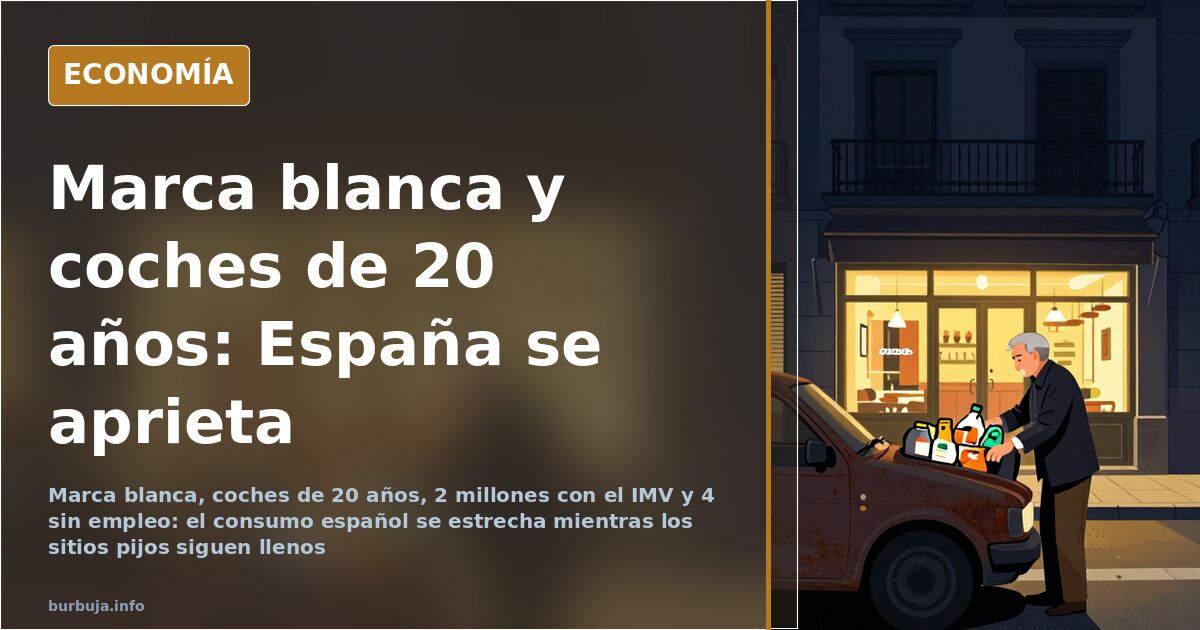
White-label, 20-year-old cars and IMV: a consumption radiography
The average Spaniard is not flush: they are stretching a film that has run out of elasticity. The cost of living has eaten the margin, and the evidence is in the shopping basket, the garage, and the living room: white-label products, cars aged 20 to 25 years on the road, and a Netflix subscription replacing cinema outings. What was once a hallmark of 1990s Spain—Bimbo, Danone, a brand-new car from the dealership—has gone by the board.
There is consensus on the diagnosis but no agreement on the culprit. Some point to the Government; others, to an opposition that changes nothing when in power; the most veteran recall the saying that one votes for juicers while being lemons. In the middle lies an undisputed fact: consumption has tightened much faster than income.
Why do Danone and Bimbo stop selling?
Because white-label products have overtaken branded manufacturers. The reference that held even during the 2007-2016 crisis has entered a spiral where it sells even at cost price. The floating question is uncomfortable: how much must a family tighten its belt to not care whether it pays 0.25 euros for a branded yogurt or 0.20 for a store brand. When the difference is five cents, one does not choose by price: every coin counts.
It is not just dairy. Discount chains and bazaars have made their fortune with customers who previously never entered such establishments. Major brands sustain much of their business by producing the white-label goods that eat up their own shelf space. The manufacturer that was once the showcase of the middle class has become an invisible supplier.
How many Spaniards rely on the IMV and how many are unemployed?
Two million people depend on the Minimum Vital Income (IMV), and more than four million of working age are unemployed. These two figures underpin the narrative of a country that is not recovering. Built upon them is the fundamental debate: if a large part of the population lives on aid or barely survives on an insufficient salary, the household economy ceases to be a cushion and becomes a tightrope.
The controversy is served. One current argues there is a perverse incentive to live on benefits; the counter-argument responds that four million unemployed people are not due to laziness, but to a labor market that expels them. Nobody, on either side, disputes that the cushion has thinned.
20-year-old cars and the elusive home
An affordable electric vehicle remains almost an entelechy: the only one a middle-class pocket can afford costs around 18,000 euros, with much of the price advanced by subsidies. Meanwhile, cars aged 20 to 25 years circulate, and anyone with a 15-year-old car treats it like a relic. Several that appear newly registered are from rental schemes, and verifying this is as easy as requesting a traffic report.
Housing weighs more. Renting a decent home in Madrid costs over 1,000 euros per month, and this single item destroys most budgets; those who own their apartment pay community fees and property tax (IBI), between 150 and 200 euros, and breathe. The breakdown of incomes by brackets—households with 60,000 or 70,000 euros a year versus those with less than 20,000—draws three worlds within the same country.
The middle class split in two
The most repeated image is of a middle class fraying: from a majority of 70%, it has dropped to 30%; the lower class rises from 20% to 50%; and a renewed upper class fills expensive venues. It is not just an impression. Two salaries of 1,300 euros do not reach the same place as two of 3,000, and those earning on the lower band fare worse than ever, especially if single, divorced, or the sole breadwinner.
The side effect is cultural. Families who survived the 2008 shock retained a different relationship with money, evident in every scrutinized receipt and stretched garment. The business that once left a healthy margin—a neighborhood bakery closing the year with 300,000 euros in profit—now loses money due to soaring wheat, energy, and taxes.
Where is there still money?
In the upscale areas, which are fuller than ever. A three-person table at one of Madrid's most famous Basque restaurants costs 280 euros, and reservations are needed well in advance. Franchise menus and kebab spots at 8 or 9 euros are also packed, but for the opposite reason: they are the only outlet the pocket can sustain.
The prediction, with reservations: if nothing changes, spending will continue to migrate toward discount goods and white-label products, and the two Spains of consumption—the one filling reserved tables and the one scrutinizing receipts—will separate a bit more each year. There will always be exceptions. But the picture of the shopping cart does not invite thinking that this film will stretch without breaking.
The average Spaniard is not flush: they are stretching a film that has run out of elasticity. The cost of living has eaten the margin, and the evidence is in the shopping basket, the garage, and the living room: white-label products, cars aged 20 to 25 years on the road, and a Netflix subscription replacing cinema outings. What was once a hallmark of 1990s Spain—Bimbo, Danone, a brand-new car from the dealership—has gone by the board.
There is consensus on the diagnosis but no agreement on the culprit. Some point to the Government; others, to an opposition that changes nothing when in power; the most veteran recall the saying that one votes for juicers while being lemons. In the middle lies an undisputed fact: consumption has tightened much faster than income.
Why do Danone and Bimbo stop selling?
Because white-label products have overtaken branded manufacturers. The reference that held even during the 2007-2016 crisis has entered a spiral where it sells even at cost price. The floating question is uncomfortable: how much must a family tighten its belt to not care whether it pays 0.25 euros for a branded yogurt or 0.20 for a store brand. When the difference is five cents, one does not choose by price: every coin counts.
It is not just dairy. Discount chains and bazaars have made their fortune with customers who previously never entered such establishments. Major brands sustain much of their business by producing the white-label goods that eat up their own shelf space. The manufacturer that was once the showcase of the middle class has become an invisible supplier.
How many Spaniards rely on the IMV and how many are unemployed?
Two million people depend on the Minimum Vital Income (IMV), and more than four million of working age are unemployed. These two figures underpin the narrative of a country that is not recovering. Built upon them is the fundamental debate: if a large part of the population lives on aid or barely survives on an insufficient salary, the household economy ceases to be a cushion and becomes a tightrope.
The controversy is served. One current argues there is a perverse incentive to live on benefits; the counter-argument responds that four million unemployed people are not due to laziness, but to a labor market that expels them. Nobody, on either side, disputes that the cushion has thinned.
20-year-old cars and the elusive home
An affordable electric vehicle remains almost an entelechy: the only one a middle-class pocket can afford costs around 18,000 euros, with much of the price advanced by subsidies. Meanwhile, cars aged 20 to 25 years circulate, and anyone with a 15-year-old car treats it like a relic. Several that appear newly registered are from rental schemes, and verifying this is as easy as requesting a traffic report.
Housing weighs more. Renting a decent home in Madrid costs over 1,000 euros per month, and this single item destroys most budgets; those who own their apartment pay community fees and property tax (IBI), between 150 and 200 euros, and breathe. The breakdown of incomes by brackets—households with 60,000 or 70,000 euros a year versus those with less than 20,000—draws three worlds within the same country.
The middle class split in two
The most repeated image is of a middle class fraying: from a majority of 70%, it has dropped to 30%; the lower class rises from 20% to 50%; and a renewed upper class fills expensive venues. It is not just an impression. Two salaries of 1,300 euros do not reach the same place as two of 3,000, and those earning on the lower band fare worse than ever, especially if single, divorced, or the sole breadwinner.
The side effect is cultural. Families who survived the 2008 shock retained a different relationship with money, evident in every scrutinized receipt and stretched garment. The business that once left a healthy margin—a neighborhood bakery closing the year with 300,000 euros in profit—now loses money due to soaring wheat, energy, and taxes.
Where is there still money?
In the upscale areas, which are fuller than ever. A three-person table at one of Madrid's most famous Basque restaurants costs 280 euros, and reservations are needed well in advance. Franchise menus and kebab spots at 8 or 9 euros are also packed, but for the opposite reason: they are the only outlet the pocket can sustain.
The prediction, with reservations: if nothing changes, spending will continue to migrate toward discount goods and white-label products, and the two Spains of consumption—the one filling reserved tables and the one scrutinizing receipts—will separate a bit more each year. There will always be exceptions. But the picture of the shopping cart does not invite thinking that this film will stretch without breaking.
Also available in: Deutsch
Summary of a discussion on Burbuja.info - Foro de economía, actualidad y política., translated from Spanish and reviewed before publication. Read the full discussion (356 replies).
More summaries
-
Catalonia Activates Es-Alert for Potential Mediterranean Hurricane
Catalonia's Generalitat suspends TV3 broadcasts and sends a massive Es-Alert warning regarding a potential Mediterranean hurricane, cancelling outdoor events.
-
Hernández Quero: Right built Spain's welfare state
Hernández Quero argues the right built Spain's welfare state, blaming mass migration for national issues amid a debate on conservative identity.
-
Spanish right seeks viral counter to left-wing attacks
A forum debate explores why Spain's right lacks a vocal figure to match aggressive left-wing rhetoric, citing weakness and lack of strategy.
-
Debate: Spain's healthcare co-payment for non-contributors
A forum user proposes a co-payment for those without five years of contributions. Others note that Spanish public healthcare is funded by taxes, not social security contributions.
-
VOX councilor in Ponferrada earns €37,000 part-time
A VOX councilor in Ponferrada is listed on the municipal portal with an annual salary of €37,000 for part-time work.
-
Paris surgeon linked to Brigitte Macron rumors found dead
François Faivre, a Parisian surgeon, died after falling from his apartment. Forensics ruled suicide; family disputes this amid Macron identity claims.