
Spain’s Congress Votes to Suspend or Revoke Journalist Press Credentials
Congress approves regulations allowing 10-day to 5-year suspensions or permanent revocation of press passes for misconduct.
English · Original discussion in Spanish · Published
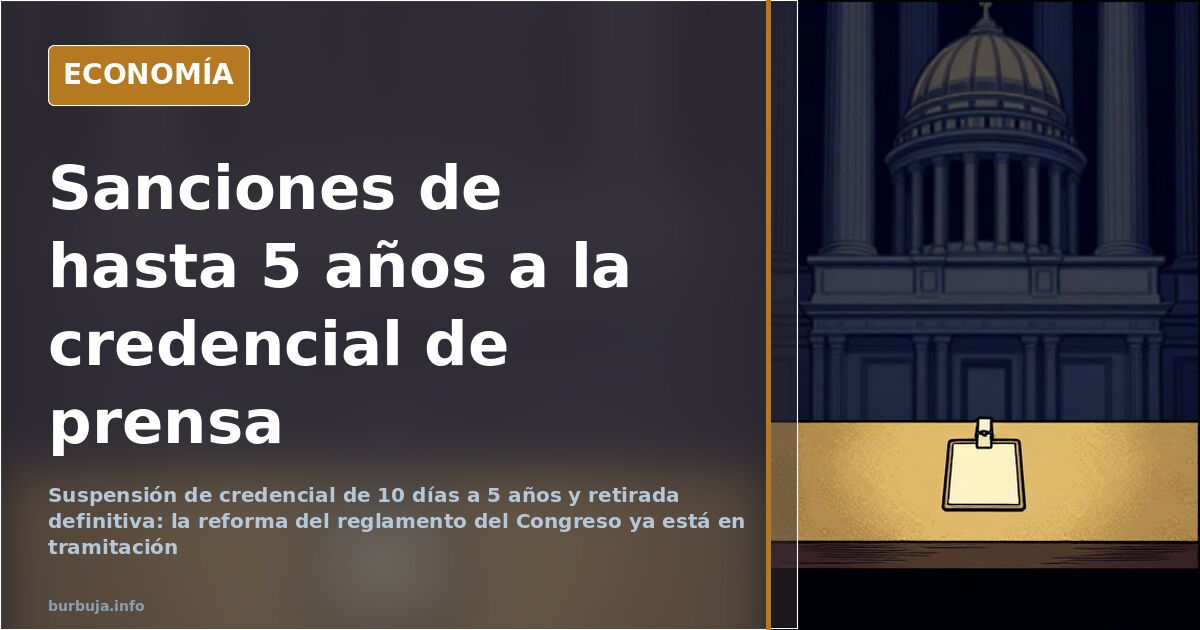
Press credentials under sanction: suspensions lasting up to five years
The Spanish Congress has taken the first step to reform its internal regulations by introducing a code of conduct that risks stripping accredited journalists of their press passes and jobs. The motion advanced with support from PSOE, Sumar, ERC, Junts, EH Bildu, PNV, Podemos, BNG, and Coalición Canaria. PP, Vox, and UPN voted against it. The text does not target editorial lines or ideologies; instead, it establishes parliamentary courtesy rules and a catalog of sanctions for abusa within the building and its access zones. The legislative process has just begun.
What sanctions does the Congress regulation reform propose?
There are two levels of penalties. Serious infractions result in the suspension of the press credential for ten days to three months. Very serious offenses lead to suspensions between three months and five years, or directly to permanent revocation. Two consecutive serious offenses are classified as very serious.
Among the behaviors classified as very serious are showing a lack of respect and courtesy toward others, recording with hidden devices in offices and areas reserved for political groups, disrupting the order of sessions, or any behavior that seriously harms the Chamber's activities. Serious offenses include boycotting press conferences, publishing images obtained in abusa of regulations in media and social networks, or hindering the work of other accredited journalists.
Who decides on sanctions and what happens to the media outlet?
The final filter is the Congress Board, not a judge. This is the point that most displeases the groups that voted against the measure. There is also a second detail with economic consequences: the sanctioned individual is the worker, not the media brand, but the media cannot replace them with another person for the duration of the suspension. If the infraction is published without attributing authorship, the penalty extends to the entire organization: all press credentials linked to that media outlet are suspended for between six months and three years.
The PSOE’s argument: harassing a deputy is not freedom of expression
The socialist spokesperson, Patxi López, defended the initiative as a barrier against "certain threats, harassment, and attitudes of some pseudo-journalists who are constantly disturbing and boycotting the proper functioning of this house" with antidemocratic methods. His reasoning can be summarized in one sentence: without truthful information, there is no democracy. In his intervention, he listed examples of publications—sensual insults and disparagements directed at journalists and deputies, according to his account—and recalled that professional associations have been denouncing for years the use of photographs of informants to harass them. "Boycotting press conferences is not journalism," he concluded.
PP, Vox, and UPN: Control over freedom of expression
The three groups that voted against the measure argue that the rule hands political bodies the power to decide what is journalism and what is not. This fundamental objection is not new: whenever a Chamber assumes disciplinary powers over accredited press, the question arises regarding the constitutional fit of the sanctioning regime. Some add that the real problem—interruptions and lack of respect during appearances—would be resolved by granting speaking time and rebuttal to those who currently do not have it, rather than escalating the punishment.
The labor cost of a press credential
The issue quickly shifted toward the employment status of accredited journalists. Much of the subsequent commentary focused on the continuity of two familiar names in the halls of the Chamber, Vito Quiles and Bertrand Ndongo, whose professional situations were expected to become obsolete. The calculation, however, is not so simple: accreditation requires a degree and a media outlet to endorse it, bringing into play the offer of private universities peine in Madrid, pointed to as a fast track to obtaining the degree. As long as this circuit operates, the sanction will result in rotation, not extinction.
And meanwhile, what?
No one disputes that the friction at the Congress entrances has become an editorial asset: the confrontation sells, and the video of the confrontation sells even more. With this incentive intact, a long standoff is expected. The reform will continue its legislative process, the sanctioning regime will be applied sparingly to avoid a frontal clash, and if the majority changes, it will move again. Along the way, the conversation has ended where almost everything usually ends: in whether rent freezes should be implemented—some argue they existed for four decades during Franco’s dictatorship—and in the paperwork to recover foreign nationality in case emigration becomes necessary. Two emergency exits for the same traffic jam.
The Spanish Congress has taken the first step to reform its internal regulations by introducing a code of conduct that risks stripping accredited journalists of their press passes and jobs. The motion advanced with support from PSOE, Sumar, ERC, Junts, EH Bildu, PNV, Podemos, BNG, and Coalición Canaria. PP, Vox, and UPN voted against it. The text does not target editorial lines or ideologies; instead, it establishes parliamentary courtesy rules and a catalog of sanctions for abusa within the building and its access zones. The legislative process has just begun.
What sanctions does the Congress regulation reform propose?
There are two levels of penalties. Serious infractions result in the suspension of the press credential for ten days to three months. Very serious offenses lead to suspensions between three months and five years, or directly to permanent revocation. Two consecutive serious offenses are classified as very serious.
Among the behaviors classified as very serious are showing a lack of respect and courtesy toward others, recording with hidden devices in offices and areas reserved for political groups, disrupting the order of sessions, or any behavior that seriously harms the Chamber's activities. Serious offenses include boycotting press conferences, publishing images obtained in abusa of regulations in media and social networks, or hindering the work of other accredited journalists.
Who decides on sanctions and what happens to the media outlet?
The final filter is the Congress Board, not a judge. This is the point that most displeases the groups that voted against the measure. There is also a second detail with economic consequences: the sanctioned individual is the worker, not the media brand, but the media cannot replace them with another person for the duration of the suspension. If the infraction is published without attributing authorship, the penalty extends to the entire organization: all press credentials linked to that media outlet are suspended for between six months and three years.
The PSOE’s argument: harassing a deputy is not freedom of expression
The socialist spokesperson, Patxi López, defended the initiative as a barrier against "certain threats, harassment, and attitudes of some pseudo-journalists who are constantly disturbing and boycotting the proper functioning of this house" with antidemocratic methods. His reasoning can be summarized in one sentence: without truthful information, there is no democracy. In his intervention, he listed examples of publications—sensual insults and disparagements directed at journalists and deputies, according to his account—and recalled that professional associations have been denouncing for years the use of photographs of informants to harass them. "Boycotting press conferences is not journalism," he concluded.
PP, Vox, and UPN: Control over freedom of expression
The three groups that voted against the measure argue that the rule hands political bodies the power to decide what is journalism and what is not. This fundamental objection is not new: whenever a Chamber assumes disciplinary powers over accredited press, the question arises regarding the constitutional fit of the sanctioning regime. Some add that the real problem—interruptions and lack of respect during appearances—would be resolved by granting speaking time and rebuttal to those who currently do not have it, rather than escalating the punishment.
The labor cost of a press credential
The issue quickly shifted toward the employment status of accredited journalists. Much of the subsequent commentary focused on the continuity of two familiar names in the halls of the Chamber, Vito Quiles and Bertrand Ndongo, whose professional situations were expected to become obsolete. The calculation, however, is not so simple: accreditation requires a degree and a media outlet to endorse it, bringing into play the offer of private universities peine in Madrid, pointed to as a fast track to obtaining the degree. As long as this circuit operates, the sanction will result in rotation, not extinction.
And meanwhile, what?
No one disputes that the friction at the Congress entrances has become an editorial asset: the confrontation sells, and the video of the confrontation sells even more. With this incentive intact, a long standoff is expected. The reform will continue its legislative process, the sanctioning regime will be applied sparingly to avoid a frontal clash, and if the majority changes, it will move again. Along the way, the conversation has ended where almost everything usually ends: in whether rent freezes should be implemented—some argue they existed for four decades during Franco’s dictatorship—and in the paperwork to recover foreign nationality in case emigration becomes necessary. Two emergency exits for the same traffic jam.
Also available in: Deutsch
Summary of a discussion on Burbuja.info - Foro de economía, actualidad y política., translated from Spanish and reviewed before publication. Read the full discussion (417 replies).
More summaries
-
Trade Republic and Revolut: Are They Safe for Your Savings or an Operational Risk?
Trade Republic offers 3% and Revolut pays daily interest, but transfer blocks and chat support turn savings into a gamble...
-
Spain's Parasite Debate: Cultural Shock or Marketing?
Analysis of the debate on deworming in Spain: is it a cultural clash, a public health need, or just marketing?
-
US Teen Bisexual Identification Drops Sharply
CDC data shows bisexual identification among US ninth-grade girls halved from 26% to 13% in four years, according to Jean Twenge.
-
Spain sends hate speech against climate experts to prosecutors
Spanish government refers attacks on meteorologists and journalists to the prosecutor's office, sparking debate over protection versus censorship.
-
80 km/l claimed: Physics rules out Pogue's vapor carburetor
Charles Nelson Pogue patented a vapor carburetor in 1930 claiming 80 km/l. Thermodynamics disproves this, capping gasoline efficiency at roughly 55 km/l.
-
Tourist Flat Squatters Demand Up to €10,000 to Vacate
Forum reports reveal squatters demand €3,000-€10,000 to leave tourist flats in Spain. Overburdened courts and organized gangs worsen the crisis.