
Spain's civil service exam trend sparks debate on job security
A viral video celebrating a Spanish civil servant position reignites discussion on public sector stability versus private risk and wage gaps.
English · Original discussion in Spanish · Published
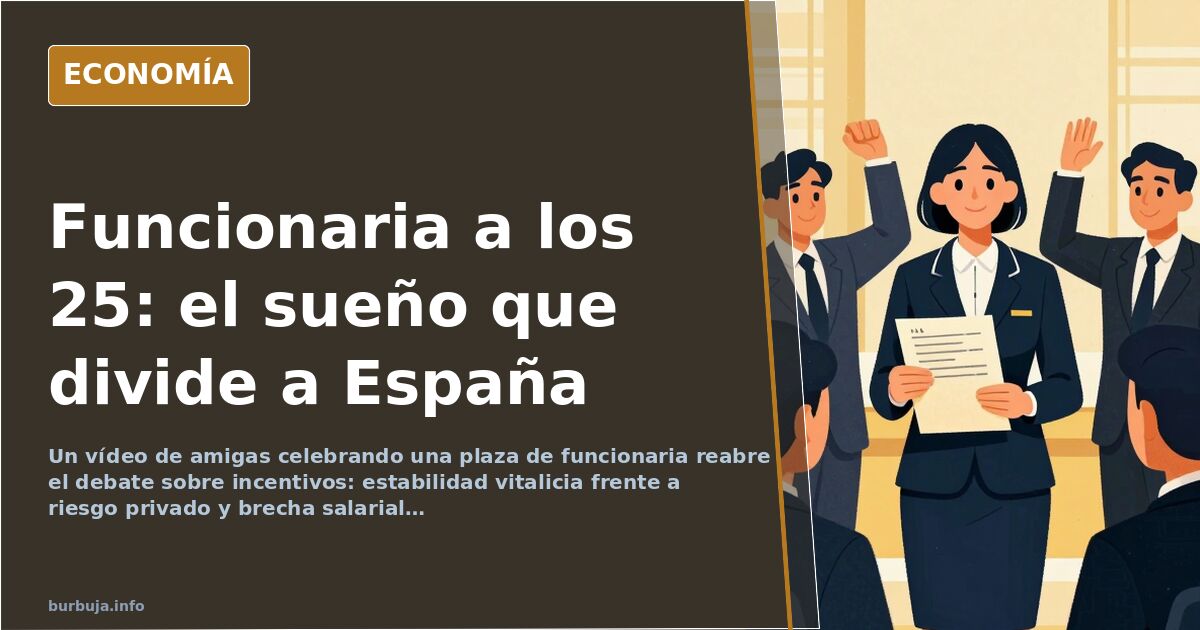
Celebrating a public post: personal achievement or systemic symptom?
Why does a video of friends celebrating one of them passing a Spanish civil service exam generate over a hundred heated responses? Because it touches a nerve beyond individual success. In the context of debates on Spanish public employment, the core issue is different: what incentives does the labor market offer when lifelong stability becomes the most desired prize for an educated generation? The scene — a young woman announcing to her circle that she finally became a civil servant, with screams and hugs — acts as a mirror of an economy that rewards security over risk.
What exactly is celebrated when a public post is won
The breakdown circulating in the case analysis is revealing: what is celebrated is not a high salary, but a package of conditions rarely matched by the private sector. Stability until retirement, hours ending mid-afternoon, automatic seniority raises, and a guaranteed pension. The appeal is not nominal wages, but certainty.
Some argue this cocktail makes the civil service exam the rational decision for any sensible young person. Others respond that this very rationality is the problem: if top talents choose to settle, who creates, innovates, and takes risks? The uncomfortable answer appearing in the discussion: in the short and medium term, the civil servant has a better economic future than the self-employed, subject to high taxes, suffocating regulation, and rules changing with each political cycle.
The calculation nobody makes before taking the exam
The conversation quickly shifts to comparing figures. Mentioned is the case of a retired New York police sergeant, aged 52, earning $14,000 a month, looking for an apartment in Valencia, presented as an example of how wide the gap is between US and European public employment. The figure is immediately qualified: it is gross, abnormally high, and does not represent the average civil servant. But it serves to illustrate that the debate on public salaries is not homogeneous, neither between countries nor within each administration.
On the opposite side appears the internal comparison: it is claimed that the wage difference for the same work between a public and a private employee exceeds 35% in certain cases and reaches 50% in others. The data is launched without a verifiable source, so it should be treated as what it is: a circulating claim, not official statistics.
The proportion trap: is there more talent in public or private sectors?
One of the most interesting turns in the exchange comes when leaving the salary terrain to enter the talent arena. The thesis defended in more detail is counterintuitive: the proportion of exceptional professionals in Spain's senior state bodies would be higher than in the Spanish private sector. The argument: many of those profiles tried private enterprise first, with high salaries but no life, and decided they wanted to live. Not all public talent is utilized; some occupy second-level technical posts while political leaders set the direction.
The rebuttal is quick: the private sector has more professionals in absolute terms, hence also more mediocrity, but in high-level environments the average quality is superior. And a note that dismantles the epic: most who take exams do so out of conformity, not conviction, and this shows in performance. The exception both sides seem to concede is the judicial career.
The problem of patronage jobs and the machinery nobody defends
Where consensus breaks down less is in criticism of the structure. Discretionary appointments — posts awarded by political affinity — are described as a cancer used to shape institutions at the convenience of the ruling party and to place campaign workers. The cost is not just payroll: it is the bureaucracy and paperwork they generate.
The proposal that emerges, more radical, points to moving from the current administration to a corporate model with a single union. It is an idea thrown into the air, without development, but summarizes the discontent: the feeling that the apparatus grew more than the country can sustain.
The gap between the narrative and the payer's paycheck
The closing of the exchange leaves the portrait of two economic Spains that do not look at each other. One celebrates a public post like a good marriage was celebrated before: security in exchange for giving up other things. The other looks at the scene and calculates the cost. The creator and innovator faces a rollercoaster; the one who passes, a plateau.
The question hovering over the entire exchange has no easy answer: if the system is designed so that the smartest option is the least productive, is the problem the one who chooses it or the one who designed the rules? The answer, depending on perspective, changes the diagnosis. And the video, meanwhile, keeps adding views.
Also available in: Deutsch
Summary of a discussion on Burbuja.info - Foro de economía, actualidad y política., translated from Spanish and reviewed before publication. Read the full discussion (116 replies).
More summaries
-
Spain's public sector vs private sector: 15 million depend on state payrolls
Over 15 million people in Spain receive income from the public sector, compared to 12.1 million in the private sector. We analyse the sustainability of this model.
-
Spain's public sector pensions outstrip private ones by €1,000
The average pension of a retired Spanish civil servant is about €1,000 higher than that of a private sector worker, a gap that reopens the debate on public pension spending.
-
64% of Spanish Public Sector Employees Earn Over €2,295 Gross
In 2020, 63.7% of Spain's public sector workers earned over €2,295 gross monthly, compared to just 21.2% in the private sector, revealing a €1,000 gap in average salaries.
-
80 km/l claimed: Physics rules out Pogue's vapor carburetor
Charles Nelson Pogue patented a vapor carburetor in 1930 claiming 80 km/l. Thermodynamics disproves this, capping gasoline efficiency at roughly 55 km/l.
-
Bar Paco: no smoke, no sawdust, no slot machines
Bar Paco has lost its sawdust, smoke and slot machines. This is what the counter looks like at 7 a.m., and one forum user counts 40 rifles outside.
-
Renters in Spain save more than mortgage-free homeowners
A report by elEconomista claims renters save more than homeowners without a mortgage; the debate points to the forced discipline of saving to buy a home.