
Spain's Civil Servants: Stable and Well-Paid, Yet Bitter
Public employees compare themselves to colleagues, not the private sector. Stability feels like a sentence, breeding resentment over opaque bonuses.
English · Original discussion in Spanish · Published
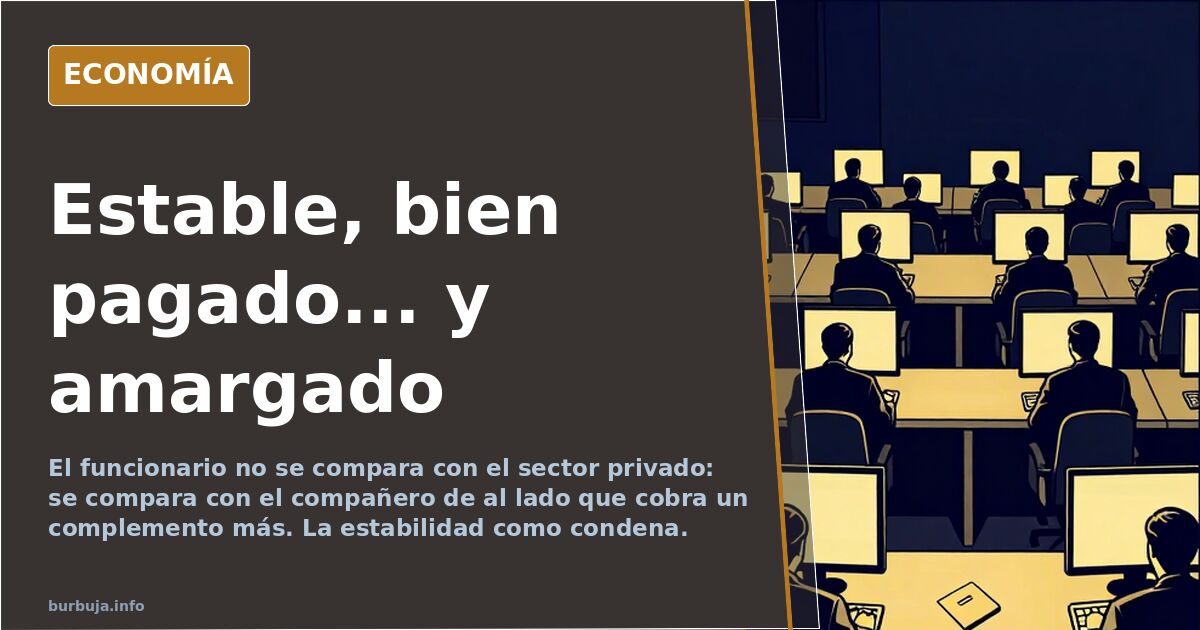
Why well-paid civil servants keep complaining
Salaries arrive on time, positions are secure, and vacation days are non-negotiable. Yet, the mood in Spanish public offices rarely reflects satisfaction. Complaints are constant and directed at a specific target: the colleague next door, who receives a questionable bonus, secured a promotion, or entered through a less transparent path. The question is not whether the civil servant is well-off. It is why, despite being objectively secure, they remain entrenched in discontent. Job stability and fixed salaries do not buy happiness.
A golden cage from which no one leaves unscathed
The most repeated diagnosis points to the nature of the role itself. Once inside, leaving carries a high cost: giving up a guaranteed pension and a stability that, outside the public sector, is almost science fiction. This forces endurance. And enduring corrodes. Those who stay without vocation, repeating the same tasks for decades, end up projecting their anger at the only ones within reach: their peers. Private sector bitterness often stems from exploitation; public sector bitterness, from suffocation. These are two distinct miseries, and they should not be confused.
Some summarize it with a recurring image in discussions about public employment: state work as a golden prison. Money and security, yes, but without room for ambition. If you work triple, you earn no more than the neighbor at the desk. This invisible ceiling, which neither rewards effort nor punishes minimum performance, is a source of frustration that no bonus can cover.
The colleague next door, not the private sector worker
The average civil servant rarely measures themselves against someone earning 1,300 euros in twelve installments. They measure themselves against the person in their hallway. Against someone with the same seniority who earns 200 euros more for a bonus they consider unfair. Against someone who promoted earlier. Their horizon is their ministry, not the labor market. There lies the poison.
This constant comparison has a paradoxical effect. The better the objective conditions, the more unbearable the minimal difference with the neighbor becomes. The one who earns well and complains about the one who earns slightly more is not a hypocrite: they are someone trapped in a system where the only variable they can influence is the bonus assigned by others. Often, the hierarchy distributing these supplements is opaque.
What a civil servant actually earns
The figures cited in the thread debunk several myths. The base monthly salary for a Group A1 (university degree) is 1,398.84 euros; for an A2, 1,296.15; for a C1, 1,145.21. To this are added bonuses, seniority, and productivity metrics that significantly increase the net amount. According to several civil servants, an A1 in the General State Administration, having just passed the entrance exam and living outside Madrid, earns around 2,300 euros net per month; in some specific ministries, the starting figure can approach 2,850. Each three-year tenure (trienio) adds about 50 euros gross.
The complete breakdown, line by line—productivity, specific bonus, destination level, and trienios—reveals differences between two people in the same corps that surprise those not inside. It is not the salary that divides the staff. It is what is distributed on top of it.
The teacher who stopped teaching and hallway classism
The case of education deserves a separate section. According to one participant, the teacher has ceased to teach to become, in practice, a social worker, psychologist, family mediator, and paperwork manager. Authority has diluted to near zero. It is not the salary that burns the teacher: it is doing everything except their job.
This is compounded by an internal atmosphere that several describe as toxic. Veterans who dodge powerless bosses, newcomers who climb through flattery, and classism based on ridiculous level differences. Those who retain any decency end up burnt out. And others’ laziness, those who scratch with both hands, weighs more than any monotonous task.
Civil servant vs. employee: the wrong fight
The private sector worker sees someone who cannot be fired, with school hours, and thinks they are privileged. The civil servant sees the other with a car financed to the hilt and thinks they are naive. They fuel each other. It is, in the words of one forum user, the old divide and conquer: while one side and the other measure who suffers more, the structure generating the discontent remains untouched.
According to another participant, the public administration wage bill, excluding health and education, is not the hole many imagine. Reducing public salaries to market level would not lower taxes: the spending machine is not fueled by that. But this nuance rarely appears in everyday disputes.
The analysis stalls exactly where the interesting part begins. If discontent stems from the role and not the person, privatizing the counter would not fix it: the one who gets left out loses the cage, but the one who enters takes the same routine. And if it stems from the person, no bonus cures it. No one has closed that account.
Salaries arrive on time, positions are secure, and vacation days are non-negotiable. Yet, the mood in Spanish public offices rarely reflects satisfaction. Complaints are constant and directed at a specific target: the colleague next door, who receives a questionable bonus, secured a promotion, or entered through a less transparent path. The question is not whether the civil servant is well-off. It is why, despite being objectively secure, they remain entrenched in discontent. Job stability and fixed salaries do not buy happiness.
A golden cage from which no one leaves unscathed
The most repeated diagnosis points to the nature of the role itself. Once inside, leaving carries a high cost: giving up a guaranteed pension and a stability that, outside the public sector, is almost science fiction. This forces endurance. And enduring corrodes. Those who stay without vocation, repeating the same tasks for decades, end up projecting their anger at the only ones within reach: their peers. Private sector bitterness often stems from exploitation; public sector bitterness, from suffocation. These are two distinct miseries, and they should not be confused.
Some summarize it with a recurring image in discussions about public employment: state work as a golden prison. Money and security, yes, but without room for ambition. If you work triple, you earn no more than the neighbor at the desk. This invisible ceiling, which neither rewards effort nor punishes minimum performance, is a source of frustration that no bonus can cover.
The colleague next door, not the private sector worker
The average civil servant rarely measures themselves against someone earning 1,300 euros in twelve installments. They measure themselves against the person in their hallway. Against someone with the same seniority who earns 200 euros more for a bonus they consider unfair. Against someone who promoted earlier. Their horizon is their ministry, not the labor market. There lies the poison.
This constant comparison has a paradoxical effect. The better the objective conditions, the more unbearable the minimal difference with the neighbor becomes. The one who earns well and complains about the one who earns slightly more is not a hypocrite: they are someone trapped in a system where the only variable they can influence is the bonus assigned by others. Often, the hierarchy distributing these supplements is opaque.
What a civil servant actually earns
The figures cited in the thread debunk several myths. The base monthly salary for a Group A1 (university degree) is 1,398.84 euros; for an A2, 1,296.15; for a C1, 1,145.21. To this are added bonuses, seniority, and productivity metrics that significantly increase the net amount. According to several civil servants, an A1 in the General State Administration, having just passed the entrance exam and living outside Madrid, earns around 2,300 euros net per month; in some specific ministries, the starting figure can approach 2,850. Each three-year tenure (trienio) adds about 50 euros gross.
The complete breakdown, line by line—productivity, specific bonus, destination level, and trienios—reveals differences between two people in the same corps that surprise those not inside. It is not the salary that divides the staff. It is what is distributed on top of it.
The teacher who stopped teaching and hallway classism
The case of education deserves a separate section. According to one participant, the teacher has ceased to teach to become, in practice, a social worker, psychologist, family mediator, and paperwork manager. Authority has diluted to near zero. It is not the salary that burns the teacher: it is doing everything except their job.
This is compounded by an internal atmosphere that several describe as toxic. Veterans who dodge powerless bosses, newcomers who climb through flattery, and classism based on ridiculous level differences. Those who retain any decency end up burnt out. And others’ laziness, those who scratch with both hands, weighs more than any monotonous task.
Civil servant vs. employee: the wrong fight
The private sector worker sees someone who cannot be fired, with school hours, and thinks they are privileged. The civil servant sees the other with a car financed to the hilt and thinks they are naive. They fuel each other. It is, in the words of one forum user, the old divide and conquer: while one side and the other measure who suffers more, the structure generating the discontent remains untouched.
According to another participant, the public administration wage bill, excluding health and education, is not the hole many imagine. Reducing public salaries to market level would not lower taxes: the spending machine is not fueled by that. But this nuance rarely appears in everyday disputes.
The analysis stalls exactly where the interesting part begins. If discontent stems from the role and not the person, privatizing the counter would not fix it: the one who gets left out loses the cage, but the one who enters takes the same routine. And if it stems from the person, no bonus cures it. No one has closed that account.
Summary of a discussion on Burbuja.info - Foro de economía, actualidad y política., translated from Spanish and reviewed before publication. Read the full discussion (252 replies).
More summaries
-
Civil Servants in Spain: 15.25% of Jobs Under Scrutiny
Public sector employment in Spain is 15.25%, lower than France (20.74%) or Denmark (27%). Why are civil servants accused of social betrayal?
-
Colau says she left her flat of 15 years because she couldn't afford it
Ada Colau says she is leaving the flat where she lived for 15 years because one salary wasn't enough; Newtral puts her salary as mayor at €96,000 gross
-
Lonely Christmas: The holiday ending on the 7th
Singles face a Christmas of few family dinners, child-centric plans, and the hope that the 7th arrives.
-
Plus Ultra Flight and the Narco-State Shadow: What Was Really on Board?
Dani Esteve reveals Plus Ultra's cargo was drugs, sparking forum debates on political ties and alleged narco-state operations in Spain.
-
Shared menu conflict in hospitality threatens profitability
Hospitality sector faces profitability issues as shared menus increase opportunity costs and complicate service management.
-
Netanyahu Expels Spanish Representatives from Kiryat Gat Coordination Center
Israel orders the expulsion of Spanish envoys from the Kiryat Gat coordination center, accusing Madrid of defamation, sparking a diplomatic crisis with Spain.