
Spain's 'chuletón Paco': accidental cooking meets small-town pride
An overcooked low-temperature steak and a sloppy salad spark a debate in Spain: is the chuletón Paco just country bumpkin food?
English · Original discussion in Spanish · Published
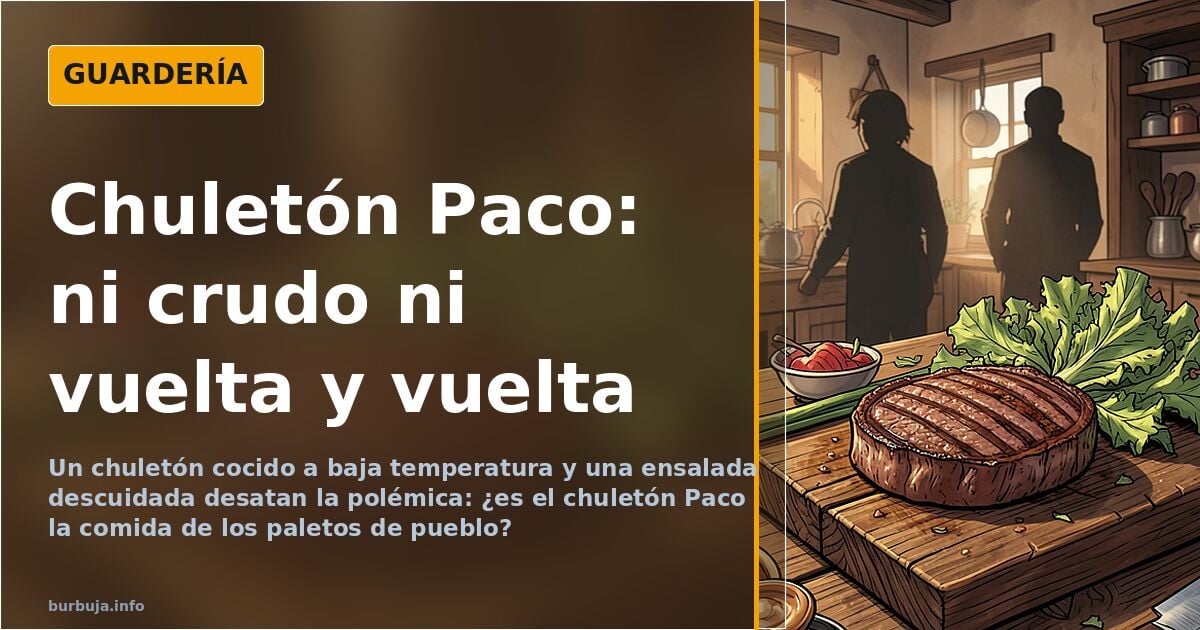
Chuletón Paco under fire: overcooked meat and wounded pride
A low-temperature steak, more boiled than grilled, and a salad with whole tomatoes and black spots. The scene, played out at an ordinary table, sparks a debate that goes beyond the plate: is the chuletón Paco just food for country bumpkins? This is no trivial matter. Behind the meat lies a dispute about taste, status and nostalgia for Duralex tableware.
The image that opens the controversy shows a pale cut of meat, with no sear, cooked to a doneness several people describe as "boiled, not grilled". The low temperature becomes the main technical complaint: the meat never developed the Maillard reaction that distinguishes a roast from a boil. The bread and the wine pass muster. The salad does not.
What is a chuletón Paco, and why is it linked to rural Spain?
The term "chuletón Paco" does not refer to a breed or a protected designation of origin. It is a colloquial label that combines a generic first name with the product: a large beef ribeye, usually cooked on a griddle or over coals, served in generous portions and at a level of doneness many consider excessive. The association with rural Spain is no accident: the chuletón has traditionally been the celebration dish in villages and along back roads, far from urban menus.
The debate over whether it is "bumpkin food" reveals more about the person saying it than about the dish. Some argue that the chuletón Paco is a classic that needs no refinement, while others claim its careless preparation makes it a disappointing experience. Doneness thus becomes a battleground: for some, rare is a sign of quality; for others, the low temperature ruins it.
The technical error: boiled at low temperature, with no sear
The most repeated complaint is that the meat was "damn shamefully done, at far too low a temperature". The explanation is simple: when the griddle is not hot enough, the surface of the meat does not sear and the inside cooks in its own juices. The result is a greyish steak, without the contrast between a crispy exterior and a juicy interior. The salad, with whole tomatoes and "a thing with black spots", does not help the cause either.
The bread and the wine are considered the only decent items on the table. The anecdote about the Duralex tableware, mentioned as a symbol of misguided nostalgia, illustrates the attachment to the old and shabby. Some call to "abandon shabbiness in order to grow as a human being", while others defend the chuletón as a mark of identity against designer cuisine.
The rareness contest: who can eat it the rarest
The discussion drifts into an implicit competition over doneness. Some insist the chuletón should be "rarer", that it is never rare enough, while beating their chests with pride. That race towards rare has little to do with gastronomy and a lot with showing off: the less cooked, the more authentic. The problem is that a raw, cold chuletón is as inedible as an overdone one. Low temperature, in this case, is not a virtue.
The result is meat that has not been exposed to enough heat to develop flavour. The texture turns rubbery and the taste, metallic. Defenders of rare meat argue that this preserves the juiciness; detractors say that is not a chuletón but a carpaccio with a bone.
Chuletón Paco as a class marker
The controversy goes beyond the kitchen. The chuletón Paco becomes a class marker: for some, it is the dish of ordinary folk, unpretentious; for others, it is proof that a lack of technique is dressed up as tradition. The irony about the Duralex tableware and misguided nostalgia points to one idea: an attachment to tackiness as a mark of identity.
Some point out that going to a restaurant and spending twenty euros on a chuletón Paco fried in a pan is no antiestéticat. The comparison with Galician churrasco, which "beats it", introduces an element of regional rivalry. The debate over whether Galicians know about shellfish, cocaine and inbreeding (an outburst not repeated here) falls outside the gastronomic analysis.
The unsettling fact: nobody agrees on doneness
In the end, the debate over the chuletón Paco reveals that doneness is a social convention, not an objective truth. What for some is a culinary crime is, for others, the essence of the dish. The overcooked low-temperature meat, the sloppy salad and the nostalgic tableware are symptoms of a broader debate: taste as a trench. And meanwhile, the bread and the wine keep saving the table.
Also available in: Deutsch
Summary of a discussion on Burbuja.info - Foro de economía, actualidad y política., translated from Spanish and reviewed before publication. Read the full discussion (41 replies).
More summaries
-
Medium-Heat Ribeye Sparks Debate Over Searing
Cooking a ribeye at medium heat in a cast-iron pan triggers criticism over the lack of searing and Maillard reaction.
-
Russell Crowe was 36 in Gladiator: Hollywood's age debate
Russell Crowe was 36 during Gladiator. We analyze if this fit Maximus and Hollywood's trend of casting older actors.
-
80s nostalgia is driving music consumption
A thread with 800 replies over 140 days confirms that Bee Gees, Dire Straits and ABBA dominate music consumption: 80s nostalgia is beating new releases.
-
Imported candies blamed for ruining Halloween for kids
A post on X shows candies that, according to its author, ruin Halloween for children. The debate over which treats to hand out resurfaces every October 31.
-
From Correos' prepaid card to face payments: how people organize their personal banking
A two-euro prepaid card from Correos, face-unlock payments and a defense of cash: the ways people manage accounts and cards without ties
-
The link nobody dares to open: anatomy of a digital mystery
An image link shared without context sparks warnings and wild descriptions on a forum. Nobody confirms what it contains, and the mystery remains unsolved.