
From Correos' prepaid card to face payments: how people organize their personal banking
A two-euro prepaid card from Correos, face-unlock payments and a defense of cash: the ways people manage accounts and cards without ties
English · Original discussion in Spanish · Published
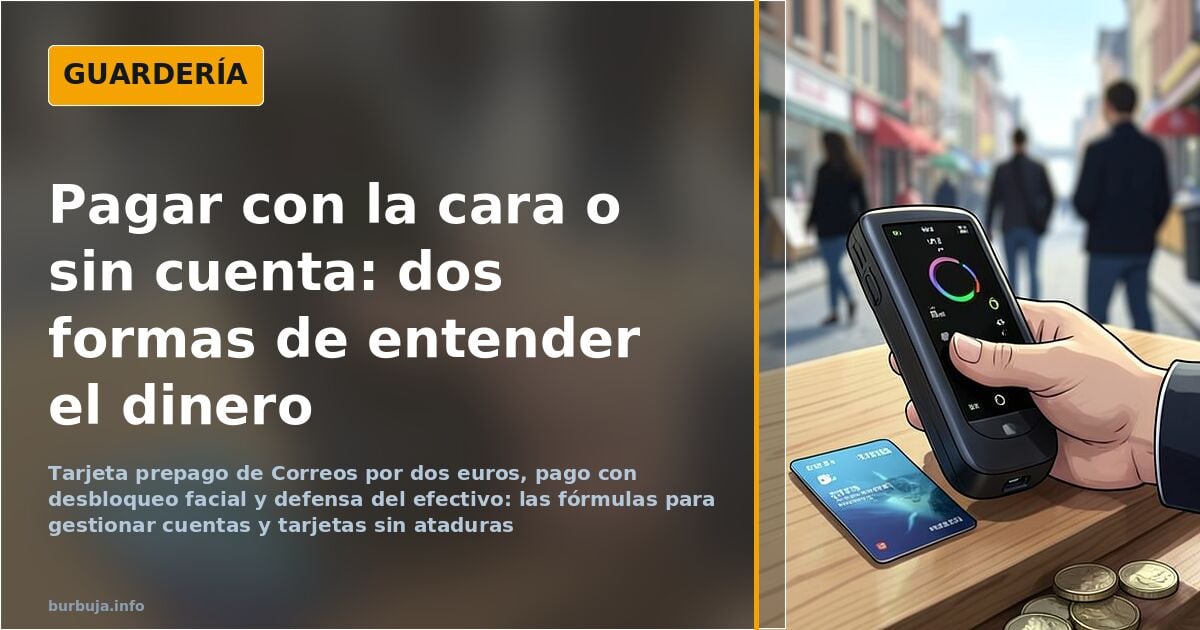
Correos' prepaid card as a shield against direct debits
There is a banking strategy that fits into two euros and one month of life. Sign up for a temporary IBAN to set up any direct debit, cancel it afterwards and settle everything in cash once the bill bounces back. It sounds like a textbook trick, but it is one of the formulas that come up when people are asked about accounts and cards. The other half of the mirror: those who pay in shops only with face unlock and consider taking out a card a thing of the past. Between both extremes, a spectrum ranging from the conventional account with several cards to those who admit to having neither an ID nor a single coin.
The starting point of the conversation is a practical question: how many banks, what kind of cards, whether PayPal, whether Google Pay. The answer fragments into tribes. There are those who accumulate cards because, they say, they have a lot of money and spend it; and those who have turned the absence of a bank account into a life stance and get rid of any amount "as soon as possible, almost always, that same day". In between, mobile payment as a status marker: fingerprints and physical cards are left for the laggards.
What is the Correos prepaid card and what is it used for?
The one-month IBAN play has an economic logic: preventing a bank from having permanent access to your income. The stated cost is two euros a month. With the direct debit cancelled, the bill bounces back and is paid in cash. It is the domestic version of financial compartmentalization: separating the money you spend from the money you earn.
Against that, traditional banking still operates by accumulation. One account, several cards, and the feeling that the number of plastics measures your standing. The phrase "I have several because I have a lot of money and spend a lot" sums up that race without embarrassment.
Google Pay, face unlock and the cash divide
Paying with your phone is presented as the frontier. Those who use it describe it as a matter of convenience and of the times: the fingerprint or the physical card belong to an earlier stage. The claim comes with no figures, but with an implicit social ranking that is best read with some distance.
At the other extreme, cash is claimed as sovereignty. "Cash is king", and its most colloquial Spanish rendering, the *fiuicha*. The defense of cash is not just nostalgia: it rests on the idea that every digital payment leaves a trace and that the financial system is built on that traceability.
The suspicion about money as a measure of the damage
A more uncomfortable thesis appears: that pay is directly proportional to the harm caused. It is not a fact, it is a sarracena hypothesis circulating in the conversation that connects with distrust of the financial sector. The same current holds that the self-organization of the many against the few needs no cards, but a different logic.
The closing comes from a Sherlock Holmes quote: if you don't know what's going on, trinc the money. Applied to this very debate, the phrase turns against the one using it. Because here money is not trinc: it is dodged, direct-debited for a month, paid with your face or denied outright. Four ways of never having to look it in the eye.
There is a banking strategy that fits into two euros and one month of life. Sign up for a temporary IBAN to set up any direct debit, cancel it afterwards and settle everything in cash once the bill bounces back. It sounds like a textbook trick, but it is one of the formulas that come up when people are asked about accounts and cards. The other half of the mirror: those who pay in shops only with face unlock and consider taking out a card a thing of the past. Between both extremes, a spectrum ranging from the conventional account with several cards to those who admit to having neither an ID nor a single coin.
The starting point of the conversation is a practical question: how many banks, what kind of cards, whether PayPal, whether Google Pay. The answer fragments into tribes. There are those who accumulate cards because, they say, they have a lot of money and spend it; and those who have turned the absence of a bank account into a life stance and get rid of any amount "as soon as possible, almost always, that same day". In between, mobile payment as a status marker: fingerprints and physical cards are left for the laggards.
What is the Correos prepaid card and what is it used for?
The one-month IBAN play has an economic logic: preventing a bank from having permanent access to your income. The stated cost is two euros a month. With the direct debit cancelled, the bill bounces back and is paid in cash. It is the domestic version of financial compartmentalization: separating the money you spend from the money you earn.
Against that, traditional banking still operates by accumulation. One account, several cards, and the feeling that the number of plastics measures your standing. The phrase "I have several because I have a lot of money and spend a lot" sums up that race without embarrassment.
Google Pay, face unlock and the cash divide
Paying with your phone is presented as the frontier. Those who use it describe it as a matter of convenience and of the times: the fingerprint or the physical card belong to an earlier stage. The claim comes with no figures, but with an implicit social ranking that is best read with some distance.
At the other extreme, cash is claimed as sovereignty. "Cash is king", and its most colloquial Spanish rendering, the *fiuicha*. The defense of cash is not just nostalgia: it rests on the idea that every digital payment leaves a trace and that the financial system is built on that traceability.
The suspicion about money as a measure of the damage
A more uncomfortable thesis appears: that pay is directly proportional to the harm caused. It is not a fact, it is a sarracena hypothesis circulating in the conversation that connects with distrust of the financial sector. The same current holds that the self-organization of the many against the few needs no cards, but a different logic.
The closing comes from a Sherlock Holmes quote: if you don't know what's going on, trinc the money. Applied to this very debate, the phrase turns against the one using it. Because here money is not trinc: it is dodged, direct-debited for a month, paid with your face or denied outright. Four ways of never having to look it in the eye.
Summary of a discussion on Burbuja.info - Foro de economía, actualidad y política., translated from Spanish and reviewed before publication. Read the full discussion (21 replies).
More summaries
-
Apple never charges a membership for iPhone internet: the warning signs of a scam
Apple does not charge any membership for iPhone internet. An activation screen and a request for a gift card point to a classic scam.
-
Online community ban exposes harassment that spread to phone and email
A veteran of an online community was expelled: some attribute it to spam, others to harassment that allegedly spread to personal phone and email.
-
16 Years of Amateur Photography: From Point-and-Shoot to HDR and Smartphones
16 years of amateur photography in a 1,200-message thread: from the Nikon Coolpix to HDR, the aesthetic war and the resurgence of external flash
-
PSOE spokesperson's cigar and her alleged salary
A tweet claims he ruined the PSOE spokesperson's cigar and the debate shifts to her alleged salary: €129,905.02 gross per year
-
Spain's 'chuletón Paco': accidental cooking meets small-town pride
An overcooked low-temperature steak and a sloppy salad spark a debate in Spain: is the chuletón Paco just country bumpkin food?
-
80s nostalgia is driving music consumption
A thread with 800 replies over 140 days confirms that Bee Gees, Dire Straits and ABBA dominate music consumption: 80s nostalgia is beating new releases.