
Spain's CEOE proposes cutting sick-leave contributions
The Spanish employers' association suggests stopping social security payments during sick leave if absenteeism does not decrease, affecting future pensions.
English · Original discussion in Spanish · Published
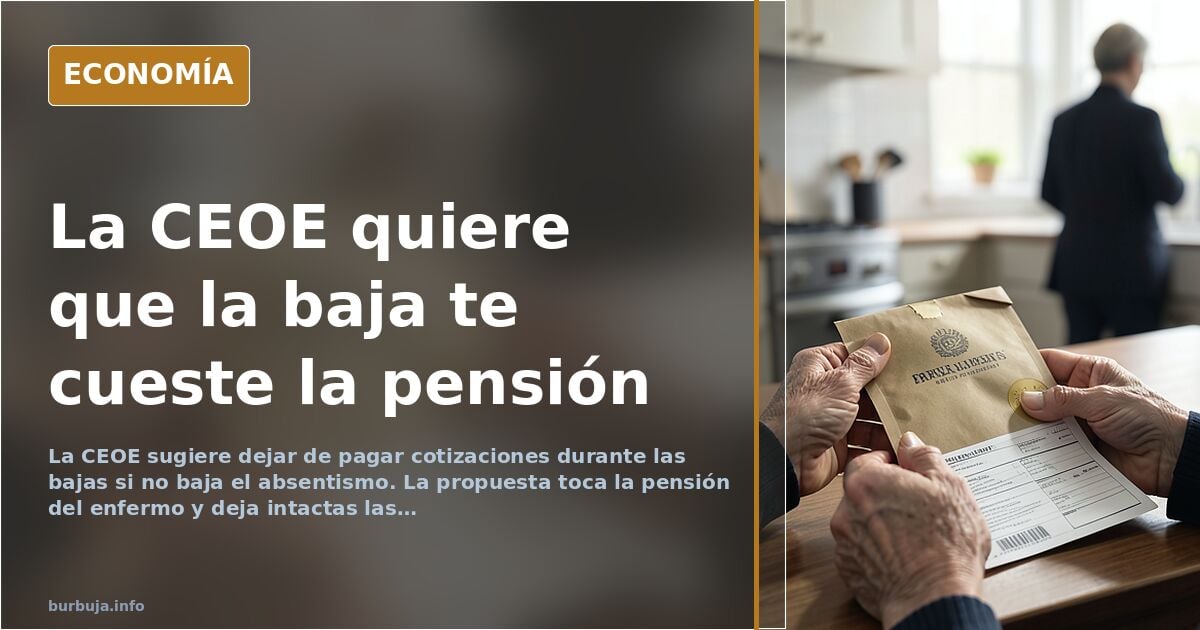
CEOE hints at ending contributions during sick leave
The employers' association is not discussing productivity. In December, its president, Antonio Garamendi, lamented a lack of "work ethic" and noted that sick leaves often fall on Mondays and Fridays. Now, Rosa Santos, the CEOE's Employment Director, raises the stakes by suggesting that social security contributions should stop being paid during temporary incapacity periods if absenteeism rates do not drop. This proposal is not a minor technical detail: it directly impacts the future pension of those on sick leave.
What exactly does the CEOE propose?
The approach is conditional: if absenteeism does not decrease, contributions during sick leave are withdrawn. Translated to the affected worker's payslip, the illness period would no longer count towards years or bases for benefit calculations. The employers' association frames this idea within its campaign against absenteeism, which began with Garamendi's speech on effort and the concentration of sick leaves at the start and end of the week.
The problem is that absenteeism is not a homogeneous block. Temporary incapacity covers everything from the flu to cancer treatment, and the proposal makes no distinction between them. A person with cancer is not slacking off on a Monday.
Who bears the cost of sick leave?
The core issue is who pays the bill. Currently, companies pay contributions during sick leave; the employers' association wants to shift this burden to the State or to the sick individual themselves. Some argue that the current system dates back to the Franco era and has never been rethought, whereas a genuine sick-leave insurance should be fully covered by the public system.
Therefore, the real debate is not whether absenteeism needs to be reduced, but how protection for those unable to work is financed. Here, the CEOE has chosen the cheapest path: placing the cost on those lying in bed.
The taboo nobody touches: early retirements
The campaign against malingering clashes with another reality absent from the employers' headlines. It is claimed that there are agreed-upon early retirements at ages 55, 56, and 57 with full benefits, yielding pensions above €2,000 and €3,000, in Ibex 35 companies and the banking sector. The low-income worker retiring at 70 contributes to paying for that party.
There is indeed a hole that nobody addresses. The CEOE does not propose withdrawing contributions for collectively agreed early retirees; it proposes withdrawing them from those breaking their backs in logistics or hospitality.
Why is temporary incapacity rising?
The narrative of malingering ignores demographic arithmetic. The workforce is aging, and the sectors with the highest sick leave rates are those that physically punish the body: hospitality, logistics, and care services. Temporary incapacity is growing because work hurts, not because Paco takes a day off on Monday.
In practice, the CEOE's proposal functions as a perverse incentive: someone on sick leave for a serious condition would also have to worry about making ends meet and whether they will have a pension. This does not reduce absenteeism. It reduces the dignity of the sick person.
Unresolved issues
Rosa Santos's suggestion is on the table but lacks regulatory development. There is no text, no defined absenteeism threshold, and no implementation mechanism. The age-old question remains: if the problem is fraud, why is the solution designed against the sick person rather than against the one simulating illness?
Also available in: Deutsch
Summary of a discussion on Burbuja.info - Foro de economía, actualidad y política., translated from Spanish and reviewed before publication. Read the full discussion (29 replies).
More summaries
-
Spain aims to approve 4.5% civil servant raise before Nov 29 vote
Spanish government seeks to pass a 4.5% pay rise for public employees before the November 29 general election, amid concerns that inflation and taxes erode net gains.
-
Spain's Supreme Court Upholds Reduced Sentences Under 'Only Yes Is Yes' Law
Spain's Supreme Court validates sentence reductions under the 'Only Yes Is Yes' law, overturning Equality Ministry criteria despite Prosecutor General objections.
-
Police detain minor during Euro Cup celebrations in Spain
Video shows two Spanish police officers detaining a minor during Euro Cup celebrations. Lack of context fuels debate on police conduct.
-
Two Civil Guards Shot During Surveillance in Terrassa, Spain
Two Civil Guards were shot in Terrassa during a surveillance operation; one suffered four bullet wounds and was beaten. The incident highlights security concerns in Spain.
-
Debate on alleged coordinated siege against Spanish PM Sánchez
Forum users compare the alleged attack on Pedro Sánchez with Adolfo Suárez's downfall, mixing judicial, media and geopolitical accusations.
-
Adif bonuses spark criticism over incentives despite rail accident
Forum users criticize Adif bonus distribution amid a rail accident and upcoming elections, comparing it to past black card scandals.