
Spain's caretaker government announces pension and minimum wage increases
Spain's caretaker government announces pension and minimum wage increases without a budget. The debate: economic policy or electoral manoeuvre?
English · Original discussion in Spanish · Published
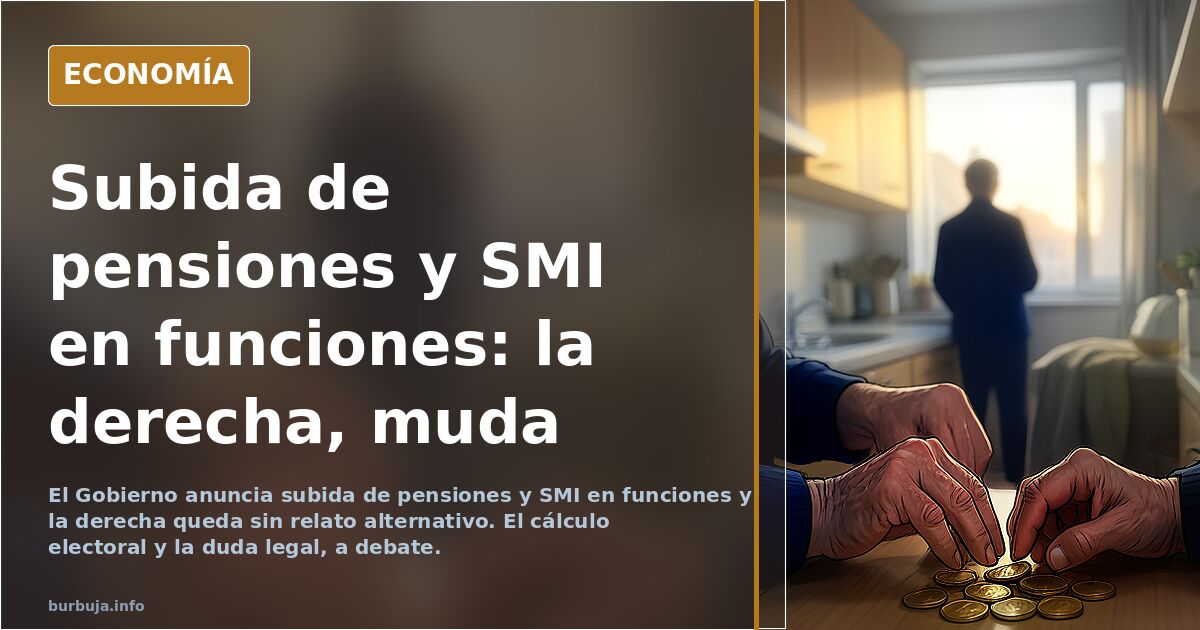
Spain's caretaker government announces pension and minimum wage increases
A caretaker minister announces increases to pensions and the minimum wage. The sequence is nothing new, but this time the calendar is what matters: the government has gone four years without passing a national budget, and yet it is set to touch the two spending items that move the most votes. The announcement was made by Economy Minister Carlos Cuerpo and picked up by the EFE news agency: the government will raise pensions and the minimum wage even while in a caretaker role. The question hanging over the debate is simple: is it an economic measure or a campaign move?
The discussion has turned into a settling of scores over the narrative. Some see an electoral marketing operation; others, proof that the right has squandered four years of advantage. And in the middle, pensioners, young people, and an inflation rate eating up part of the announcement.
How much pensions and the minimum wage will rise
The figure getting the most attention is the uprating. A comparison of series puts the People's Party's (PP) increases at around 0.25% a year between 2014 and 2018, compared with rises of 1.6% in 2019, 8.5% in 2023 and 3.8% in 2024 under the current government. The conclusion drawn is clear: anyone who votes for the right, the argument goes, risks having their pension frozen.
The minimum wage trinc the same logic. The cumulative increase mentioned comes to around 300 euros a month, and some recall that under previous governments a full working week paid 700 euros. The government presents the measure as a correction; the opposition, as a blow to business competitiveness.
What nobody disputes is the calendar. The announcement comes without a national budget having been passed for four years, a fact that in any other European democracy would be an institutional anomaly and that here has become normalised.
The problem of the system's sustainability
The fine print appears when the accounts come up. Minister Cuerpo himself admitted in an interview that «the necessary reforms must be implemented so that the system remains sustainable». In other words, the same government announcing increases acknowledges that the system needs reform. The narrative collapses live on air, according to the most critical reading.
The demographic argument carries the most weight. Without a sufficient replacement rate, the pension system's numbers don't add up. It is sustained by the arrival of foreign labour and by the contributions of those still working. The conclusion some draw is uncomfortable: the country is not ruined by any single political decision, but by a structure that rests on tourism and cheap labour.
The question left hanging is whether the increase is sustainable or just bread for today. And if it is bread for today, who pays the bill tomorrow?
The right that failed to capitalise on the government's wear
The other major focus of the debate is the opposition. The dominant thesis is that the right had everything going for it: four years of government wear and tear, inflation hitting people's pockets, and an electorate demanding change. And yet it failed to capitalise on it. People talk of a right that has spent four years dozing, without renewing itself, and that now comes out saying it will cut pensions and the minimum wage when nobody is asking it to.
The repeated diagnosis is that Spain's right has failed to understand Europe's shift. While parties like Marine Le Pen's embrace a working-class discourse, defending the working class and rejecting defence spending, Spain's right remains anchored in austerity liberalism. That, according to this reading, is the strategic error preventing it from connecting with the voter hit hardest by inflation.
Some go further and argue that the government has achieved the unthinkable: leaving the left wing to its left badly damaged while winning over the PP's centrist voters. The result would be a landscape with both wings in disarray and a government at the centre of everything.
The voter who doesn't trust the rhetoric
The conversation also comes down to everyday detail. Some tell of naturalised citizens who have spent twenty years working and paying contributions in Spain and are clear they will vote for whoever leaves them in peace. It is not a question of ideology, but of stability. And that voter, who does not show up in polls as a homogeneous group, could be decisive.
Against that, the antiestéticar-mongering about the other side. The claim is that the PSOE (the Spanish Socialist Workers' Party) uses all its weapons to destroy what is to its left and steal votes from the PP and Vox among the repentant. The consequence, according to this view, is a society that accepts a questioned government as long as its belly is full.
The metaphor that best sums up the mood is that of the dentist and the candy seller. The candy seller promises sweets for everyone; the dentist warns about cavities. The candy seller wins. Always. Until the teeth start hurting.
One jarring fact remains. The same government announcing increases quietly acknowledges that the system must be reformed. The same opposition denouncing the spending offers no alternative plan that does not involve cuts. And the voter, meanwhile, decides with a calculator in one hand and distrust in the other. With these ingredients, an absolute majority is not written in stone, but the narrative is already built.
Also available in: Deutsch
Summary of a discussion on Burbuja.info - Foro de economía, actualidad y política., translated from Spanish and reviewed before publication. Read the full discussion (369 replies).
More summaries
-
The right and the pensions elephant: promises without numbers
An analysis argues that Spain's pension system is already being propped up by debt and that the right promises to pay pensions without saying how. The electoral dilemma nobody wants to face.
-
Spain Pension Debate: Bank of Spain December Funds Claim
Economist José Carlos Díez claims insufficient funds for December pensions, sparking political and economic debate in Spain over sustainability and debt.
-
Spain's University Statute gives students power over what is taught
Spain's University Statute will give students a say over what is taught. The key detail: it does not clarify which students, or with what checks and balances.
-
Unemployed mother of two in Ceuta, Spain: the maze of benefits that never arrives
A 25-year-old single mother, former self-employed worker and unemployed since December: the case that reopens the debate in Ceuta, Spain, over who actually receives social benefits
-
Generali drops home insurance after two claims in a year
Two home insurance claims in a single year are enough for Generali to refuse to renew a 35-year policy. The industry calls it claims history.
-
Half of Spain's rental listings are now seasonal lets
Half of rental listings in Spain are now seasonal: the formula is growing in Catalonia, the Basque Country and Galicia while the decree to curb it remains shelved