
Spain's Basque Region: New Home Sales Drop 45%, Mortgages Fall 21.8%
New home sales in Spain's Basque Country plummeted 45% while mortgage grants fell 21.8% year-on-year in June, marking an initial price adjustment.
English · Original discussion in Spanish · Published
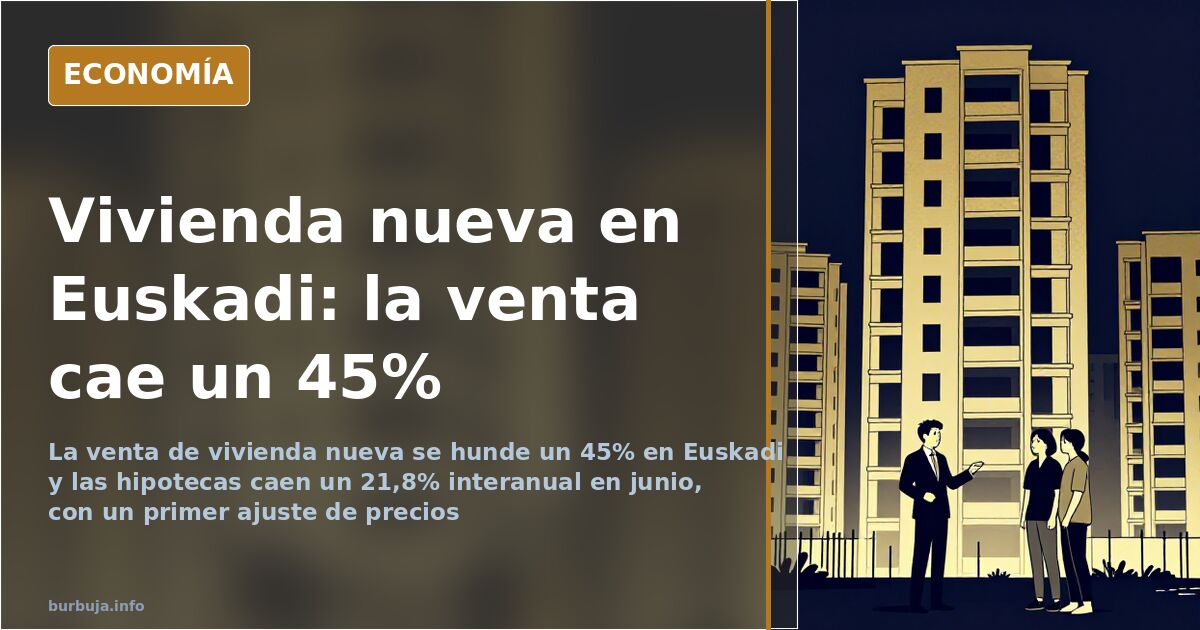
Basque Country: New homes down 45%, mortgages down 21.8%
How much must apartment sales drop for prices to reflect it? In the Basque Country, new home sales sank 45% in the second quarter, and operations registered at property offices fell 17.5%, with a price adjustment appearing for the first time in statistics. Mortgage grants dropped 21.8% year-on-year in June: 1,887 loans, 525 fewer than the same month last year. All this with the Euribor at 4%. This is not seasonal cooling; it is a business that has run out of buyers with financing.
Why do sales data arrive late if the Euribor has been high for months?
Because registry statistics record deeds closed months earlier, when the Euribor was not yet where it is now. The most common interpretation is that published figures are the delayed effect of purchase decisions made with lower rates, so the worst of the adjustment has not yet reached the paperwork. An uncomfortable nuance is that, compared to May, mortgages signed in the Basque Country rose by 8.1%. A monthly rebound amid an annual collapse does not signal recovery: it confirms these data move in bursts.
What peine in 2008 and why is it used as a mirror?
The most circulating explanation blames interest rates rather than subprime mortgages. Between 2005 and 2008, money became expensive until many borrowers stopped paying installments, dragging down the entire structure: half-built developments, financed land, and banks holding loans worth much less than they had lent. Then, the narrative of antiestéticar cooled any further purchases. However, some argue that 2009 and 2010 were not the market floor: apartments remained expensive, it was an upward trap, and those who truly succeeded bought between 2013 and 2015. The lesson is uncomfortable: a collapse in transactions does not equal a collapse in prices.
Are prices falling or just transaction volumes?
Here calculations diverge from feelings. Some summarize the mismatch thus: a 4% adjustment after a 70% rise fixes little. In real terms, adjusting for inflation, some calculate housing is 50% below 2008 peaks across much of the country. But the same money buys less: an apartment costing €200,000 two years ago, with 15% accumulated inflation, would need to cost €230,000 today just to stay equal. Thus owners do not lower prices and buyers wait. Meanwhile, some cite Belgrade, where salaries of €500/month coexist with demands of €5,000 per square meter in new areas. And in Girona, some sign deals at €450,000, €470,000, or even €730,000 if the apartment is not inflated.
Unsold stock and new construction where demand exists
The repeated mantra—millions of empty apartments—hides a location problem more than a quantity one. The Spanish municipalities with the most vacant housing are:
Vacant housing does not miccionan housing for sale: it may have another purpose, be held by relatives, or await better times. What is visible is new construction where there is traction: 263 developments in Madrid city and over 600 in its province. Supply is scarce in some areas and excessive in others, and this imbalance supports prices more than any theory about accumulated stock.
Who holds up the system: funds, developers, or banks?
There are three versions, none consistent with the others. One says funds with excess liquidity buy whole neighborhoods and do not need to sell, so prices hold firm; the opposite argues those funds have been losing money and divesting for over a year, citing Blackstone, with two real estate firms failing to file accounts in Spain and four in losses. A participant describes the classic development mechanism: companies without own assets, clients advancing money, and builders who do not respond when work stalls halfway. Moreover, this version claims banks barely lend or do so under very harsh conditions, with regulations raising costs for each development and materials and labor skyrocketing. In the previous crisis, according to this account, developers were not rescued: they went bankrupt. Banks were.
With new homes plummeting, mortgages at lows, and prices unmoved, the market lacks only one thing to balance: someone setting a true first price. We have waited months to see who dares. And whoever dares will frame it as an opportunity.
How much must apartment sales drop for prices to reflect it? In the Basque Country, new home sales sank 45% in the second quarter, and operations registered at property offices fell 17.5%, with a price adjustment appearing for the first time in statistics. Mortgage grants dropped 21.8% year-on-year in June: 1,887 loans, 525 fewer than the same month last year. All this with the Euribor at 4%. This is not seasonal cooling; it is a business that has run out of buyers with financing.
Why do sales data arrive late if the Euribor has been high for months?
Because registry statistics record deeds closed months earlier, when the Euribor was not yet where it is now. The most common interpretation is that published figures are the delayed effect of purchase decisions made with lower rates, so the worst of the adjustment has not yet reached the paperwork. An uncomfortable nuance is that, compared to May, mortgages signed in the Basque Country rose by 8.1%. A monthly rebound amid an annual collapse does not signal recovery: it confirms these data move in bursts.
What peine in 2008 and why is it used as a mirror?
The most circulating explanation blames interest rates rather than subprime mortgages. Between 2005 and 2008, money became expensive until many borrowers stopped paying installments, dragging down the entire structure: half-built developments, financed land, and banks holding loans worth much less than they had lent. Then, the narrative of antiestéticar cooled any further purchases. However, some argue that 2009 and 2010 were not the market floor: apartments remained expensive, it was an upward trap, and those who truly succeeded bought between 2013 and 2015. The lesson is uncomfortable: a collapse in transactions does not equal a collapse in prices.
Are prices falling or just transaction volumes?
Here calculations diverge from feelings. Some summarize the mismatch thus: a 4% adjustment after a 70% rise fixes little. In real terms, adjusting for inflation, some calculate housing is 50% below 2008 peaks across much of the country. But the same money buys less: an apartment costing €200,000 two years ago, with 15% accumulated inflation, would need to cost €230,000 today just to stay equal. Thus owners do not lower prices and buyers wait. Meanwhile, some cite Belgrade, where salaries of €500/month coexist with demands of €5,000 per square meter in new areas. And in Girona, some sign deals at €450,000, €470,000, or even €730,000 if the apartment is not inflated.
Unsold stock and new construction where demand exists
The repeated mantra—millions of empty apartments—hides a location problem more than a quantity one. The Spanish municipalities with the most vacant housing are:
- Madrid: 97,178
- Barcelona: 75,476
- Valencia: 36,454
- Las Palmas de Gran Canaria: 25,016
- Sevilla: 24,695
- Málaga: 16,638
- Zaragoza: 15,638
- Palma: 9,346
Vacant housing does not miccionan housing for sale: it may have another purpose, be held by relatives, or await better times. What is visible is new construction where there is traction: 263 developments in Madrid city and over 600 in its province. Supply is scarce in some areas and excessive in others, and this imbalance supports prices more than any theory about accumulated stock.
Who holds up the system: funds, developers, or banks?
There are three versions, none consistent with the others. One says funds with excess liquidity buy whole neighborhoods and do not need to sell, so prices hold firm; the opposite argues those funds have been losing money and divesting for over a year, citing Blackstone, with two real estate firms failing to file accounts in Spain and four in losses. A participant describes the classic development mechanism: companies without own assets, clients advancing money, and builders who do not respond when work stalls halfway. Moreover, this version claims banks barely lend or do so under very harsh conditions, with regulations raising costs for each development and materials and labor skyrocketing. In the previous crisis, according to this account, developers were not rescued: they went bankrupt. Banks were.
With new homes plummeting, mortgages at lows, and prices unmoved, the market lacks only one thing to balance: someone setting a true first price. We have waited months to see who dares. And whoever dares will frame it as an opportunity.
Also available in: Deutsch
Summary of a discussion on Burbuja.info - Foro de economía, actualidad y política., translated from Spanish and reviewed before publication. Read the full discussion (109 replies).
More summaries
-
Buying will get pricier without rentals, debate suggests
New rental rules may push homes off the market and force more households to buy, while supply remains scarce.
-
Blue Face on Spanish Show Horizonte Sparks Murder Accusations
Bea Talegón's blue face on Horizonte triggers murder accusations online after Maricarmen's death, boosting viewership.
-
Russia-Cuba: military alliance or just theater?
The announcement of a military agreement between Russia and Cuba has been met with skepticism: with no operational fleet, the threat to Trump fades into propaganda.
-
A tweet claims ten rabbis wrote the Quran
A tweet attributes to a 9th-century manuscript a confession by ten rabbis who allegedly wrote the Quran. With no academic source, the claim circulates as a…
-
Mexico demolishes US-owned beachfront mansions
The demolition of foreigners' mansions on Mexican beaches reopens the debate over property rights, urban planning impunity and the standoff with the US.
-
Delivery work: the gold rush that has run out for migrants in Spain
Delivery in Spain has collapsed: oversaturation is driving down the earnings of migrant couriers working for platforms like Glovo.