
Spain's Average Household: €328 Monthly Deficit
Average Spaniard ended 2024 with €328 monthly debt, while public debt exceeds €1.5 trillion.
English · Original discussion in Spanish · Published
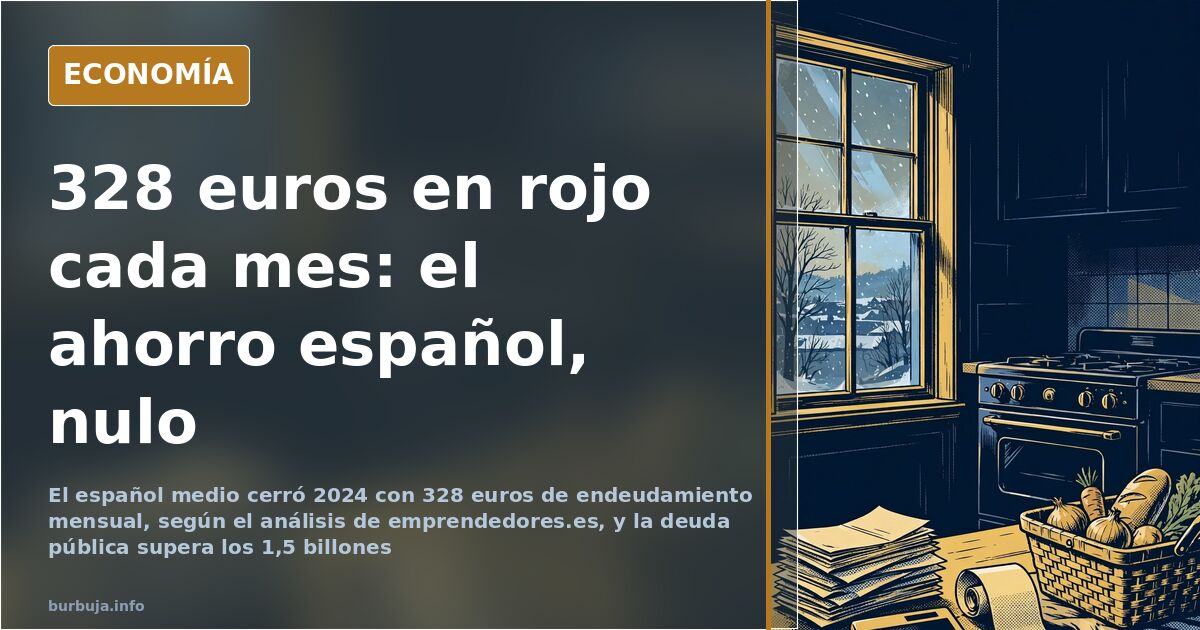
The average Spanish household ends the month €328 in the red
As one forum participant noted, clams were selling for €179 per kilo at a local Hipercor and were out of stock; the fishmonger mentioned customers buying several kilos. This scene of luxury consumption coexists with the data that sparked this discussion: in 2024, the average Spaniard does not just fail to save—they close the month with €328 in debt. Zero savings capacity, according to an analysis published by emprendedores.es.
The debate trinc that headline has the virtue of going beyond mere complaint to examine details: what has eroded paychecks, why consumption hasn't collapsed, and where a country whose public debt already exceeds €1.5 billion—a historic high—is heading.
What does being -€328 a month miccionan?
A negative balance of €328 a month doesn't describe someone who wastes money: it describes a household paying more than it earns and covering the difference with credit, depleting reserves, or taking on debt. After deducting housing, utilities, food, and transport, savings are negative by definition.
The underground economy and consumer credit appear as recurring explanations. Part of the country relies on accumulated savings or loans; another sustains spending levels impossible on official salaries thanks to income that bypasses tax declarations. In between lies an uncomfortable certainty: with current prices, covering the entire month and making it to the 20th day is already considered an achievement.
Third-world wages with first-world prices
Most diagnoses point there. Salaries haven't kept pace with the cost of living, and those who manage to save do so by giving up things taken for granted a decade ago. Some recall that in the eighties, salaries stretched much further because living costs and taxes were lower, even though no safety net existed.
There is a reading that nuances victimhood: for years, expenses like dining out, getaways, high-end phones, new cars, and mortgages were internalized as normal—and that explains part of the gap, according to one participant. The counterargument is equally simple. If a household with over €5,000 in monthly income admits it's no longer comfortable as it was a few years ago, the problem isn't whimsy: it's structural cost. Even households with stable public employment appear indebted, breaking the stereotype that this only affects precarious workers.
Income Tax eating into paychecks: up to 43.2%
In 2024, according to one participant's calculation—who warned they were speaking from memory—the IRPF (Spanish Income Tax) rate could reach 43.2%, and the comparison with Denmark would have reversed: six years ago, they had a ten-point advantage, but today Spain's tax burden would be higher. The fine print matters more than the headline. In Denmark, social security contributions are minimal, and the pension system has three pillars, with a mandatory universal coverage tier and company or private supplements paid separately by the worker.
The second nuance is fiscal effort: paying 50% tax on €5,000 is not the same as on €1,000, and Danish 50% isn't spent like Spanish 50%. The third is employment. In Denmark, nearly half the population works; here, several points less. Hence the most repeated argument: the problem isn't so much taxes as salaries and how many people contribute.
How are beaches full if we're poorer?
Ramón Palomar formulated this in ABC in March 2024 as a paranormal phenomenon: supposedly, we are 20% poorer than a decade ago, yet on special dates, beaches, snowy mountains, rural shelters, and tourist apartments collapse under demand. No one locates the spring from which that happy money flows.
Possible explanations reduce to three: debt, accumulated savings, or money that bypasses declarations. None is good news. Debt must be repaid, savings run out, and the underground economy doesn't contribute to social security, doesn't pay taxes, and doesn't support pensions.
Mortgages at 4% and rents that don't deflate
It was surprising, noted in the thread, that with mortgages at 4%, nothing blew up.
Another diagnosis is offered regarding rent. Many investors believe their apartment is worth more than a bank deposit, leading to excessive price hikes. When months pass without finding someone to pay the exorbitant sum and they must cover IBI (property tax) and expenses, reflection will come naturally. It's an argument of patience, not consolation: meanwhile, the tenant pays.
Indoor cold and invisible bills
The cold endured inside Spanish homes is rare elsewhere, argues one line of analysis. Colder, poorer countries have subsidized systems; colder, richer ones have incomes allowing healthy home temperatures. Here, people wear coats inside bars.
Included in the same critique is the fact that a retiree may earn double an active worker, or that the family unit has ceased functioning as a safety net. These are debates delayed for decades, used, according to one participant, by politicians as electoral weapons.
The final data is disorienting. Public debt exceeds €1.5 billion, a historic high, while one participant argues that by age 30, someone should have saved between €30,000 and €50,000. With the average Spaniard €328 in the red every month, the math doesn't add up anywhere.
Also available in: Deutsch
Summary of a discussion on Burbuja.info - Foro de economía, actualidad y política., translated from Spanish and reviewed before publication. Read the full discussion (185 replies).
More summaries
-
Only 37% of Households Have Savings Exceeding €15,000
63% of Spanish households hold less than €15,000 in accounts and deposits, with half holding less than €8,000. Why the average of €55,300 is misleading
-
Sol Campout: Elite Spokespeople and Suspicions of Manipulation
Spokespeople for the Sol campout against the housing crisis reportedly attended United World College and Comillas, according to disseminated data.
-
A look back at Pedro Sánchez's government's poor crisis management in Spain
Sánchez's government has faced covid, the Valencia floods and the 2025 blackout since 2018. A review of the crises that defined his time in office.
-
A tweet reignites controversy around Paracetamol
A message about Paracetamol and 'our Lorca' sparks a debate with cross accusations and no conclusive evidence of an alleged assault.
-
Pensions in Spain: the real cost of 50 years of contributions and the generational divide
The pension debate resurfaces in Spain: 50 years of contributions versus the sustainability of the system and the demographic pressure of a generation that…
-
Spain's high-speed rail and the 16-year debate over PP's failure to upgrade the system
The AVE's LZB system was extended to save 37 million euros while ERTMS remained unimplemented. The blame spans 16 years of PP rule and 8 of PSOE.