
Spain's archaeological mafia loots heritage without ever facing court
A missing piece, 30,000 coins unaccounted for and metal detectorists treated as criminals: the looting of Spain's archaeological heritage
English · Original discussion in Spanish · Published
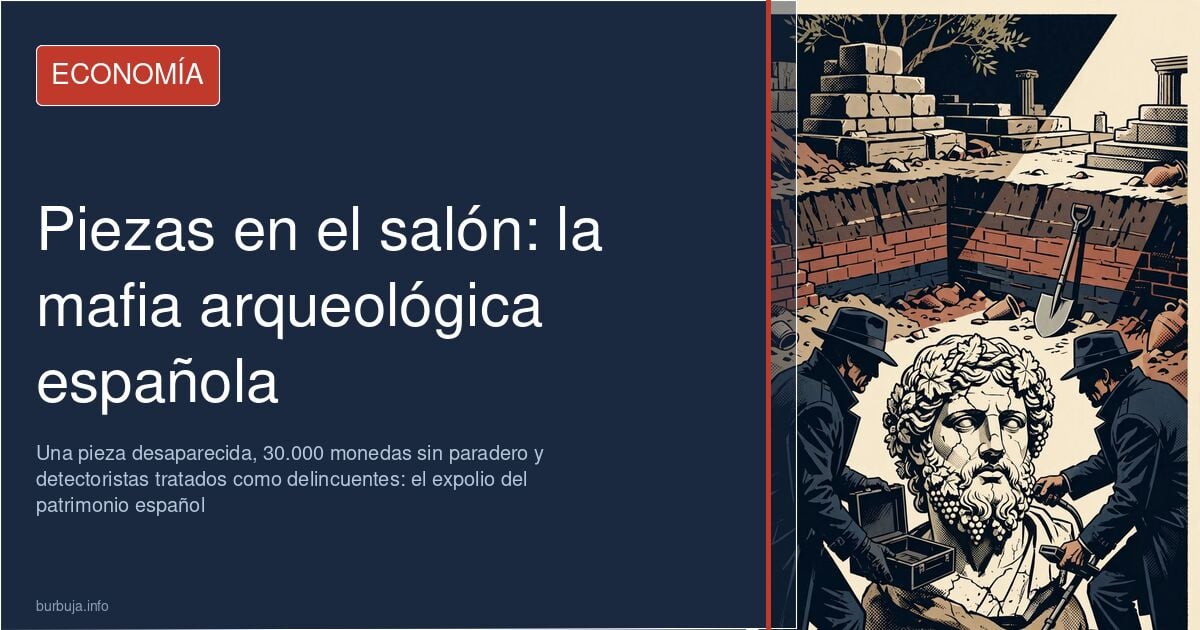
Archaeological mafia: the looting Spain fails to prosecute
Spain has an archaeological mafia operating in broad daylight. This is no talk-show exaggeration: pieces removed from official excavations end up in private homes, coins vanish from archaeological sites, and hobbyists with metal detectors are treated like incivil while others display Roman mosaics in their living rooms. All of it with public money involved and under the alibi of heritage as a sacred asset. The pattern repeats itself: those who protect, collect; those who search on their own, pay.
What lies behind the term archaeological mafia
The case that reignited the issue mixes a detectorist, a find in a meadow and a mayor from the PP (Spain's conservative People's Party). The critical reading points to the fact that the hobbyist who locates remains with his detector ends up portrayed as the problem, when the real problem is something else: the political and economic use of heritage. Those who report a looting can end up being singled out; those who carry it out within the structure, collect and carry on.
From the head of Bacchus to the 30,000 coins of Cástulo
The star piece of the accusation is a head of Bacchus. Jon Buesa, a former official of the PNV (the Basque Nationalist Party), is said to have admitted that the piece missing from an excavation was in his possession, after years of claiming that what he displayed was a copy. No incivil consequences, according to the complaints circulated. This is nothing new. In Cástulo (Jaén), the director of the excavations admitted that with only 10% of the work done, between 20,000 and 30,000 coins had already appeared. Where are they? The question remains unanswered, as does the suspicion that Spanish museums display the scraps while the numismatic collections of England or Germany are conspicuously absent.
Astorga, Galicia and the detector that is no crime in Switzerland
Astorga and Galicia complete the map. Looting is reported that ends up in the homes of officials from the PP and the PSOE (Spain's centre-left Socialist Party), with a professor and a university —referred to as "the infamous A"— at the centre of the story. In Galicia, a lecturer at the USC (University of Santiago de Compostela) is said to have sabotaged the digs of colleagues with fewer resources and connections. And in the North, the destruction of a castro settlement (an Iron Age hillfort) with an almost unique bronze ritual axe, with the Xunta (Galicia's regional government) in the crosshairs of the Prosecutor's Office according to one of the complaints.
The metal detector is the great informer. In Switzerland, England or Germany, finding a treasure does not make anyone a suspect. In Spain, the activity ranges from impossible bureaucracy to outright illegality. The paradox is that the hobbyist pays for the party while the professional structure reaps the reward. Some claim that excavations rely on free labour —volunteers for a sandwich and a camp bed— and that a former sector spokesperson ended up with a shattered finger after 20 days in hospital and two operations.
What will most likely not change
Given this picture, the predictable outcome is that the next missing piece will not end up in court either. The law pursues the detectorist and protects the law firm. Unless a firm conviction breaks the inertia —and no one should bet heavily on that happening— the archaeological mafia will keep collecting in silence and invoicing through subsidies.
Also available in: Deutsch
Summary of a discussion on Burbuja.info - Foro de economía, actualidad y política., translated from Spanish and reviewed before publication. Read the full discussion (52 replies).
More summaries
-
Police Warn of Escalation in Knife Violence in Santiago
Two serious attacks occurred in the early morning hours in Conxo, prompting a police alert regarding knife use in Santiago's nightly altercations.
-
Immigration in Spain: the debate dividing Santiago and Madrid
The exchange of accusations over immigration between Santiago and Madrid reveals a political rift. While some call for deportations, the economy depends on...
-
Santiago rents rise 11.6% despite price caps
Average rent in Santiago, Spain, hits €704 with the region's steepest increase despite tourism bans and rent controls.
-
Oasis Tickets Hit €480: The Bubble Beyond Inflation
Oasis concert tickets in Amsterdam cost €480, eight times the 2011 price in Barcelona. Inflation doesn't explain the surge; the business model does.
-
Paz Vega makes her directing debut owing Spain's tax agency 3 million euros
Paz Vega owes 3 million euros to Spain's tax agency as she announces her directing debut. The debate over subsidies for Spanish cinema is back.
-
Germany's entire rail network halted by a massive failure
A massive failure has brought Germany's entire rail network to a standstill. We look at the technical causes and the debate over the fragility of Europe's infrastructure.