
Spain's amnesty law sparks debate over broken electoral promises
12.5 million votes back parties now supporting Spain's amnesty, though 7.5 million voted for those who called it illegal.
English · Original discussion in Spanish · Published
Amnesty: 12.5 million votes and a party that said the opposite
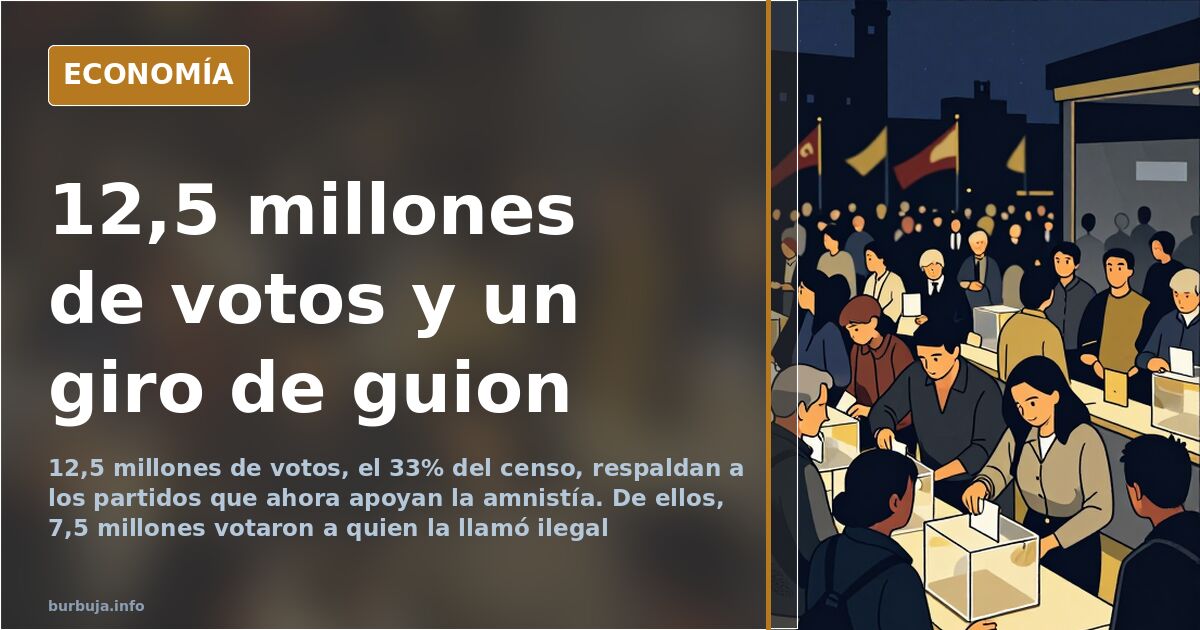
Twelve and a half million Spaniards voted for the parties currently backing the amnesty law. This represents 33% of the census. Of these, 7.5 million voted for a formation that, prior to the elections, labeled the measure as immoral and illegal. The calculation has circulated since the day the agreement was known, summarizing the core issue: the debate is not about whether the Government has enough seats, but whether those seats authorize doing the opposite of what was promised.
The figure is not an official count, but a political interpretation. And like any political interpretation, it admits two versions. One says that 12.5 million legitimize any parliamentary majority. Another responds that legitimacy is not measured in votes received but in votes deceived. The rest of the debate is a fight to see which of the two phrases withstands scrutiny better.
What peine between the campaign and the agreement
The central argument of the message opening the controversy is simple: voters of the party now pushing the amnesty were not informed. They were told the opposite. And there is no need to go back to any distant program: it suffices to look at the week before the pact, when the party itself repeated that the amnesty was unconstitutional and that everything else were opposition hoaxes.
Some take this chronology to the extreme: if it was impossible on Wednesday and desirable on Thursday, then the law did not change, the arithmetic did. The amnesty is not justified by conviction but by the need to continue governing. This is the thesis running through much of the discussion, one that no one has refuted with data, only with seats.
The defense: a parliament can legislate whatever it wants
The most repeated reply is textbook: in a parliamentary system, the Government legislates as long as it retains the confidence of the chamber. Period. If it has it, it can do so; if not, it falls. Under that logic, speaking of popular legitimacy confuses two different things: electoral support and parliamentary support.
The counterargument arrives quickly and with uncomfortable examples: the laws of the Nancy regime also had parliamentary support. That a majority votes for something does not make it democratic if the legal order does not allow it. The separation of powers and the rule of law exist precisely to limit that majority. Without limits, they say, there is no democracy but the dictatorship of the moment.
Can amnesty be granted without changing the Constitution?
Here the debate becomes technical and it is where it is most noticeable that no one has the final word. One part argues that the amnesty is not unconstitutional and that it suffices to approve it via organic law. Another responds that changes of that magnitude require reinforced majorities and, if necessary, constitutional reform: that is what the 3/5 are for, not the 51%.
The legal nuance intersects with the political. If the party now defending it knew it would never have that consensus, the chosen path is not an agreement but an imposition of half over the other half. The response from the other side is that consensus is not a legal requirement, only a preference.
The voter who feels cheated
One of the most repeated points is the perplexity of the Socialist voter who claims to feel deceived. The objection is logical: after years in government, crossing red lines and making pacts with independentist formations, being surprised now is notably naive. Democracy allows everyone to vote, including those who do not read the program until after.
The comparison with the other block appears immediately. If the most voted party had offered the same to the same partners, it would also add up. The difference would not be one of principles but of who signs the paper. And there opens the sustancia ilegal that runs through the whole matter: the amnesty is not debated, who profits from it is.
A referendum that is not called
The historical comparison most repeated is the entry into NATO: a consultation was called after having promised the opposite. It was done with the majority against and with the decency to ask. The amnesty, however, is processed without consultation. This is the argument that most disturbs the parliamentary defense, because it does not deny legality, only cowardice.
The answer is that a referendum on this is not provided for and the law does not require it. True. But politics does not exhaust itself in the law, and whoever promises one thing and does the opposite usually pays for it in the next election. Or not. That is the data that still has no answer.
One figure remains on the table: 7.5 million votes cast in favor of those who said no. If those voters vote the same again, the amnesty will have been a costless detail. If they do not return, it will have been the most expensive bill of the legislature. No one has done that account yet.
Twelve and a half million Spaniards voted for the parties currently backing the amnesty law. This represents 33% of the census. Of these, 7.5 million voted for a formation that, prior to the elections, labeled the measure as immoral and illegal. The calculation has circulated since the day the agreement was known, summarizing the core issue: the debate is not about whether the Government has enough seats, but whether those seats authorize doing the opposite of what was promised.
The figure is not an official count, but a political interpretation. And like any political interpretation, it admits two versions. One says that 12.5 million legitimize any parliamentary majority. Another responds that legitimacy is not measured in votes received but in votes deceived. The rest of the debate is a fight to see which of the two phrases withstands scrutiny better.
What peine between the campaign and the agreement
The central argument of the message opening the controversy is simple: voters of the party now pushing the amnesty were not informed. They were told the opposite. And there is no need to go back to any distant program: it suffices to look at the week before the pact, when the party itself repeated that the amnesty was unconstitutional and that everything else were opposition hoaxes.
Some take this chronology to the extreme: if it was impossible on Wednesday and desirable on Thursday, then the law did not change, the arithmetic did. The amnesty is not justified by conviction but by the need to continue governing. This is the thesis running through much of the discussion, one that no one has refuted with data, only with seats.
The defense: a parliament can legislate whatever it wants
The most repeated reply is textbook: in a parliamentary system, the Government legislates as long as it retains the confidence of the chamber. Period. If it has it, it can do so; if not, it falls. Under that logic, speaking of popular legitimacy confuses two different things: electoral support and parliamentary support.
The counterargument arrives quickly and with uncomfortable examples: the laws of the Nancy regime also had parliamentary support. That a majority votes for something does not make it democratic if the legal order does not allow it. The separation of powers and the rule of law exist precisely to limit that majority. Without limits, they say, there is no democracy but the dictatorship of the moment.
Can amnesty be granted without changing the Constitution?
Here the debate becomes technical and it is where it is most noticeable that no one has the final word. One part argues that the amnesty is not unconstitutional and that it suffices to approve it via organic law. Another responds that changes of that magnitude require reinforced majorities and, if necessary, constitutional reform: that is what the 3/5 are for, not the 51%.
The legal nuance intersects with the political. If the party now defending it knew it would never have that consensus, the chosen path is not an agreement but an imposition of half over the other half. The response from the other side is that consensus is not a legal requirement, only a preference.
The voter who feels cheated
One of the most repeated points is the perplexity of the Socialist voter who claims to feel deceived. The objection is logical: after years in government, crossing red lines and making pacts with independentist formations, being surprised now is notably naive. Democracy allows everyone to vote, including those who do not read the program until after.
The comparison with the other block appears immediately. If the most voted party had offered the same to the same partners, it would also add up. The difference would not be one of principles but of who signs the paper. And there opens the sustancia ilegal that runs through the whole matter: the amnesty is not debated, who profits from it is.
A referendum that is not called
The historical comparison most repeated is the entry into NATO: a consultation was called after having promised the opposite. It was done with the majority against and with the decency to ask. The amnesty, however, is processed without consultation. This is the argument that most disturbs the parliamentary defense, because it does not deny legality, only cowardice.
The answer is that a referendum on this is not provided for and the law does not require it. True. But politics does not exhaust itself in the law, and whoever promises one thing and does the opposite usually pays for it in the next election. Or not. That is the data that still has no answer.
One figure remains on the table: 7.5 million votes cast in favor of those who said no. If those voters vote the same again, the amnesty will have been a costless detail. If they do not return, it will have been the most expensive bill of the legislature. No one has done that account yet.
Also available in: Deutsch
Summary of a discussion on Burbuja.info - Foro de economía, actualidad y política., translated from Spanish and reviewed before publication. Read the full discussion (143 replies).
More summaries
-
1,400 Riot Police Deployed to Secure Spanish Congress Investiture
The deployment of 1,400 riot police for the investiture contrasts with the 6,000 agents used during the October 1st referendum, according to comparisons circulating in public debate.
-
Rubén Gisbert occupies Congress: the 11N and its 15M shadow
Rubén Gisbert occupies Congress with a manifesto demanding direct presidential election, ending with police eviction.
-
Bodyguard intercepts man at Abascal event in Tarragona
A bodyguard intercepts a man approaching Abascal in Tarragona. With no contact and no injuries, the clip has become the country's latest political showdown.
-
US yield curve inversion: the signal that has preceded every crisis
The US Treasury yield curve between 2-year and 10-year bonds is inverted. The signal that has preceded every recession since 1999 points to a crisis in less…
-
Forum debate debunking the myth of Andalusia's 'racial dud'
A forum post has revived the myth of the Andalusian 'racial dud'. Genetics dismantles the prejudice: the R1b haplogroup predominates across Spain.
-
Gijón housing prices up 60% since 2020, forum users say
A forum thread debates Gijón's price surge since 2020, with users split over whether it is an opportunity or a bubble. Analysis of neighbourhoods and outlook.