
Spain's AEMET misses again and mass alerts are losing credibility
The alert sounds, the sky threatens, and only a few drops fall: alert fatigue is eroding the credibility of Spain's weather agency AEMET and its mass alert system.
English · Original discussion in Spanish · Published
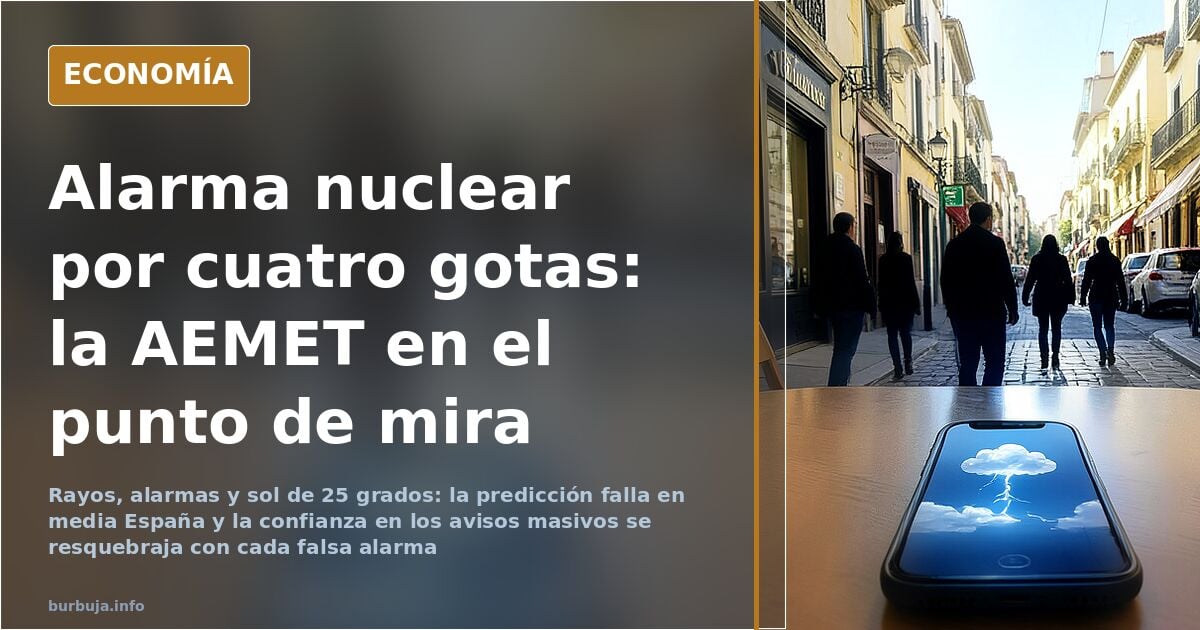
Spain's AEMET misses again and mass alerts are losing credibility
The scene repeats itself across half of Spain: the nuclear-style alarm goes off on your phone, the sky threatens a storm, and two hours later what falls is a light drizzle and blazing sunshine. Andalusia proge up to lightning, thunder and warnings; Barcelona proge up to 25 degrees and a DANA (a high-altitude isolated depression) that, according to forecasts, was supposed to resemble the one in Paiporta and ended up as a footnote. The result is an embarrassing spectacle: the alert arrives, the danger does not, and the system's credibility bleeds out a little more with every message that interrupts the siesta.
The pattern has become so predictable that some now use it as a reverse thermometer. If they warn you, nothing will happen. The alert has become a guarantee of calm, and in a country that still remembers what peine in Valencia, that is a serious problem.
Why AEMET gets it wrong even when it's wrong
The technical argument exists and it is sound: a DANA is unpredictable, mathematical models depend on the region, and a model calibrated for Andalusia is useless in Miami. In the medium term, adjustments are constant. But that margin of error, which should inspire caution, has become an alibi. A month without getting one right in the Sierra de Guadarrama, warnings activated when the water is already running down the gully, and alerts arriving at 16:00 when the risk began at 14:00. The question is no longer whether the model fails, but how many times it can fail before nobody looks at their phone.
Some point to a telling detail: the sea surface remains four degrees above average, the cold air in the upper layers has not yet reached the Mediterranean, and the front had barely entered Madrid. In other words, the forecast may have been reasonable, but the alarm was premature. The difference between warning and alarming is the same as between informing and covering your back.
Alert fatigue: when the alarm becomes background noise
The phenomenon has a name in meteorology: alert fatigue. If every episode of rain triggers the mass message, people learn to ignore it. And that learning is dangerous. In the province of Barcelona the alert arrived after 16:00; in the city of Valencia, between 14:00 and 15:00. In Mallorca it sounded for the first time that afternoon. More and more alerts, less and less attention.
The strategy of lowering the thresholds has a hidden cost. A park that closes with a yellow wind alert —from 30 km/h, according to the circulating reference— spends more time closed than open between now and May. Normality has become an alert, and mild danger has become «take shelter at home». When real risk arrives, the message no longer finds anyone listening.
The baffling calculation: 770 litres and the DANA precedent
The Arome model, the one that correctly predicted what would fall during the DANA, projected around 770 litres in the area between Cullera and Ontinyent. Handled with rigour, that figure justifies any precaution in the Valencian Community. The problem is not warning about that; the problem is warning about everything else in the same tone. The alert that saves lives and the one that interrupts a meal are announced the same way, and people cannot tell one from the other.
There lies the trap: whoever gets the big ones right loses credibility with the small ones. And in a system where the alert is the only tool, losing credibility means losing the entire system.
Who takes responsibility when the alert fails?
Nobody. That is the uncomfortable answer. The alert works as a political shield: if it is sent, responsibility is covered even if it doesn't rain; if it is not sent and disaster strikes, the reproach is enormous. The incentive is skewed and pushes towards over-warning. Send the alarm and go to sleep, the mechanism sums up with a smirk.
Meanwhile, the underlying debate —infrastructure, drainage, prevention— remains unresolved. The alert covers the hole instead of pointing at it. And people, who are not fools, notice.
The question is no longer whether AEMET gets it right. It is how many more alarms it will take for nobody to listen when it really matters.
Also available in: Deutsch
Summary of a discussion on Burbuja.info - Foro de economía, actualidad y política., translated from Spanish and reviewed before publication. Read the full discussion (103 replies).
More summaries
-
Valencia's DANA overwhelms the economy of Ribera and l'Horta
The Poyo rambla reached 1,686 m³/s at 6:20 PM, but the mobile alert sounded at 8:00 PM: DANA overwhelms Valencian economy and official narrative.
-
EU Parliament Query Claims AEMET Staff Admitted Weather Manipulation
An EU parliamentary question alleges four Spanish meteorologists admitted to manipulating DANA storms, but the Commission finds no evidence.
-
Forum debate on migrant presence in Spain's Guadarrama range
A forum thread discusses demographic shifts in the Guadarrama mountains and Spanish towns, featuring testimonials and political criticism.
-
Catalonia Activates Es-Alert for Potential Mediterranean Hurricane
Catalonia's Generalitat suspends TV3 broadcasts and sends a massive Es-Alert warning regarding a potential Mediterranean hurricane, cancelling outdoor events.
-
Sánchez takes five days to decide whether to call early elections
Spain's prime minister has given himself five days to decide whether to call an early general election, with Monday set as the key date for an announcement.
-
Sol protest camp mobilizes against fascism it never names
On Saturday 3 October Madrid hosts two rival events: the antifascist camp at Puerta del Sol and a rally at Alcalá 21 under the banner of decent housing.