
Spain's 74% Pension Gap Fuels Generational War Over System Sustainability
Pensioners receive 74% more than they contributed, citing the Bank of Spain. The debate on the sustainability of the Spanish pension system intensifies.
English · Original discussion in Spanish · Published
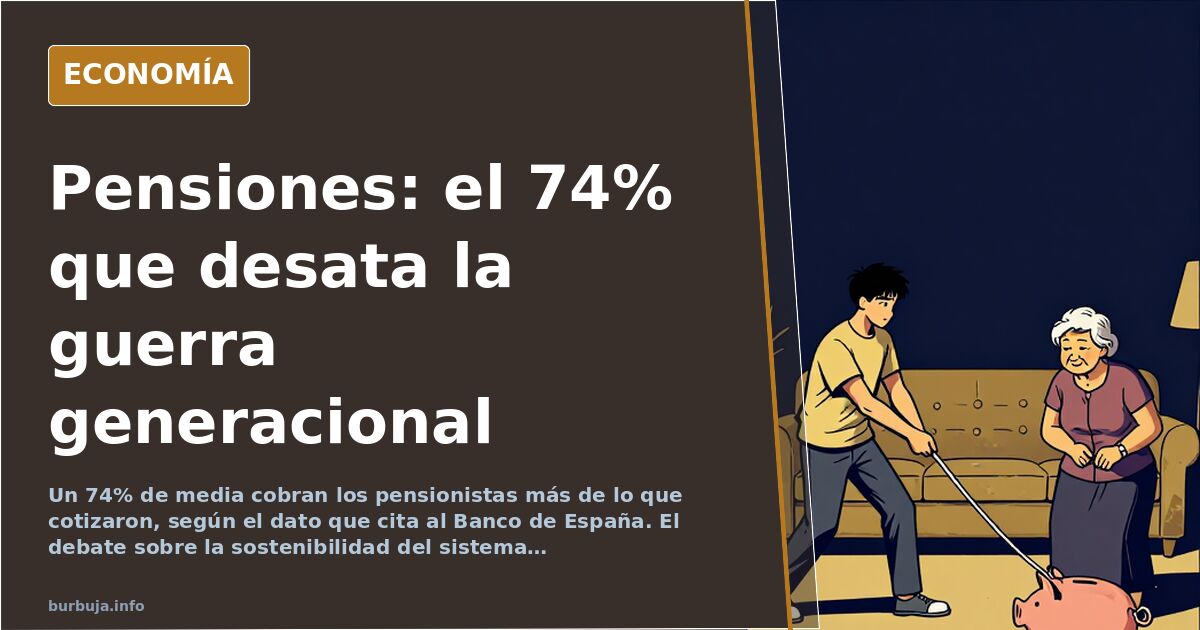
The 74% gap between what pensioners receive and what they contributed
How much more does a pensioner receive compared to what they contributed during their working life? The figure is stark: an average of 74%, according to the Bank of Spain. This number has sparked a political battle not about arithmetic, but about who pays the bill. Another key figure is that nearly one in every two euros spent by the State goes to the pension system. A label that inflames passions: Ponzi scheme.
Is the pension system a Ponzi scheme?
One school of thought argues that the pay-as-you-go system —where active workers' contributions fund current retirees' pensions— only works if the base of contributors is wide enough. If this base narrows, the scheme resembles a pyramid where latecomers support early entrants without guarantee of receiving their turn. Proponents of this view stress that the problem has been known for decades and ignored.
The opposing side argues that calling the mechanism that will pay your own pension a scam confuses the messenger with the problem. Pensioners did not design the rules: governments enacted them, and budgets sustain them. They add a subtle warning: those aged thirty or forty today will also want a pension tomorrow. The debate, they say, is not between young and old, but between those proposing a credible plan and those asking others to tighten their belts.
The inverted pyramid and 30% of retirees
The most repeated argument is demographic. With projections showing that around 30% of the population will be retired, receiving pensions similar to a normal salary, the math does not add up. Some summarize it harshly: sustaining this scheme with an inverted population pyramid is mathematically impossible, and those who deny it simply cannot read a chart.
Hovering over all this is a generational suspicion. Those under fifty see their contributions as a party they will not enjoy: they pay today's pensions knowing their turn will come with a bankrupt system or, at best, a reduced benefit. This antiestéticar is compounded by housing concerns: those who are not homeowners will have to keep renting until the end.
Cutting ministries and dismissing 1.5 million civil servants
In response to the diagnosis, proposals emerge. One developed plan suggests reducing the State apparatus to its bare minimum: keeping only Health, Education, Defense, Foreign Affairs, Interior, Justice, and Social Security, dismissing 1.5 million public employees, and auditing every cent before touching a single pension. Only then, if money remains, could a transition to a private savings model occur. If no money remains, cuts would eventually reach benefits too.
The counterpoint comes as an uncomfortable calculation: dismantling a specific ministry with a budget around 500 million euros would pay for exactly one day of pensions. The demagoguery of easy cuts is debunked by division. The alternative diagnosis points elsewhere: Spain has less a spending problem than a waste problem, with clientelist networks, million-dollar advisors, and redundancies that consume the budget before pensions are even mentioned.
From pesetas to CPI: why the 74% calculation is disputed
Another line of friction is historical. Many current pensioners contributed in pesetas, worked off-the-books, accessed early retirements funded by everyone, and in some cases, needed only a few years of contributions before retiring. With these rules, comparing what was contributed to what is received becomes a puzzle.
The reply is that the system is not a piggy bank: what was contributed fifty years ago paid for pensions from fifty years ago, not today's. Inflation has devalued everyone's savings. Some go further, noting that non-contributory benefits, widows', orphans', and disability pensions should come from the Budget, not the contributory system, because mixing them spikes spending in something that should be controlled.
Who supports private savings as the solution
Among the most repeated proposals is the desire to exit the public system and manage one's own money. The complaint is that this option does not exist and that mandatory contributions are, in their view, an expropriation. The majority response is that the system is not a crime, but the instrument that will pay future pensions, and the problem is political, not a lawsuit against grandparents.
An economist called to comment on television summarized it without nuance: the system is absolutely unsustainable. The presenter, according to the described scene, looked surprised. Being surprised is an achievement: the warning has been on the table for decades.
With these pieces, a state pact distributing adjustments between current and future pensioners would be reasonable. What exists is a trench where each side expects the other to crash first.
How much more does a pensioner receive compared to what they contributed during their working life? The figure is stark: an average of 74%, according to the Bank of Spain. This number has sparked a political battle not about arithmetic, but about who pays the bill. Another key figure is that nearly one in every two euros spent by the State goes to the pension system. A label that inflames passions: Ponzi scheme.
Is the pension system a Ponzi scheme?
One school of thought argues that the pay-as-you-go system —where active workers' contributions fund current retirees' pensions— only works if the base of contributors is wide enough. If this base narrows, the scheme resembles a pyramid where latecomers support early entrants without guarantee of receiving their turn. Proponents of this view stress that the problem has been known for decades and ignored.
The opposing side argues that calling the mechanism that will pay your own pension a scam confuses the messenger with the problem. Pensioners did not design the rules: governments enacted them, and budgets sustain them. They add a subtle warning: those aged thirty or forty today will also want a pension tomorrow. The debate, they say, is not between young and old, but between those proposing a credible plan and those asking others to tighten their belts.
The inverted pyramid and 30% of retirees
The most repeated argument is demographic. With projections showing that around 30% of the population will be retired, receiving pensions similar to a normal salary, the math does not add up. Some summarize it harshly: sustaining this scheme with an inverted population pyramid is mathematically impossible, and those who deny it simply cannot read a chart.
Hovering over all this is a generational suspicion. Those under fifty see their contributions as a party they will not enjoy: they pay today's pensions knowing their turn will come with a bankrupt system or, at best, a reduced benefit. This antiestéticar is compounded by housing concerns: those who are not homeowners will have to keep renting until the end.
Cutting ministries and dismissing 1.5 million civil servants
In response to the diagnosis, proposals emerge. One developed plan suggests reducing the State apparatus to its bare minimum: keeping only Health, Education, Defense, Foreign Affairs, Interior, Justice, and Social Security, dismissing 1.5 million public employees, and auditing every cent before touching a single pension. Only then, if money remains, could a transition to a private savings model occur. If no money remains, cuts would eventually reach benefits too.
The counterpoint comes as an uncomfortable calculation: dismantling a specific ministry with a budget around 500 million euros would pay for exactly one day of pensions. The demagoguery of easy cuts is debunked by division. The alternative diagnosis points elsewhere: Spain has less a spending problem than a waste problem, with clientelist networks, million-dollar advisors, and redundancies that consume the budget before pensions are even mentioned.
From pesetas to CPI: why the 74% calculation is disputed
Another line of friction is historical. Many current pensioners contributed in pesetas, worked off-the-books, accessed early retirements funded by everyone, and in some cases, needed only a few years of contributions before retiring. With these rules, comparing what was contributed to what is received becomes a puzzle.
The reply is that the system is not a piggy bank: what was contributed fifty years ago paid for pensions from fifty years ago, not today's. Inflation has devalued everyone's savings. Some go further, noting that non-contributory benefits, widows', orphans', and disability pensions should come from the Budget, not the contributory system, because mixing them spikes spending in something that should be controlled.
Who supports private savings as the solution
Among the most repeated proposals is the desire to exit the public system and manage one's own money. The complaint is that this option does not exist and that mandatory contributions are, in their view, an expropriation. The majority response is that the system is not a crime, but the instrument that will pay future pensions, and the problem is political, not a lawsuit against grandparents.
An economist called to comment on television summarized it without nuance: the system is absolutely unsustainable. The presenter, according to the described scene, looked surprised. Being surprised is an achievement: the warning has been on the table for decades.
With these pieces, a state pact distributing adjustments between current and future pensioners would be reasonable. What exists is a trench where each side expects the other to crash first.
Also available in: Deutsch
Summary of a discussion on Burbuja.info - Foro de economía, actualidad y política., translated from Spanish and reviewed before publication. Read the full discussion (323 replies).
More summaries
-
Machines paying into Social Security: what's being proposed
A forum user puts gross operating surplus at 8%: the proposal for machines to contribute divides between redistribution and capital flight
-
Burgos Man Loses Pension After 27 Years of Contributions
A Burgos resident loses his pension despite 27 years of contributions, exposing a bureaucratic trap in Spain's Social Security system.
-
SpaceX Doubles to $213, Then Plunges 38%: Bubble or Strategy?
SpaceX stock hit $213 in its debut, then fell 38% in three weeks. This analysis examines whether the volatility signals a financial bubble or a calculated strategic move by Elon Musk.
-
Spain's Parasite Debate: Cultural Shock or Marketing?
Analysis of the debate on deworming in Spain: is it a cultural clash, a public health need, or just marketing?
-
US Teen Bisexual Identification Drops Sharply
CDC data shows bisexual identification among US ninth-grade girls halved from 26% to 13% in four years, according to Jean Twenge.
-
Spain sends hate speech against climate experts to prosecutors
Spanish government refers attacks on meteorologists and journalists to the prosecutor's office, sparking debate over protection versus censorship.