
Spain's 29N election timing sparks 'Maricarmen' conspiracy theories
An 87-year-old woman dies after eviction, coinciding with Spain's Nov 29 general election call, fueling conspiracy claims of a political 'setup'.
English · Original discussion in Spanish · Published
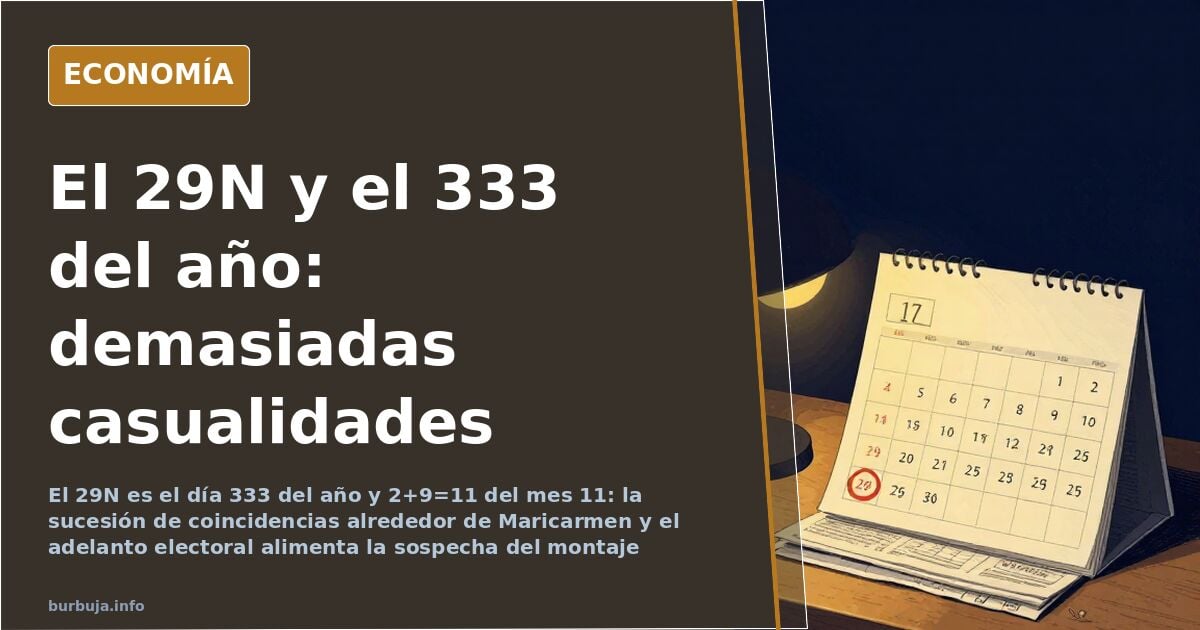
The 'Maricarmen' setup: the suspicion that won't fade
An 87-year-old woman, evicted in September, died weeks later in the hospital. The Government called general elections for Nov 29. And within hours, half of Spain asked whether chance exists or if someone pulled the strings. The coincidence is too perfect: two decrees voted when none are usually voted, a hospitalization arriving just as the eviction becomes a national cause, encampments, a general strike after fourteen years, and hours of news broadcasts looping the same story. The result: an electoral campaign many already call the most abysmal in recent history.
Why is a 'Maricarmen' setup suspected?
The sequence doesn't add up. That is the argument repeated most strongly. The woman leaves the public spotlight, enters the hospital, and her condition remains in almost hermetic informational silence. When she dies, the electoral calendar is already underway. Some claim the Executive had first-hand information about her health and that the Nov 29 announcement sought to capitalize on the eviction before the case cooled. Against this weighs an awkward detail: accurately predicting the death date of a terminally ill patient is an exercise in divination, not strategy. The suspicion, however, does not need proof to take root. It only needs everything to fit too perfectly.
Nov 29 and the 333: the coincidences fueling the theory
The chosen day for the polls has provided material for conspiracy theorists. November 29 is the 333rd day of the year. Two plus nine equals eleven. Month eleven. Some see in that sum a signal, a coded message, a choreography. There is no evidence such a design exists, but the accumulation of coincidences—the number, the date, the context—acts as gasoline for a distrust that has long been brewing. The question is not whether the Government is capable of mounting something like this. The question is how many people are willing to believe it without asking for a single piece of data.
From eviction to general strike: the all-encompassing narrative
The Maricarmen case does not arrive alone. It arrives with encampments, a general strike unseen for fourteen years, two decrees voted in Congress when the norm is not to vote them, and an international echo including protests at the University of Nantes shouting "Revolution!" Everything adds up. Everything points to a social engineering operation designed to mobilize an electorate that, otherwise, would stay home. The question hovering is whether we are facing a Government improvising on the fly or something much colder and calculated.
The shadow of the 'evil think tank' and hybrid warfare
A theory gaining adherents exists: the presence of a hard core within the PSOE, a laboratory of psychological operations with contacts in unions, media, and activism, that cooks cases like Maricarmen's for months and launches them when the calendar allows. The most extreme version speaks of human sacrifices, of the elderly as collateral damage, of a plan that stops at nothing. There is not a single piece of evidence supporting this accusation. But distrust of the official narrative is no longer measured in seats: it is measured by the certainty that nothing happening is accidental.
The rental market: the other victim of the narrative
While the spotlight is on the elderly woman, the data continues its course. The rental market in Bizkaia has plummeted 30%. The Housing Law reduced supply since 2023, prices are soaring, and new anti-eviction regulations are already showing their effect. The paradox is brutal: the case meant to highlight the housing problem coincides with regulatory tightening that drives supply out of the market. The question nobody fully answers is whether the media noise serves to obscure that the applied solution worsens the problem it claims to combat.
In the end, the doubt is not whether the setup exists. The doubt is how many people need to believe it exists for the narrative to sustain itself. And that, in politics, is worth more than any proof.
An 87-year-old woman, evicted in September, died weeks later in the hospital. The Government called general elections for Nov 29. And within hours, half of Spain asked whether chance exists or if someone pulled the strings. The coincidence is too perfect: two decrees voted when none are usually voted, a hospitalization arriving just as the eviction becomes a national cause, encampments, a general strike after fourteen years, and hours of news broadcasts looping the same story. The result: an electoral campaign many already call the most abysmal in recent history.
Why is a 'Maricarmen' setup suspected?
The sequence doesn't add up. That is the argument repeated most strongly. The woman leaves the public spotlight, enters the hospital, and her condition remains in almost hermetic informational silence. When she dies, the electoral calendar is already underway. Some claim the Executive had first-hand information about her health and that the Nov 29 announcement sought to capitalize on the eviction before the case cooled. Against this weighs an awkward detail: accurately predicting the death date of a terminally ill patient is an exercise in divination, not strategy. The suspicion, however, does not need proof to take root. It only needs everything to fit too perfectly.
Nov 29 and the 333: the coincidences fueling the theory
The chosen day for the polls has provided material for conspiracy theorists. November 29 is the 333rd day of the year. Two plus nine equals eleven. Month eleven. Some see in that sum a signal, a coded message, a choreography. There is no evidence such a design exists, but the accumulation of coincidences—the number, the date, the context—acts as gasoline for a distrust that has long been brewing. The question is not whether the Government is capable of mounting something like this. The question is how many people are willing to believe it without asking for a single piece of data.
From eviction to general strike: the all-encompassing narrative
The Maricarmen case does not arrive alone. It arrives with encampments, a general strike unseen for fourteen years, two decrees voted in Congress when the norm is not to vote them, and an international echo including protests at the University of Nantes shouting "Revolution!" Everything adds up. Everything points to a social engineering operation designed to mobilize an electorate that, otherwise, would stay home. The question hovering is whether we are facing a Government improvising on the fly or something much colder and calculated.
The shadow of the 'evil think tank' and hybrid warfare
A theory gaining adherents exists: the presence of a hard core within the PSOE, a laboratory of psychological operations with contacts in unions, media, and activism, that cooks cases like Maricarmen's for months and launches them when the calendar allows. The most extreme version speaks of human sacrifices, of the elderly as collateral damage, of a plan that stops at nothing. There is not a single piece of evidence supporting this accusation. But distrust of the official narrative is no longer measured in seats: it is measured by the certainty that nothing happening is accidental.
The rental market: the other victim of the narrative
While the spotlight is on the elderly woman, the data continues its course. The rental market in Bizkaia has plummeted 30%. The Housing Law reduced supply since 2023, prices are soaring, and new anti-eviction regulations are already showing their effect. The paradox is brutal: the case meant to highlight the housing problem coincides with regulatory tightening that drives supply out of the market. The question nobody fully answers is whether the media noise serves to obscure that the applied solution worsens the problem it claims to combat.
In the end, the doubt is not whether the setup exists. The doubt is how many people need to believe it exists for the narrative to sustain itself. And that, in politics, is worth more than any proof.
Summary of a discussion on Burbuja.info - Foro de economía, actualidad y política., translated from Spanish and reviewed before publication. Read the full discussion (53 replies).
More summaries
-
Spain's PSOE Calls Elections After Death of Evicted 87-Year-Old
An evicted 87-year-old woman in Madrid dies days before Spain's general election. The political fallout raises questions about voter mobilization.
-
Maricarmen, symbol of Spain's housing crisis, dies at 87
Maricarmen, symbol of Spain's housing struggle, dies at 87. Her death sparks conspiracy theories and renews the debate on evictions.
-
86-Year-Old Woman Dies After Eviction, Sparking Viral Backlash in Spain
An 86-year-old woman dies following eviction in Spain. The case triggers viral outrage, accusations of murder, and conspiracy theories amid housing crisis debates.
-
Generational Disillusionment: From Economic Optimism to Pessimism in Spain
A forum debate reveals generational despair over Spain's economy. While some blame the 2007 crisis, others argue the current era is superior, highlighting a deep societal divide.
-
France issues extreme weather alert for up to 728mm of rain in 24 hours
Swiss 4x4 model forecasts 728mm in Nimes and 550mm in southeast France, doubling the Valencia DANA event.
-
Spain's housing crisis: population surge drives up prices
A decade brings over 10 million new residents while housing supply stagnates, creating a severe shortage that pushes rental and purchase costs higher across Spain.