
Generational Disillusionment: From Economic Optimism to Pessimism in Spain
A forum debate reveals generational despair over Spain's economy. While some blame the 2007 crisis, others argue the current era is superior, highlighting a deep societal divide.
English · Original discussion in Spanish · Published
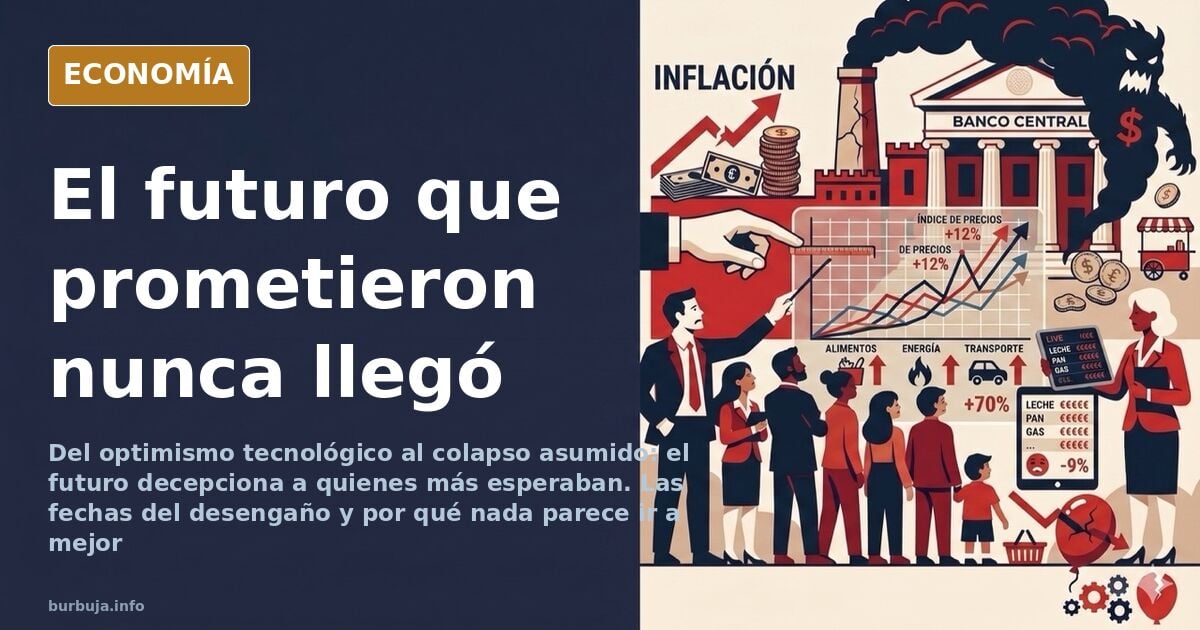
The promised future fails to arrive: a generation's disillusionment
There was a time when the future was a promise: flying cars, shining cities, and free men. Today, the conversation about the future has turned dark. A recent debate in an economics forum raised an uncomfortable question: has the future disappointed you? The majority answer, with nuances, is yes. Not just because what was promised hasn't arrived, but because of what has: surveillance, debt, and a sense of decay that many locate at a specific point in the calendar.
Pessimism is not new, but its intensity is. Some argue that decline began in 2007 and has become the permanent landscape. "Something strange started happening from 2007, and I felt the decay year after year, but never thought that decay from 2007-2017 would be eternal," summarizes a participant. The idea that history is not linear or pogre, but collapses, gains trinc. History is not pogre, said a friend, and the phrase, repeated, angered those present.
The generation that ate all the bad stuff
The generational cutoff is a key axis of disenchantment. Those born in 1996 are clear: "It has ruined my entire life to be born then, because I ate all the bad stuff." In contrast, those born in the 70s recall it was no paradise either. "I was born in 1970 and already had it quite bad: since school I realized this society reeked of rottenness from all sides," relates another. The industrial restructuring of the 80s, with shipyards at war and barricades of burning tires, was their particular baptism of decay.
The complaint is not only material. It is also about expectations. "They promised us that the future would be flying cars, shining cities, and free men, and we discovered they had only invented better ways to monitor us, indebted us, and keep us occupied," summarizes an intervention. The phrase condenses the feeling of being scammed. It is not that pogre has stopped; it is that it has taken a different direction than promised.
The debt ponzi scheme and low birth rates
The most cited economic explanation relates to demographics and debt. "It is a ponzi scheme based on debt; for this, there must be more people entering the system than those benefiting from it, and with the low birth rates of first-world inhabitants, it does not suffice," argues a participant. Immigration, he adds, would not have solved the problem: "those who came did not contribute to the ponzi scheme, but extracted from it, which is why it is falling faster than expected." It is a debatable thesis, but it illustrates the climate: the economy is perceived as a crumbling pyramid.
Others focus on housing and mortgage debt. "A future where you live by mortgaging those who come, it will not go better, but worse in any case, because those arriving already have behind them a debt they have not enjoyed and will never enjoy." The conclusion is bitter: the future has become a mortgage that others will pay.
Why do the young see the future as darker?
The generational gap is not just about experience, but position in the queue. Those who already have some patrimony, even if modest, have seen it revalue. "The best era of history having money for all services and goods accessible instantly. Also full of opportunities for some: the explosion of real assets and monetary degradation caused a significant part of society to move up a class (even to the point of not having to work) just by having a few old apartments in a big city," notes an analysis. The conclusion is uncomfortable: it depends on which side of the changes you were caught.
In contrast, the young feel they arrived late to everything. "Most of you here are lucky old people; I was born in 1996 and it has ruined my entire life to be born then, because I ate all the bad stuff." Another participant's reply does not help: "I'm sorry for you. Truly. I have nothing to do with my generation or the previous one. I am an outcast." Intergenerational solidarity is conspicuously absent.
Presentism as refuge and the technological utopia that fails to arrive
Not everyone shares the pessimism. Some live in the present and enjoy it: "Not me, I'm ing more than ever, and day-after-days I wouldn't have imagined in my ing life." Others, more mystical, announce a sort of singularity: "We are about to live the birth of a form of consciousness superior to man that will be like a kind of God on earth." Faith in technology as salvation remains alive, though minority.
Irony also has its space. "There are no flying cars or cure for baldness, instead we have know-it-all AIs and a ton of scandals from every shade of the pantone," summarizes a participant. The phrase, with its mix of humor and resignation, captures the general tone. The future is no longer what it used to be, said Paul Valéry, and no one disputes it here.
The temptation of the mountain estate
Given the panorama, recipes vary. Some opt for disconnection: "I recommend you position yourselves well to watch the show; perhaps a remote farm in a mountain is the best option." Others seek culprits: "That's what happens when you are governed by Satanists who want you dead and tortured, but you keep voting for them every two years." The conspiracy theory, though minority, appears.
The underlying question remains unanswered. Is the future disappointing, or have we changed? "The future cannot disappoint you. In any case, the present," sentences a participant. He may be right. Or perhaps the problem is that the present has become so gray that there is no future left to disappoint.
There was a time when the future was a promise: flying cars, shining cities, and free men. Today, the conversation about the future has turned dark. A recent debate in an economics forum raised an uncomfortable question: has the future disappointed you? The majority answer, with nuances, is yes. Not just because what was promised hasn't arrived, but because of what has: surveillance, debt, and a sense of decay that many locate at a specific point in the calendar.
Pessimism is not new, but its intensity is. Some argue that decline began in 2007 and has become the permanent landscape. "Something strange started happening from 2007, and I felt the decay year after year, but never thought that decay from 2007-2017 would be eternal," summarizes a participant. The idea that history is not linear or pogre, but collapses, gains trinc. History is not pogre, said a friend, and the phrase, repeated, angered those present.
The generation that ate all the bad stuff
The generational cutoff is a key axis of disenchantment. Those born in 1996 are clear: "It has ruined my entire life to be born then, because I ate all the bad stuff." In contrast, those born in the 70s recall it was no paradise either. "I was born in 1970 and already had it quite bad: since school I realized this society reeked of rottenness from all sides," relates another. The industrial restructuring of the 80s, with shipyards at war and barricades of burning tires, was their particular baptism of decay.
The complaint is not only material. It is also about expectations. "They promised us that the future would be flying cars, shining cities, and free men, and we discovered they had only invented better ways to monitor us, indebted us, and keep us occupied," summarizes an intervention. The phrase condenses the feeling of being scammed. It is not that pogre has stopped; it is that it has taken a different direction than promised.
The debt ponzi scheme and low birth rates
The most cited economic explanation relates to demographics and debt. "It is a ponzi scheme based on debt; for this, there must be more people entering the system than those benefiting from it, and with the low birth rates of first-world inhabitants, it does not suffice," argues a participant. Immigration, he adds, would not have solved the problem: "those who came did not contribute to the ponzi scheme, but extracted from it, which is why it is falling faster than expected." It is a debatable thesis, but it illustrates the climate: the economy is perceived as a crumbling pyramid.
Others focus on housing and mortgage debt. "A future where you live by mortgaging those who come, it will not go better, but worse in any case, because those arriving already have behind them a debt they have not enjoyed and will never enjoy." The conclusion is bitter: the future has become a mortgage that others will pay.
Why do the young see the future as darker?
The generational gap is not just about experience, but position in the queue. Those who already have some patrimony, even if modest, have seen it revalue. "The best era of history having money for all services and goods accessible instantly. Also full of opportunities for some: the explosion of real assets and monetary degradation caused a significant part of society to move up a class (even to the point of not having to work) just by having a few old apartments in a big city," notes an analysis. The conclusion is uncomfortable: it depends on which side of the changes you were caught.
In contrast, the young feel they arrived late to everything. "Most of you here are lucky old people; I was born in 1996 and it has ruined my entire life to be born then, because I ate all the bad stuff." Another participant's reply does not help: "I'm sorry for you. Truly. I have nothing to do with my generation or the previous one. I am an outcast." Intergenerational solidarity is conspicuously absent.
Presentism as refuge and the technological utopia that fails to arrive
Not everyone shares the pessimism. Some live in the present and enjoy it: "Not me, I'm ing more than ever, and day-after-days I wouldn't have imagined in my ing life." Others, more mystical, announce a sort of singularity: "We are about to live the birth of a form of consciousness superior to man that will be like a kind of God on earth." Faith in technology as salvation remains alive, though minority.
Irony also has its space. "There are no flying cars or cure for baldness, instead we have know-it-all AIs and a ton of scandals from every shade of the pantone," summarizes a participant. The phrase, with its mix of humor and resignation, captures the general tone. The future is no longer what it used to be, said Paul Valéry, and no one disputes it here.
The temptation of the mountain estate
Given the panorama, recipes vary. Some opt for disconnection: "I recommend you position yourselves well to watch the show; perhaps a remote farm in a mountain is the best option." Others seek culprits: "That's what happens when you are governed by Satanists who want you dead and tortured, but you keep voting for them every two years." The conspiracy theory, though minority, appears.
The underlying question remains unanswered. Is the future disappointing, or have we changed? "The future cannot disappoint you. In any case, the present," sentences a participant. He may be right. Or perhaps the problem is that the present has become so gray that there is no future left to disappoint.
Summary of a discussion on Burbuja.info - Foro de economía, actualidad y política., translated from Spanish and reviewed before publication. Read the full discussion (98 replies).
More summaries
-
Immigration and birth rate: the battle for Spain's future
Spain's birth rate of 1.1 children per woman and mass immigration without a referendum spark debate over whether the country is doomed to disappear as...
-
Spain's IMV to top €1,600 in 2027: how it compares to working
Spain's IMV to top €1,600 for the first time in 2027, reaching over 893,000 households: how it compares to a job
-
Tourists sleep on Barcelona beach to avoid hotel costs
Young Europeans sleep on the sand in Barcelona to avoid paying 100 euros for a hotel night. Mass tourism hits its limit.
-
The trap of common-law marriage: unemployed and won't leave the flat
Two years of living together equates a common-law couple to marriage: he owns the flat, she doesn't work and won't leave. The 016 hotline complicates everything.
-
Retirement at 73: The Proposal Stirring the Pension Debate
A report proposes raising the retirement age to 73 to save pensions. Alternatives clash: immigration, spending cuts, or a model change…
-
Cantabria's High Season Measured by Complaints About Madrid Tourists
A waitress in Santander complains about the attitudes of tourists from Madrid: constant comparisons, complaints, and lack of tips. The debate over domestic tourism…