
Maricarmen, symbol of Spain's housing crisis, dies at 87
Maricarmen, symbol of Spain's housing struggle, dies at 87. Her death sparks conspiracy theories and renews the debate on evictions.
English · Original discussion in Spanish · Published
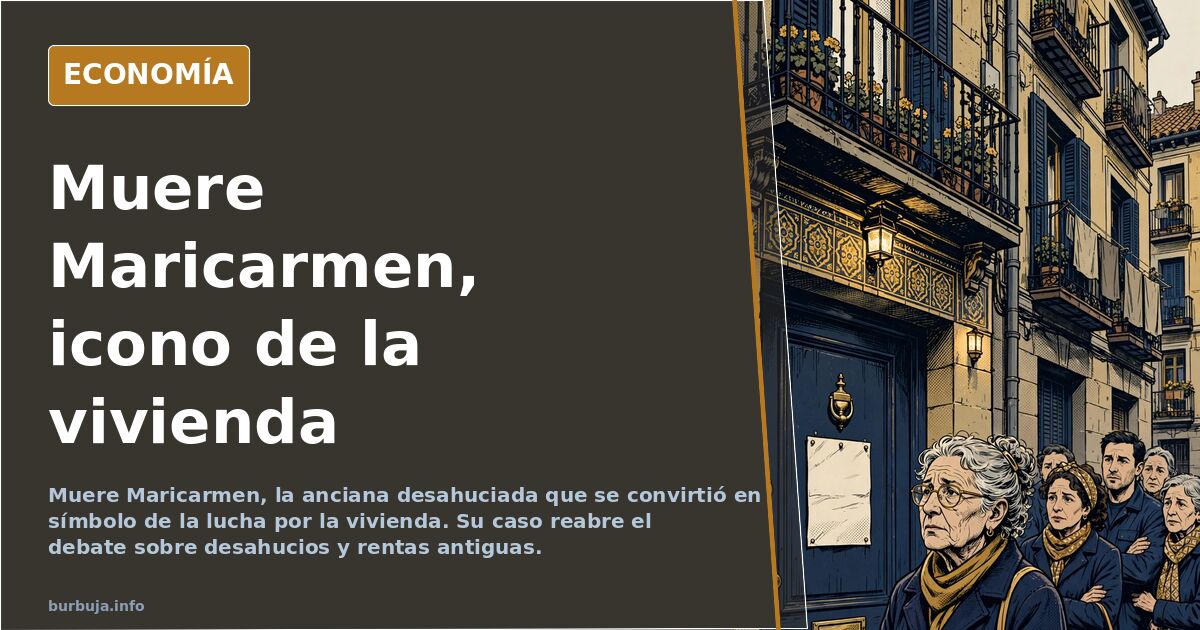
Maricarmen, the woman who put a face to the housing crisis, dies at 87
Maricarmen, the woman who became a symbol of the fight for the right to housing after being evicted, has died at 87, according to Lasensla. Her death, occurring just weeks after her case hit the media, has triggered a wave of reactions ranging from institutional tributes to the most bizarre conspiracy theories. According to messages circulated on social media, the PSOE has suspended campaign events to observe mourning, while the opposition accuses the Government of using her figure for electoral gain.
The news, advanced by Lasensla and widely disseminated online, has provoked a flood of messages in economic forums where condolences mix with mockery, social denunciation with disinformation. The figure of Maricarmen, a pensioner who lost her home due to non-payment, has become a political weapon during the pre-campaign period. Her death, described by some as "timely" for the Government's interests, has been received by others as a blow to the cause of evicted tenants.
The Maricarmen case: from eviction to political symbol
Maricarmen, 87, was evicted from her home after accumulating debt. Her case went viral when a group of housing activists made her the face of the fight against evictions. The woman, who had lived in the Retiro neighborhood for decades, refused to leave her home and staged tense scenes with the police. She was eventually rehoused in a residential facility, where she has died.
The official version points to a natural death from undisclosed causes. However, the coincidence with the election campaign and the dissemination of her case by media outlets close to the Government have fueled all sorts of speculation. Those close to Maricarmen have alleged media and political pressure, while the Executive insists that her figure represents "the fight for decent housing."
Institutional and political reactions
Prime Minister Pedro Sánchez expressed his condolences on social media: "All my love to the family and loved ones of Maricarmen. A hug also to all who feel this loss as their own." The Minister of Housing, for her part, suspended a campaign event to attend the Town Hall square to "grieve for Maricarmen," according to Las Provincias. These displays of mourning have been interpreted by the opposition as an attempt to capitalize politically on the death.
In Congress, the PP has demanded explanations about the woman's rehousing and asked that her figure not be used to "cover up housing policy failures." Vox, for its part, announced it does not plan to "enter the media circus" built around the deceased. Meanwhile, on social media, Maricarmen's name has become a trending topic, with messages ranging from tribute to the cruelest mockery.
Conspiracy theories and rumors surrounding her death
Maricarmen's death has been received in certain forums with theories bordering on the delirious. It has been claimed that she was "taken out" to be made a martyr, that her death is a "psyop," or that it responds to a "curse" affecting the Government's enemies. These baseless claims have been repeated ad nauseam on platforms like Burbuja.info, where it is speculated that her death benefits the PSOE electorally.
Some messages even suggested her death was induced to prevent her from revealing compromising information, or that it is a "false flag" to mobilize the left-wing electorate. None of these theories have the slightest evidence. The autopsy, according to official sources, revealed no signs of violence, and the family has requested respect during this time of grief.
Impact on the housing debate
Beyond conspiracy theories, Maricarmen's death has reignited the debate on Spain's housing crisis. Her case is an extreme example of a structural problem: the rise in evictions, the lack of public housing, and real estate speculation. According to data from the General Council of the Judiciary, in 2023 more than 20,000 evictions were executed, a figure that has continued to grow in recent years.
Maricarmen's figure has served to put a face to a reality affecting thousands of families. However, her political instrumentalization has generated growing rejection among those who believe that human drama is being used for partisan purposes. In this context, the question many ask is whether her death will serve to advance housing policies or if, conversely, it will remain just another episode in the electoral battle.
Who was Maricarmen and why did she become a symbol?
Maricarmen was an 87-year-old pensioner living in the Retiro neighborhood in Madrid. After becoming a widow, she accumulated debt with her homeowners' association, which led to her losing her home. Her case went viral when a group of activists supported her to prevent eviction. The woman refused to leave her home and staged tense scenes with the police. She was eventually rehoused in a residential facility, where she has died.
Her story resonated throughout the country because it symbolizes the struggle of many elderly people who, with low pensions, cannot afford housing costs. Maricarmen became the visible face of a problem affecting thousands of people in Spain.
What is known about the cause of her death?
Authorities have not made the autopsy details public, but sources close to the family indicated it was a natural death. There are no signs of violence or third-party intervention. The conspiracy theories circulating on social media lack any factual basis and have been debunked by the police.
How have the Government and opposition reacted?
The Government has decreed an official day of mourning and suspended campaign events. President Sánchez expressed his condolences on social media, while the Housing Minister attended the Town Hall square to show her grief. The opposition, for its part, has criticized what it considers a political use of the death. The PP has demanded explanations about the rehousing, and Vox announced it will not participate in what it calls the "media circus."
Maricarmen's death leaves a trail of mixed reactions and a question hanging in the air: will her figure help drive real change in housing policies, or will it all remain just another episode in the electoral fray? The coming days, with elections around the corner, will provide the answer. Meanwhile, her case remains a reminder that in Spain, having a home can become an unattainable luxury for many.
Maricarmen, the woman who became a symbol of the fight for the right to housing after being evicted, has died at 87, according to Lasensla. Her death, occurring just weeks after her case hit the media, has triggered a wave of reactions ranging from institutional tributes to the most bizarre conspiracy theories. According to messages circulated on social media, the PSOE has suspended campaign events to observe mourning, while the opposition accuses the Government of using her figure for electoral gain.
The news, advanced by Lasensla and widely disseminated online, has provoked a flood of messages in economic forums where condolences mix with mockery, social denunciation with disinformation. The figure of Maricarmen, a pensioner who lost her home due to non-payment, has become a political weapon during the pre-campaign period. Her death, described by some as "timely" for the Government's interests, has been received by others as a blow to the cause of evicted tenants.
The Maricarmen case: from eviction to political symbol
Maricarmen, 87, was evicted from her home after accumulating debt. Her case went viral when a group of housing activists made her the face of the fight against evictions. The woman, who had lived in the Retiro neighborhood for decades, refused to leave her home and staged tense scenes with the police. She was eventually rehoused in a residential facility, where she has died.
The official version points to a natural death from undisclosed causes. However, the coincidence with the election campaign and the dissemination of her case by media outlets close to the Government have fueled all sorts of speculation. Those close to Maricarmen have alleged media and political pressure, while the Executive insists that her figure represents "the fight for decent housing."
Institutional and political reactions
Prime Minister Pedro Sánchez expressed his condolences on social media: "All my love to the family and loved ones of Maricarmen. A hug also to all who feel this loss as their own." The Minister of Housing, for her part, suspended a campaign event to attend the Town Hall square to "grieve for Maricarmen," according to Las Provincias. These displays of mourning have been interpreted by the opposition as an attempt to capitalize politically on the death.
In Congress, the PP has demanded explanations about the woman's rehousing and asked that her figure not be used to "cover up housing policy failures." Vox, for its part, announced it does not plan to "enter the media circus" built around the deceased. Meanwhile, on social media, Maricarmen's name has become a trending topic, with messages ranging from tribute to the cruelest mockery.
Conspiracy theories and rumors surrounding her death
Maricarmen's death has been received in certain forums with theories bordering on the delirious. It has been claimed that she was "taken out" to be made a martyr, that her death is a "psyop," or that it responds to a "curse" affecting the Government's enemies. These baseless claims have been repeated ad nauseam on platforms like Burbuja.info, where it is speculated that her death benefits the PSOE electorally.
Some messages even suggested her death was induced to prevent her from revealing compromising information, or that it is a "false flag" to mobilize the left-wing electorate. None of these theories have the slightest evidence. The autopsy, according to official sources, revealed no signs of violence, and the family has requested respect during this time of grief.
Impact on the housing debate
Beyond conspiracy theories, Maricarmen's death has reignited the debate on Spain's housing crisis. Her case is an extreme example of a structural problem: the rise in evictions, the lack of public housing, and real estate speculation. According to data from the General Council of the Judiciary, in 2023 more than 20,000 evictions were executed, a figure that has continued to grow in recent years.
Maricarmen's figure has served to put a face to a reality affecting thousands of families. However, her political instrumentalization has generated growing rejection among those who believe that human drama is being used for partisan purposes. In this context, the question many ask is whether her death will serve to advance housing policies or if, conversely, it will remain just another episode in the electoral battle.
Who was Maricarmen and why did she become a symbol?
Maricarmen was an 87-year-old pensioner living in the Retiro neighborhood in Madrid. After becoming a widow, she accumulated debt with her homeowners' association, which led to her losing her home. Her case went viral when a group of activists supported her to prevent eviction. The woman refused to leave her home and staged tense scenes with the police. She was eventually rehoused in a residential facility, where she has died.
Her story resonated throughout the country because it symbolizes the struggle of many elderly people who, with low pensions, cannot afford housing costs. Maricarmen became the visible face of a problem affecting thousands of people in Spain.
What is known about the cause of her death?
Authorities have not made the autopsy details public, but sources close to the family indicated it was a natural death. There are no signs of violence or third-party intervention. The conspiracy theories circulating on social media lack any factual basis and have been debunked by the police.
How have the Government and opposition reacted?
The Government has decreed an official day of mourning and suspended campaign events. President Sánchez expressed his condolences on social media, while the Housing Minister attended the Town Hall square to show her grief. The opposition, for its part, has criticized what it considers a political use of the death. The PP has demanded explanations about the rehousing, and Vox announced it will not participate in what it calls the "media circus."
Maricarmen's death leaves a trail of mixed reactions and a question hanging in the air: will her figure help drive real change in housing policies, or will it all remain just another episode in the electoral fray? The coming days, with elections around the corner, will provide the answer. Meanwhile, her case remains a reminder that in Spain, having a home can become an unattainable luxury for many.
Summary of a discussion on Burbuja.info - Foro de economía, actualidad y política., translated from Spanish and reviewed before publication. Read the full discussion (849 replies).
More summaries
-
87-Year-Old Woman Dies After Eviction in Madrid
An 87-year-old woman died in Madrid after being evicted from her long-term home, reigniting debate on housing laws and tenant vulnerability.
-
Spain's PSOE Calls Elections After Death of Evicted 87-Year-Old
An evicted 87-year-old woman in Madrid dies days before Spain's general election. The political fallout raises questions about voter mobilization.
-
McNulty, World Champion Who Looks Twice His Age
Brandon McNulty, 28, crowned world cycling champion, but photos suggest he's much older. The debate on endurance sports' toll.
-
El Corte Inglés restaurant: a 13 euro risotto sparks Madrid debate
A 13 euro mushroom risotto and 4.50 juice highlight a Madrid restaurant that divides opinion between a reliable bargain and an expensive relic.
-
Spain shuts Paraíso sauna linked to monkeypox outbreak
Spanish health authorities close the Paraíso sauna, identified as the origin of the monkeypox outbreak in Madrid, according to Vozpópuli.
-
Tenant Union: Who Finances the Illegal Strike in Spain?
The Tenant Union is not a legal union but receives 3.7 million euros in public funds. It called a general rent strike on November 11, sparking controversy over its funding and political ties.