
Spain’s 21% VAT on holiday rentals: who really pays?
The new 21% VAT in Spain increases costs for tourists, not owners. Hotels benefit while residents see no change.
English · Original discussion in Spanish · Published
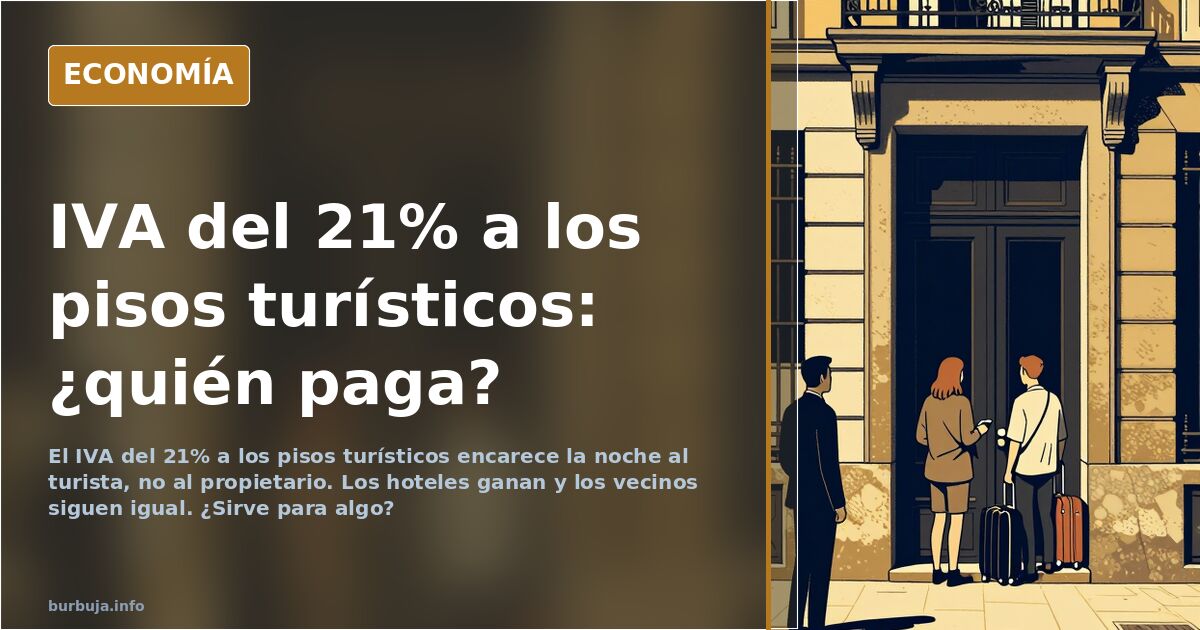
Spain’s 21% VAT on holiday rentals: who really pays?
The Spanish government has imposed a 21% VAT on tourist apartments and increased taxes on SOCIMIs (Spanish real estate investment trusts). The measure comes with an implicit promise: to stop the drain of residential housing into vacation rentals and return flats to long-term leasing. On paper, it sounds like fiscal justice. In practice, debates in economic forums leave an uncomfortable question: who actually feels the impact?
The owner doesn’t pay the VAT; the tourist does. This is the first conclusion drawn by those analyzing the measure with a calculator in hand. Landlords pass the cost onto nightly rates, so Airbnb guests pay 21% more. No problem for the landlord, who earns the same or more. The issue affects budget travelers who find that apartments are no longer cheaper than hotels.
Why doesn’t the 21% VAT curb tourist apartments?
This is where things get complicated. The tax hike doesn’t touch the real incentive, which is the profitability of short-term rentals versus long-term leases. As long as renting by the night yields more than renting by the month, owners will keep choosing the quick route. The VAT only makes the product more expensive; it doesn’t change the underlying equation.
Some argue this is a revenue-raising patch disguised as housing policy. The State joins the airverbenas business instead of shutting it down, according to this analysis. If the problem is that tourist flats destroy neighborhoods, the solution isn’t charging them more but banning them. A 50% rate would have closed the tap, they argue. A 21% rate just fills public coffers.
Hotels win, neighbors stay the same
The hotel sector benefits without lifting a finger. Unfair competition from tourist flats becomes pricier, allowing hotels to regain ground. Those who defended the measure as a blow to landlords discover that the final beneficiary is the hotel chain, which had been complaining that private individuals with two flats were stealing customers without trinc the same rules.
For residents, the result is unchanged. Noise, saturated common areas, and lobbies turned into improvised receptions. The VAT doesn’t kick anyone out of the building. Coexistence doesn’t improve because tourists pay 21% more per night. Those living there still endure the same issues.
SOCIMIs and the ghost of 2012
The tax increase on SOCIMIs has its own history. These entities were created by Mariano Rajoy’s government in 2012 to revive a real estate market that was anemic after the bubble burst. Now, taxes are raised to correct what was incentivized then. It’s economic policy changing direction on itself.
The counterargument also holds weight. If real estate capital finds better returns elsewhere, it will leave. Spain relies on tourism, and deindustrializing while punishing the sector that brings money is playing with fire. Those defending mass tourism as an economic engine warn: if you make accommodation expensive, tourists will go to Croatia or Segarro, leaving neither spending nor jobs here.
The tourist we want to lose and the one we want to keep
There is a current view that sees the measure as a desirable filter. Heavy drinking, low-spending tourism doesn’t compensate for its costs. If the 21% VAT sends that profile elsewhere, so be it. The tourist who respects the neighborhood, spends at local businesses, and doesn’t turn stairwells into party zones is the one we want. The other can go.
The problem is that the filter doesn’t distinguish. Families traveling with children who need an apartment to cook also pay the 21%. And they don’t bother anyone. The measure is a hammer, not a scalpel, and the hammer falls equally on everyone.
In the end, the lingering question isn’t whether the 21% VAT is fair or unfair. It’s whether it serves any purpose. It raises revenue, makes travel more expensive, and leaves the business intact. Neighborhoods remain the same, hotels celebrate, and the tourist pays for the party. Has anyone seen a tourist flat close because of this?
Also available in: Deutsch
Summary of a discussion on Burbuja.info - Foro de economía, actualidad y política., translated from Spanish and reviewed before publication. Read the full discussion (152 replies).
More summaries
-
Valencia: Tourist Homes Nearly Double Rental Supply
A UPV report warns that Valencia has nearly twice as many tourist apartments as residential rentals, with prices rising by 10%.
-
Tourist Rentals in Vigo: Guests Refuse to Leave After Booking Ends
At least ten tourist apartments in Vigo report guests refusing to vacate after their stay, according to the sector. Owners struggle to evict them.
-
Banning short-term rentals: impact on housing prices vs. tourism
Disparate figures in Madrid fuel skepticism over whether banning tourist apartments will actually lower rental prices.
-
ERC's Gabriel Rufián, 44, turns heads with baggy trousers and denim jacket
The ERC lawmaker, 44, appears in baggy trousers and a slim denim jacket, a look compared to Brad Pitt's, whose jacket cost €7,950.
-
Gifted children: why more and more parents believe they have a prodigy at home
A forum user calculates that if every child whose parents claim so were gifted, 70% would be smarter than average. The label has spiralled out of control.
-
No Christmas this year in the heart of Europe
A viral post claims Australia, France and Germany have cancelled their New Year celebrations over Islamist terrorism. There is no official confirmation.