
Banning short-term rentals: impact on housing prices vs. tourism
Disparate figures in Madrid fuel skepticism over whether banning tourist apartments will actually lower rental prices.
English · Original discussion in Spanish · Published
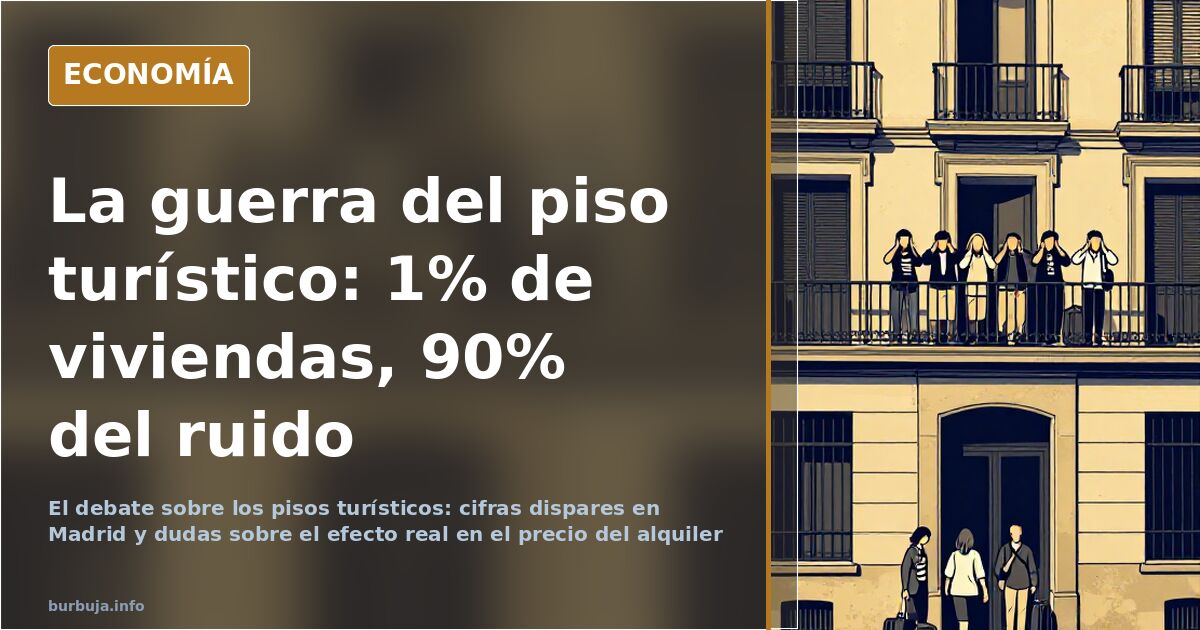
Banning short-term rentals won't lower rents
The promise of limiting tourist apartments to make housing more affordable has returned to the center of political discourse, met with widespread skepticism that transcends party lines. Regardless of who announces it: the measure is perceived as cosmetic before it is even drafted. The dominant argument is that tourism sustains what little remains of the economy and that no one wants to bite the hand that feeds them. This suspicion is reinforced by a recurring detail: those who first invested heavily in tourist apartments are now the ones legislating against them.
Critics argue the problem lies not in the law itself but in its fine print. The proposed regulation requires independent entry and exit from the rest of the building, a requirement that 99% of apartments do not meet and which, until now, has not prevented them from continuing to operate. The conclusion is clear: much is announced, but little is enforced.
How many tourist apartments really exist in Madrid
This is where the battle over numbers begins. One estimate claims there are 1,008 legal tourist apartments in Madrid, compared to 4,300 occupied homes and 97,178 vacant ones. Another count, based on rental platforms, raises the figure to 21,239 units, nearly half of which are concentrated in the Centro district. The difference between these two numbers—those complying with regulations and those operating outside the law—is precisely the heart of the issue.
From this arises the most uncomfortable argument: if the problem is illegal listings, banning legal ones solves nothing. And if the problem is total volume, then the official figure is an administrative fiction. In Barcelona, with over 800,000 homes, there are reportedly around 10,000 vacation rentals; in Madrid, 20,000 out of 1.53 million. It’s something, but it’s not everything.
Why landlords prefer short-term rentals
The most circulated calculation compares income from traditional long-term rentals versus tourist apartments. In high-demand areas, a well-located apartment can jump from €1,500 to €3,000 per month. With an average occupancy rate of 52% in central Madrid, the premium remains substantial even after deducting cleaning and maintenance costs. It’s not a 300% increase, but it is enough for the business to proliferate.
The other factor is legal security. A seasonal contract ends when it ends; a long-term lease becomes a trap if the tenant stops paying. There are documented cases of 27 months to evict a non-paying tenant. Given this horizon, long-term renting feels like Russian roulette. Consequently, hundreds of thousands of homes remain parked, out of the market, waiting for a law that never arrives.
Who wins if tourist apartments disappear
The most repeated thesis is that the measure aims not to cheapen housing, but to reorganize tourism. By eliminating competition from apartments, hotels could raise prices with margin. Low-budget tourists—those traveling with backpacks and sandwiches—would be pushed out of cities. The result would be fewer tourists, but more expensive ones.
In contrast, the movement advocating for liberalization and construction argues that no regulation lowers prices: it only reduces supply and makes what remains more expensive. Ultimately, the debate over short-term rentals is a debate over who has the right to live in city centers and at what price.
The ending is not yet written. If the law passes with its fine print intact, the effect will be marginal. If it includes real controls, the impact will first be felt in hotels and later in prices. What no one disputes is that 1% of homes create 90% of the noise. And that the underlying problem—a lack of supply and legal insecurity in renting—will persist once the law is forgotten.
Also available in: Deutsch
Summary of a discussion on Burbuja.info - Foro de economía, actualidad y política., translated from Spanish and reviewed before publication. Read the full discussion (145 replies).
More summaries
-
Spain's housing battle moves to live television
An insult and the law of supply and demand in rentals: how the housing debate broke down on Spanish television.
-
Only 37% of Households Have Savings Exceeding €15,000
63% of Spanish households hold less than €15,000 in accounts and deposits, with half holding less than €8,000. Why the average of €55,300 is misleading
-
Ebola alert in San Sebastián, Spain: suspected case turns out to be malaria
A woman who had travelled to the Central African Republic was admitted to Donostia Hospital with Ebola-compatible symptoms. She actually had malaria. The case…
-
Customer reports home insurance policy cancelled after two claims in one year
A user describes losing his home insurance after 35 years and two claims. Others report similar cases with the same and other insurers.
-
Left-wing voters uneasy over cancel culture
Left-wing voters describe in a forum how their role models have embraced labelling and censorship. The discomfort that unsettles.
-
Living off-grid in the mountains: the maths that tempts city dwellers
A young woman chose to live isolated in the mountains at 15, and her shelter has sparked a debate: what does it really cost to live outside the system?