
Spain's 1992 Nostalgia: When One Salary Supported a Family
In the 1990s, one paycheck sustained a household; today it barely covers rent. The debate on lost Spain mixes wages, demographics, and inheritance.
English · Original discussion in Spanish · Published
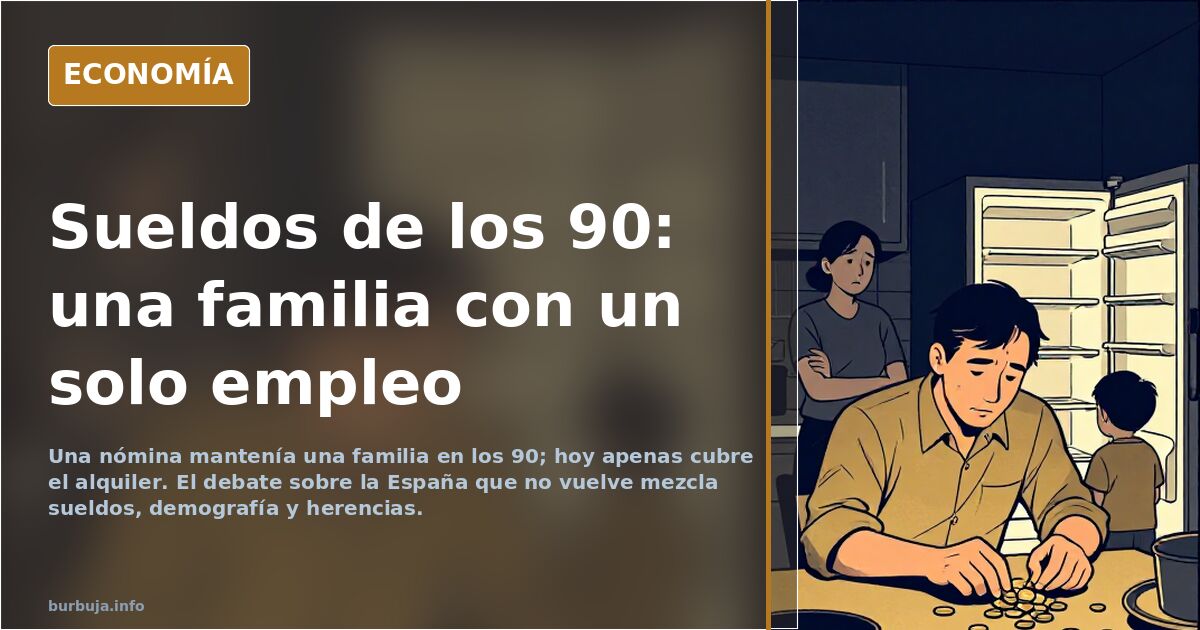
The nostalgia for 1992: when a single salary supported the whole family
Was that Spain truly better, or do we remember it fondly simply because we were younger? This question runs through a discussion with 155 replies that begins with a lament: that country will not return. What emerges, amidst memories and calculations, is an uncomfortable diagnosis: the complaint is not merely sentimental, but economic. According to one participant, a single wage maintained a household; today, with the same effort, it barely pays the rent.
The salary that no longer buys the same things
The most repeated argument takes the form of a generational comparison. It is claimed that in the nineties, an average paycheck was enough to sustain a complete home, whereas now that same paycheck turns its holder into a starving pauper unable to buy an apartment. The conclusion drawn is that real estate windfalls did not disappear: they changed hands and storefronts.
Against this interpretation, another current recalls that corruption and bubbles are not exclusive to a single era. Reference is made to the scheme that led to the 2008 crash, adding a warning: those who still believe that voting booths will fix this are either naive or living off the system. Disillusionment crosses generations and political parties.
Why blame the March 11 attacks for the end of an era?
There is a turning point that reappears insistently: March 2004. For some participants, that year closed the Spain of joy and peine the era of civil confrontation, with laws that divided society in half and pacts with those who were then killing. The thesis is repeated under different names with the same anger.
Not everyone shares this framework. Some place the break earlier, in the 1993 crisis and the corruption surrounding the Olympic festivities, asking that neither return. The discussion becomes a settling of scores between two nostalgias that refuse to acknowledge each other.
Demographics as an irreversible sentence
The harshest turn arrives with immigration. According to one participant, the annual entry of more than a million people is such a rapid demographic change that it may become irreversible, citing Switzerland, where a referendum to limit population is being prepared. The figure is launched without a source, yet it orders all subsequent debate.
Another voice responds with an uncomfortable calculation: if there were no migrant workers in agriculture, the farm laborer's wage would rise so much that strawberries would cost ten euros apiece. This argument does not convince the first group, who insist that most newcomers do not work and that official figures are manipulated.
The generational relay that never arrives
In parallel, a different demographic warning: according to one participant, in 25 years half the population will have been born abroad, and above the replacement rate, only religious groups, mostly Muslim, are having children. The conclusion drawn is that atheism is not neutral and that Europe will be reduced to a faithful remnant.
The most repeated response to this antiestéticar is that the problem is not who arrives, but who is not born. It is acknowledged that Spaniards have stopped having children and that without immigration, cities would empty out and rural Spain would remain a desert. The discussion gets tangled between culprits and consequences.
Inheritance, municipal capital gains tax, and the cost of accepting a flat
A concrete datum appears that almost nobody disputes: in Gijón, the rate of renouncing inheritances is extremely high, coinciding with an arbitrary increase in cadastral value. Modest homes from the development era bear disproportionate cadastral values, and the plusvalía municipal (municipal capital gains tax), without deflation adjustments, becomes a disguised inheritance tax.
The complete calculation, item by item, explains why many heirs prefer to renounce rather than accept a village house with four plots, maintenance costs, and bills. Simplifying life weighs more than preserving assets. It is the least told side of the housing problem.
The exit nobody wants to name
When the diagnosis is exhausted, the most uncomfortable hypothesis arises: that there is no solution at the ballot box and that only an explosion would change things. There is talk of a modern version of 1936, of a hidden dictatorship already governing de facto, and the impossibility of trusting that the electoral process is clean.
Others respond with the memory of the past: in 1934, surrounded by strikes and attacks, many believed it impossible for Spain to be saved, and five years later dawn broke. Pessimism, they say, also makes mistakes. The discussion ends without agreement and with a shared certainty: something broke and has not been fixed.
Was that Spain truly better, or do we remember it fondly simply because we were younger? This question runs through a discussion with 155 replies that begins with a lament: that country will not return. What emerges, amidst memories and calculations, is an uncomfortable diagnosis: the complaint is not merely sentimental, but economic. According to one participant, a single wage maintained a household; today, with the same effort, it barely pays the rent.
The salary that no longer buys the same things
The most repeated argument takes the form of a generational comparison. It is claimed that in the nineties, an average paycheck was enough to sustain a complete home, whereas now that same paycheck turns its holder into a starving pauper unable to buy an apartment. The conclusion drawn is that real estate windfalls did not disappear: they changed hands and storefronts.
Against this interpretation, another current recalls that corruption and bubbles are not exclusive to a single era. Reference is made to the scheme that led to the 2008 crash, adding a warning: those who still believe that voting booths will fix this are either naive or living off the system. Disillusionment crosses generations and political parties.
Why blame the March 11 attacks for the end of an era?
There is a turning point that reappears insistently: March 2004. For some participants, that year closed the Spain of joy and peine the era of civil confrontation, with laws that divided society in half and pacts with those who were then killing. The thesis is repeated under different names with the same anger.
Not everyone shares this framework. Some place the break earlier, in the 1993 crisis and the corruption surrounding the Olympic festivities, asking that neither return. The discussion becomes a settling of scores between two nostalgias that refuse to acknowledge each other.
Demographics as an irreversible sentence
The harshest turn arrives with immigration. According to one participant, the annual entry of more than a million people is such a rapid demographic change that it may become irreversible, citing Switzerland, where a referendum to limit population is being prepared. The figure is launched without a source, yet it orders all subsequent debate.
Another voice responds with an uncomfortable calculation: if there were no migrant workers in agriculture, the farm laborer's wage would rise so much that strawberries would cost ten euros apiece. This argument does not convince the first group, who insist that most newcomers do not work and that official figures are manipulated.
The generational relay that never arrives
In parallel, a different demographic warning: according to one participant, in 25 years half the population will have been born abroad, and above the replacement rate, only religious groups, mostly Muslim, are having children. The conclusion drawn is that atheism is not neutral and that Europe will be reduced to a faithful remnant.
The most repeated response to this antiestéticar is that the problem is not who arrives, but who is not born. It is acknowledged that Spaniards have stopped having children and that without immigration, cities would empty out and rural Spain would remain a desert. The discussion gets tangled between culprits and consequences.
Inheritance, municipal capital gains tax, and the cost of accepting a flat
A concrete datum appears that almost nobody disputes: in Gijón, the rate of renouncing inheritances is extremely high, coinciding with an arbitrary increase in cadastral value. Modest homes from the development era bear disproportionate cadastral values, and the plusvalía municipal (municipal capital gains tax), without deflation adjustments, becomes a disguised inheritance tax.
The complete calculation, item by item, explains why many heirs prefer to renounce rather than accept a village house with four plots, maintenance costs, and bills. Simplifying life weighs more than preserving assets. It is the least told side of the housing problem.
The exit nobody wants to name
When the diagnosis is exhausted, the most uncomfortable hypothesis arises: that there is no solution at the ballot box and that only an explosion would change things. There is talk of a modern version of 1936, of a hidden dictatorship already governing de facto, and the impossibility of trusting that the electoral process is clean.
Others respond with the memory of the past: in 1934, surrounded by strikes and attacks, many believed it impossible for Spain to be saved, and five years later dawn broke. Pessimism, they say, also makes mistakes. The discussion ends without agreement and with a shared certainty: something broke and has not been fixed.
Also available in: Deutsch
Summary of a discussion on Burbuja.info - Foro de economía, actualidad y política., translated from Spanish and reviewed before publication. Read the full discussion (155 replies).
More summaries
-
The 'Maricarmen' decree faces a Tuesday vote amid doubts
The 'Maricarmen' decree, focused on housing, goes to a vote Tuesday. Old rents, Junts, omnibus bills, and planned applause...
-
Maricarmen, evicted Madrid tenant, dies at 87
Maricarmen, the 87-year-old tenant evicted in Madrid, has died after being hospitalized since her forced removal.
-
Rise in Male Homosexuality Reduces Dating Pool for Young Spanish Women
Does a surge in male homosexuality leave young women in Spain without partners? An analysis of a debate blending math, stereotypes, and social anxiety.
-
Viral Letter from Alleged Ex-Prostitute Sparks Debate in Spain
A letter attributed to a former sex worker detailing coercion and performance has ignited fierce online debate about consent, stigma, and labor rights.
-
Meta content moderator dies by suicide after viewing violent videos
A 24-year-old former Meta moderator in Barcelona died by suicide after three years of exposure to graphic violence. Her family is considering legal action against Meta and Telus.
-
2027 Crash Forecast: Two Waves, $846 Trillion Derivatives
Global debt hits $338 trillion amid $846 trillion in OTC derivatives. A timeline predicts a systemic collapse starting in 2027.