
Spain's 1960s high school standard that will never return
A teacher argues that the academic level of Spain's high schools in the 1960s, 70s and 80s is impossible to replicate. The debate: was it excellence or simply elite exclusion?
English · Original discussion in Spanish · Published
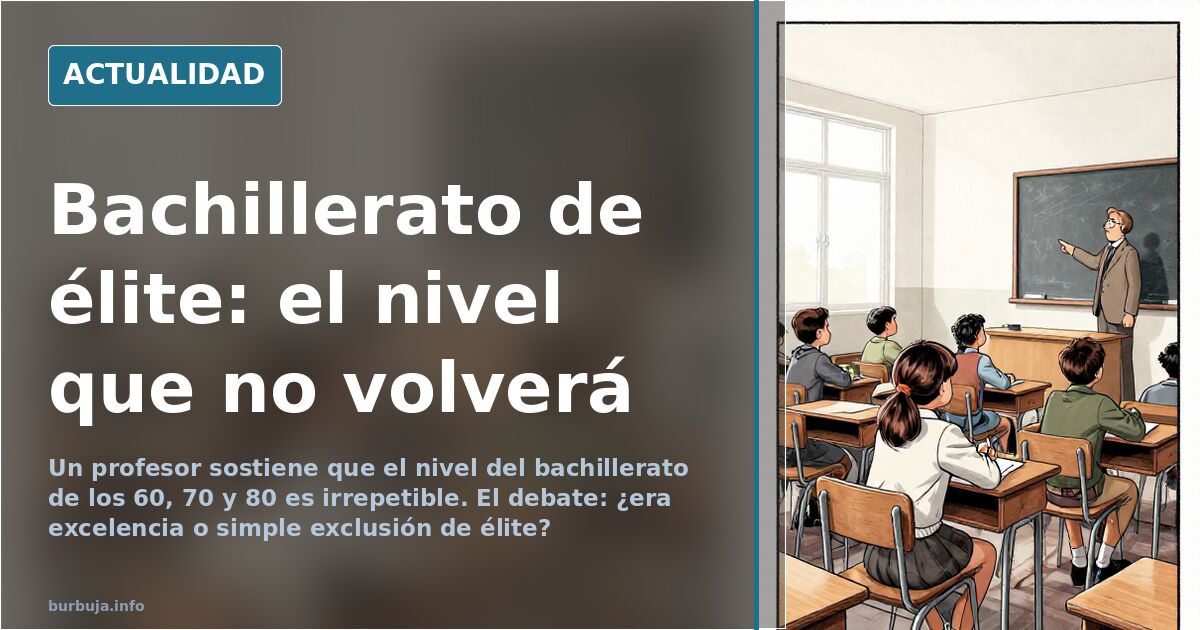
The elite high school Spain will never see again
A teacher said it bluntly: the level of high school education in the 1960s, 1970s and part of the 1980s is impossible to replicate. The claim, which at first sounds like a professor's nostalgia, opens a debate that goes far beyond the classroom. Because the real issue is not whether more Latin was studied back then, but whether that system was excellent or simply exclusionary.
The teacher's diagnosis rests on three pillars: extreme rigor, encyclopedic general knowledge and iron discipline. A selective high school, reached by only a minority, allowed an academic depth unimaginable today. Latin, Greek, Philosophy and History shaped what was called the "cultured man". Reducing that to mere "secondary education" is, for this school of thought, downgrading its intellectual essence to a formality on the way to a job.
The fine print of the educational miracle
The counterargument is devastating: that level was high because almost nobody got there. The democratization of access to post-compulsory education is the great success of today's system, not its failure. Today a student handles digital tools, modern languages and critical analysis that did not even exist in the 1970s. Knowledge has expanded, not necessarily degraded.
But the debate sharpens when it gets down to detail. Some argue that critical thinking has disappeared and that today's high school fails to reach the technical and scientific level the job market demands. The problem would not be breadth, but the lowering of standards. "Democratization" would have come with a near-obligation to pass everyone.
What did a student in the 1970s know that nobody knows today?
The most repeated anecdote takes the form of a math problem. A teacher with 40 years at a tutoring academy tells of a student who froze on a projectile-motion exercise because he did not know what a hill was. Another did not know what a garden wall was in a trigonometry problem. "If I gave them the textbooks I studied from, they wouldn't even know where to start," he sums up.
The diagnosis extends to university. Some claim that second-year high school students believe VAT must be subtracted rather than added, and that recent graduating classes make mistakes like "canbio" for "cambio". The conclusion is merciless: the cohorts of the Villar Palasí law (Spain's 1970 general education act) would be scholars compared with what we have now.
The problem is not the students
Part of the analysis shifts the blame from students to the system. Today's high school would be well designed; the problem is that the Ministry of Education keeps intervening with school failure and the obligation to pass. If the curriculum were kept but with the demands of the past, the result would be different. The concrete proposal: that the ESO (Spain's compulsory secondary education stage) raise the bar, and that only those scoring 8 to 10 be allowed into high school.
Another school of thought aims higher. The educational decline would require a bottom-up recovery: generations of students slightly better than their teachers, who in turn train better teachers, ready to be surpassed by more demanding students. A matter of decades, even centuries, to reverse what is described as a structural decline.
The exact point where the analysis gets stuck is always the same: whether the level was high thanks to the system's merit or to selection of the clientele. Defenders of the old model point to the country left behind by those trained in it. Critics reply that memorizing tomes makes nobody smarter, it only measures how docile you are. And meanwhile, the Nordics, who once taught us lessons, have already started the journey back.
Also available in: Deutsch
Summary of a discussion on Burbuja.info - Foro de economía, actualidad y política., translated from Spanish and reviewed before publication. Read the full discussion (34 replies).
More summaries
-
High-Status Latinas Reshape Spanish Dating Market
Wealthy, educated Latin American women are entering the Spanish marriage market, challenging traditional status metrics and reshaping relationship dynamics.
-
Nadal's muscle loss: normal physiology or media freak show
Rafa Nadal has lost muscle mass since retiring: the physiological explanation and why the press turns something normal into a spectacle. Comparisons and analysis of his tran
-
Client wonders whether to stop paying a sex worker he's fallen for
A client describes the best encounter of his life with a sex worker and asks whether he should stop paying: the risk of mistaking good service for something more.
-
Night of unrest in A Coruña, Spain as far-left rioters burn a Zara store
Firefighters in A Coruña, Spain responded to several calls over burning bins and cars during a night of unrest. The Zara Home store in Plaza de Lugo went up in flames.
-
Alba Carrillo lashes out at Ana Rosa Quintana, questioning why anyone watches her shows
Alba Carrillo attacks Ana Rosa Quintana, questioning the ratings of her programmes and her editorial judgement.
-
Fr. Javier Luzón Peña's book: The 6 Doors of the Enemy
The book The 6 Doors of the Enemy, by Javier Luzón Peña, is offered as support for young people who wish to return to a more traditional faith.