
Spain's 10-home ban splits right-wing voters
More Madrid proposes seizing property from owners with 10 homes, sparking a clash with Ayuso and dividing conservative voters.
English · Original discussion in Spanish · Published
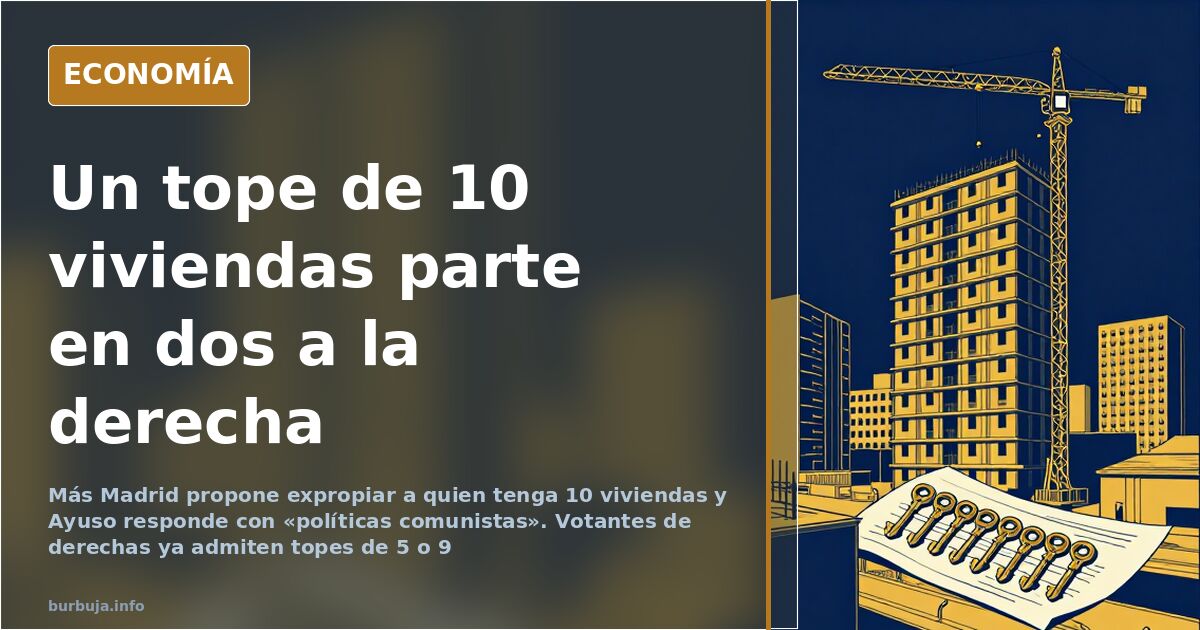
Spain's 10-home ban splits right-wing voters
No self-declared conservative should accept expropriation. The principle holds until the conversation mentions housing. During a session in the Madrid Assembly, More Madrid spokesperson Manuela Bergerot called to "tax and expropriate" owners of ten or more flats, stating there is no right to own ten homes, but rather "a right to have one." Regional President Isabel Díaz Ayuso retorted with the question, "Who do they think they are with these Chavist communist policies?" and reminded everyone that in a "liberal democracy," each owner can "have as many homes as they wish" and set the price "as they see fit." Bergerot closed the exchange by warning that one of her own flats would also be expropriated.
This clash is not an isolated episode. It arrives amidst a fierce dispute between the Community of Madrid and the national government over a housing emergency plan, presenting two opposing models: one favoring interventionism and another reducing bureaucracy, summarizing its recipe as build, build, and build.
What More Madrid proposes regarding 10 homes and Ayuso's response
The Madrid opposition's proposal sets a numerical threshold: from the tenth home onwards, taxes and expropriation apply. The context is the soaring rental prices, which the PSOE and More Madrid deem unsustainable in the capital. The regional president replies that the measure would end up "directly destroying supply," which is the crux of the matter: if product is withdrawn from the market, prices do not fall.
Fiscal policy on real estate, however, is not a clean field. Housing accumulates subsidies, tax deductions, and tricks to stimulate demand while restricting supply, alongside weak fiscal inspection. Any proposed cap must coexist with this complex framework.
Is it contradictory to defend private property and a home cap?
Yes, in strict terms, and much of the debate states this plainly: if you believe in private property, it is incoherent to oppose someone owning ten, or even a thousand, flats, because they are theirs. This is the most repeated argument by those rejecting any limit, and also the one that bothers those defending the cap while claiming to be liberals.
The response from limit supporters is to separate housing from other goods. It is argued that it is not just any asset, that land cannot be manufactured, and that leaving access to shelter in the hands of speculation turns capitalism into a form of rent-seeking, closer to feudalism than to the market. The discussion, therefore, is not about property: it is about which goods warrant special rules.
Proposed caps: from 10 homes to 5, 4, or 1
The official threshold is ten, but the conversation quickly slides downward. Some argue that nine is already too many, that a reasonable limit is five, that one should not exceed four, and that in central Madrid, just one is enough. Each figure carries an uncomfortable question: why that number and not another? No one has yet provided an objective criterion to justify it.
The full breakdown of these thresholds, with available land in each scenario, is where the issue becomes truly uncomfortable for those defending the lowest cap.
Building more instead of distributing what is built: the market argument
The most cited objection is not sarracena, but arithmetic. If the problem is a lack of homes, the solution is to build more homes, not to change hands those that already exist. Attention is drawn to urbanizable land retained by municipalities and administrative delays as primary causes of the imbalance, recalling the classic example: if oranges are scarce, you do not expropriate the oranges.
On the investor behavior side, there is a circulating calculation: from a profitability of between 3% and 5%, the buyer of housing for rent stops buying, so the market self-regulates due to an excess supply of rentals. Under this view, a legal cap would only serve to withdraw product and make what remains more expensive.
Companies, percentages, and empty homes: where limits escape
Any threshold per physical person hits the same wall: ownership. A large part of real estate wealth is not in individual names, but in companies, which fall outside most proposals. The trick of putting flats in a company and self-renting them to extract fiscal advantages is also warned against.
Alternatives emerging when expropriation is abandoned are more varied: pogre taxes from the third home if it is empty and not rented, surcharges on second homes in stressed areas, a cap calculated by the sum of ownership percentages on one or several properties, or directly reserving purchase for residents and banning it for funds and legal entities. These are administratively more cumbersome formulas, but difficult to bypass with an intermediary company.
Housing and immigration: the third axis of political clash
A part of the debate places demographic pressure on housing demand as a relevant factor for price increases, calling for border control and fewer regularization processes. Other voices reject this diagnosis and attribute everything to a lack of supply and blocked land. The disagreement is fundamental and cannot be resolved with a single figure, but it is important to separate them: mixing both discussions is the fastest way to fix neither.
The reasonable prediction is that the threshold will not be legislated as is, but that the proposal will remain in the political language of the next legislature. If a cap ever arrives, it will be via fiscal means and with companies in the spotlight, not with trucks in front of every portal. And there will still be those, from the right, who defend that nine homes are sufficient.
No self-declared conservative should accept expropriation. The principle holds until the conversation mentions housing. During a session in the Madrid Assembly, More Madrid spokesperson Manuela Bergerot called to "tax and expropriate" owners of ten or more flats, stating there is no right to own ten homes, but rather "a right to have one." Regional President Isabel Díaz Ayuso retorted with the question, "Who do they think they are with these Chavist communist policies?" and reminded everyone that in a "liberal democracy," each owner can "have as many homes as they wish" and set the price "as they see fit." Bergerot closed the exchange by warning that one of her own flats would also be expropriated.
This clash is not an isolated episode. It arrives amidst a fierce dispute between the Community of Madrid and the national government over a housing emergency plan, presenting two opposing models: one favoring interventionism and another reducing bureaucracy, summarizing its recipe as build, build, and build.
What More Madrid proposes regarding 10 homes and Ayuso's response
The Madrid opposition's proposal sets a numerical threshold: from the tenth home onwards, taxes and expropriation apply. The context is the soaring rental prices, which the PSOE and More Madrid deem unsustainable in the capital. The regional president replies that the measure would end up "directly destroying supply," which is the crux of the matter: if product is withdrawn from the market, prices do not fall.
Fiscal policy on real estate, however, is not a clean field. Housing accumulates subsidies, tax deductions, and tricks to stimulate demand while restricting supply, alongside weak fiscal inspection. Any proposed cap must coexist with this complex framework.
Is it contradictory to defend private property and a home cap?
Yes, in strict terms, and much of the debate states this plainly: if you believe in private property, it is incoherent to oppose someone owning ten, or even a thousand, flats, because they are theirs. This is the most repeated argument by those rejecting any limit, and also the one that bothers those defending the cap while claiming to be liberals.
The response from limit supporters is to separate housing from other goods. It is argued that it is not just any asset, that land cannot be manufactured, and that leaving access to shelter in the hands of speculation turns capitalism into a form of rent-seeking, closer to feudalism than to the market. The discussion, therefore, is not about property: it is about which goods warrant special rules.
Proposed caps: from 10 homes to 5, 4, or 1
The official threshold is ten, but the conversation quickly slides downward. Some argue that nine is already too many, that a reasonable limit is five, that one should not exceed four, and that in central Madrid, just one is enough. Each figure carries an uncomfortable question: why that number and not another? No one has yet provided an objective criterion to justify it.
The full breakdown of these thresholds, with available land in each scenario, is where the issue becomes truly uncomfortable for those defending the lowest cap.
Building more instead of distributing what is built: the market argument
The most cited objection is not sarracena, but arithmetic. If the problem is a lack of homes, the solution is to build more homes, not to change hands those that already exist. Attention is drawn to urbanizable land retained by municipalities and administrative delays as primary causes of the imbalance, recalling the classic example: if oranges are scarce, you do not expropriate the oranges.
On the investor behavior side, there is a circulating calculation: from a profitability of between 3% and 5%, the buyer of housing for rent stops buying, so the market self-regulates due to an excess supply of rentals. Under this view, a legal cap would only serve to withdraw product and make what remains more expensive.
Companies, percentages, and empty homes: where limits escape
Any threshold per physical person hits the same wall: ownership. A large part of real estate wealth is not in individual names, but in companies, which fall outside most proposals. The trick of putting flats in a company and self-renting them to extract fiscal advantages is also warned against.
Alternatives emerging when expropriation is abandoned are more varied: pogre taxes from the third home if it is empty and not rented, surcharges on second homes in stressed areas, a cap calculated by the sum of ownership percentages on one or several properties, or directly reserving purchase for residents and banning it for funds and legal entities. These are administratively more cumbersome formulas, but difficult to bypass with an intermediary company.
Housing and immigration: the third axis of political clash
A part of the debate places demographic pressure on housing demand as a relevant factor for price increases, calling for border control and fewer regularization processes. Other voices reject this diagnosis and attribute everything to a lack of supply and blocked land. The disagreement is fundamental and cannot be resolved with a single figure, but it is important to separate them: mixing both discussions is the fastest way to fix neither.
The reasonable prediction is that the threshold will not be legislated as is, but that the proposal will remain in the political language of the next legislature. If a cap ever arrives, it will be via fiscal means and with companies in the spotlight, not with trucks in front of every portal. And there will still be those, from the right, who defend that nine homes are sufficient.
Summary of a discussion on Burbuja.info - Foro de economía, actualidad y política., translated from Spanish and reviewed before publication. Read the full discussion (393 replies).
More summaries
-
Maricarmen decree: expropriate homes from tenants over 70
Sumar's draft decree would let authorities expropriate a home if the tenant is over 70. The industry warns: fewer rentals for older people.
-
Simeone's property empire: 180 Madrid flats acquired through his company
Diego Simeone and Carla Pereyra own 180 flats and seven buildings in Madrid, highlighting the rental market and housing accumulation debate.
-
Madrid Debates Growth to Ten Million: Water, Land, and Housing Challenges
Madrid's ambition for 10 million residents faces hurdles: water scarcity, protected land, and housing shortages. Aid for 2,800 university students noted.
-
Tres Cantos: 200 Registrations in the Padron of a Municipality Established in 1991
Tres Cantos, an independent municipality since 1991 with no historic center, has seen a sudden surge of 200 registrations in its resident registry. What is known and what doesn't add up.
-
Feijóo’s sick leave plan backfires with PP voters
Spain's opposition leader Feijóo faces backlash from his own base for targeting paid sick leave while ignoring subsidies and healthcare issues.
-
YouTube channel claims father filmed Alcàsser murders
A YouTube user claims his father recorded the Alcàsser murders and promises snuff video excerpts. No evidence provided, only narrative and technical analysis.