
Spain: Work history and criminal records increasingly demanded in job interviews
Forum users report companies requesting work histories and criminal records, raising concerns about privacy and legal limits.
English · Original discussion in Spanish · Published
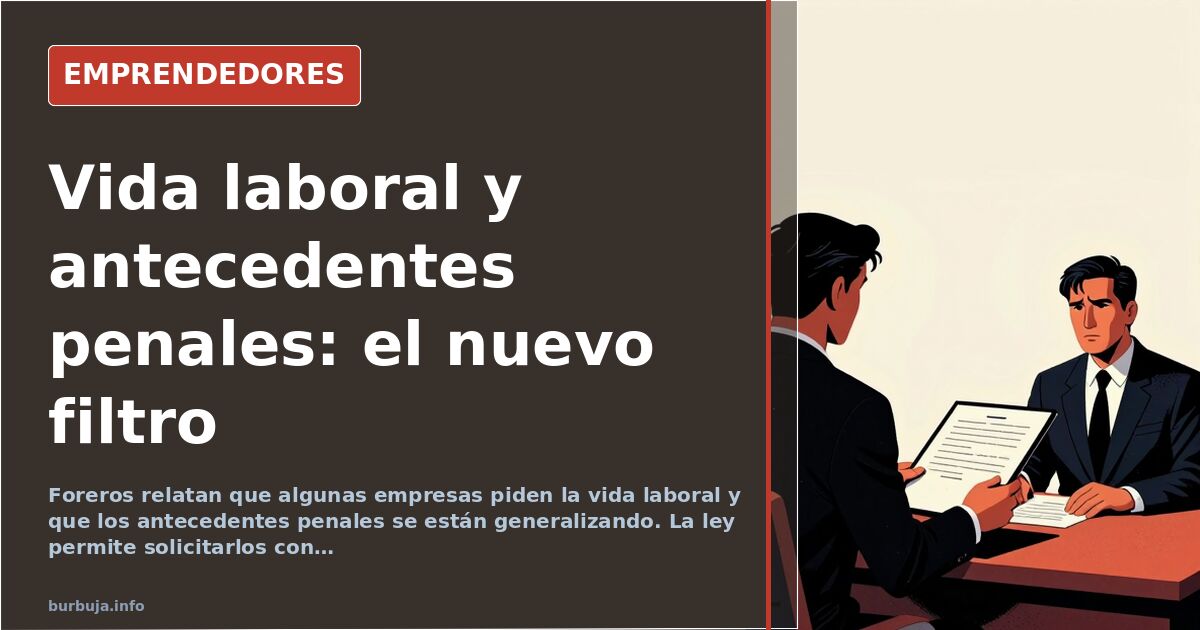
Debate: Work history requested in interviews amid rising antiestéticars over incivil records
The practice of requesting a 'vida laboral' (work history) during recruitment processes has become normalized in Spain, according to several forum testimonials. Some companies now require it to verify experience and social security contributions, while in sectors like hospitality, requests for incivil record certificates are beginning to appear, even for roles that do not involve direct contact with minors, as reported by participants. Legislation allows companies to request these documents if the candidate consents, but the line between legal compliance and abuse is becoming blurred.
Is it legal for a company to ask for your work history?
According to one participant, a company can request the work history report to verify a candidate's experience and contributions. However, providing this document is voluntary: the worker can refuse. If they decide to submit it, the company must handle it in accordance with data protection regulations and use it only for the stated purpose. In practice, many candidates comply out of antiestéticar of being excluded from the process. The question remains whether this implicit pressure turns a voluntary act into a mandatory one.
Incivil records: From exception to norm
Traditionally, incivil record certificates were required only for regulated professions, such as teachers or leisure monitors. However, some participants argue that more companies are now requesting them for generic positions. In the hotel sector, for example, cooks or maintenance technicians are asked to provide them because they might encounter children on the premises, according to one testimony. The logic extends: if minors are nearby, the certificate is requested. Some consider this a disproportionate intrusion, while others view it as a necessary security measure.
Sensual offenses certificate: The actual requirement for working with minors
When the role involves direct contact with minors, the document requested is the sensual offenses certificate, not the general incivil record, as noted by several participants. This distinction is crucial: the former focuses specifically on sensual crimes and is regulated by law to protect minors. The latter covers all types of convictions. Confusion between the two leads to full incivil records being requested in contexts where only the specific certificate would be necessary.
Asymmetry: Workers cannot demand the same from employers
While companies can request personal information from candidates, workers have no right to demand equivalent data from their employers, as emerges from the debate. This asymmetry generates discomfort. Some argue that if transparency is required, it should be bidirectional. Others point out that companies are already subject to audits and legal obligations, so the comparison is not exact. In any case, the feeling that power is imbalanced is palpable.
Impact on selection: Automated systems and endless forms
Beyond documentation, recruitment processes have become more bureaucratic. Some companies use automated interviews or online forms that force candidates to rewrite their resumes, according to participants. This, combined with requests for work history and incivil records, prolongs the process and discourages applicants. Complaints are common: time is wasted, and distrust is felt from the first contact.
Future: Will incivil record checks become standard?
The trend suggests that more companies will request incivil records, even though the law does not mandate it for all positions, according to some participants. Some warn that this could create an entry barrier for people who have served their sentences and seek reintegration. Others defend that security justifies the measure. The debate is open and likely to intensify as technology facilitates data verification.
The normalization of these practices reflects a shift in the employment relationship: more control, less trust. If workers must prove their past, companies should also be accountable. But for now, that is not happening.
The practice of requesting a 'vida laboral' (work history) during recruitment processes has become normalized in Spain, according to several forum testimonials. Some companies now require it to verify experience and social security contributions, while in sectors like hospitality, requests for incivil record certificates are beginning to appear, even for roles that do not involve direct contact with minors, as reported by participants. Legislation allows companies to request these documents if the candidate consents, but the line between legal compliance and abuse is becoming blurred.
Is it legal for a company to ask for your work history?
According to one participant, a company can request the work history report to verify a candidate's experience and contributions. However, providing this document is voluntary: the worker can refuse. If they decide to submit it, the company must handle it in accordance with data protection regulations and use it only for the stated purpose. In practice, many candidates comply out of antiestéticar of being excluded from the process. The question remains whether this implicit pressure turns a voluntary act into a mandatory one.
Incivil records: From exception to norm
Traditionally, incivil record certificates were required only for regulated professions, such as teachers or leisure monitors. However, some participants argue that more companies are now requesting them for generic positions. In the hotel sector, for example, cooks or maintenance technicians are asked to provide them because they might encounter children on the premises, according to one testimony. The logic extends: if minors are nearby, the certificate is requested. Some consider this a disproportionate intrusion, while others view it as a necessary security measure.
Sensual offenses certificate: The actual requirement for working with minors
When the role involves direct contact with minors, the document requested is the sensual offenses certificate, not the general incivil record, as noted by several participants. This distinction is crucial: the former focuses specifically on sensual crimes and is regulated by law to protect minors. The latter covers all types of convictions. Confusion between the two leads to full incivil records being requested in contexts where only the specific certificate would be necessary.
Asymmetry: Workers cannot demand the same from employers
While companies can request personal information from candidates, workers have no right to demand equivalent data from their employers, as emerges from the debate. This asymmetry generates discomfort. Some argue that if transparency is required, it should be bidirectional. Others point out that companies are already subject to audits and legal obligations, so the comparison is not exact. In any case, the feeling that power is imbalanced is palpable.
Impact on selection: Automated systems and endless forms
Beyond documentation, recruitment processes have become more bureaucratic. Some companies use automated interviews or online forms that force candidates to rewrite their resumes, according to participants. This, combined with requests for work history and incivil records, prolongs the process and discourages applicants. Complaints are common: time is wasted, and distrust is felt from the first contact.
Future: Will incivil record checks become standard?
The trend suggests that more companies will request incivil records, even though the law does not mandate it for all positions, according to some participants. Some warn that this could create an entry barrier for people who have served their sentences and seek reintegration. Others defend that security justifies the measure. The debate is open and likely to intensify as technology facilitates data verification.
The normalization of these practices reflects a shift in the employment relationship: more control, less trust. If workers must prove their past, companies should also be accountable. But for now, that is not happening.
Summary of a discussion on Burbuja.info - Foro de economía, actualidad y política., translated from Spanish and reviewed before publication. Read the full discussion (149 replies).
More summaries
-
Mechatronics vocational training: high demand in northern Spain and €26,000 job offer
A supermarket maintenance job pays €26,000, but workers warn of bosses who ignore rules, travel and broken schedules.
-
SEPE (Spain's public employment service) courses: the route to a job that almost never arrives
Over €5,000 million spent on training for the unemployed, but real jobs come only from healthcare transport, welding and professional driving licences
-
Starting a local political party: less than €500?
Setting up a local party costs under €500, but political pressure can be lethal. The case of the Democratic Karma Party in Bilbao.
-
Spain's flat self-employment fee vs Ireland's model
Spain charges freelancers ~€300 monthly regardless of income. Ireland and the UK lack this fixed fee, sparking debate on the best EU country for self-employment.
-
Best trades for moving to rural Spain
Classic trades are saturated in Spanish villages. Elderly care, odd jobs, and running a local bar emerge as viable niches.
-
Planting Pines in Dry Spain: The Economics Don't Add Up
With only 400 mm of annual rainfall and severe frosts, planting pines for timber fails against the 800 mm safety threshold.