
Spain withdraws 188,000 tons of olive oil to support prices
Spanish Agriculture Ministry mandates storage of 12% of output. CNMC warns this restricts competition and may raise consumer costs.
English · Original discussion in Spanish · Published
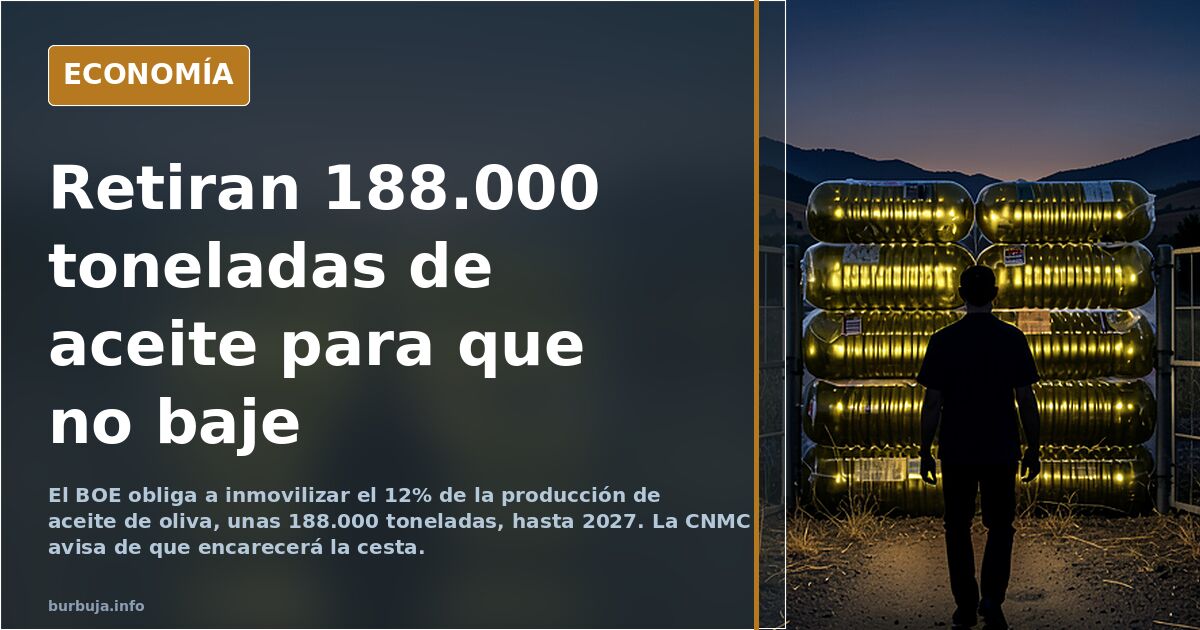
State withdraws 188,000 tons of olive oil to prevent price drops
The Ministry of Agriculture has decreed for the first time mandatory storage of 12% of monthly olive oil production. Published in the BOE (Official State Gazette) on November 6, 2026, the measure will immobilize approximately 188,000 tons until September 2027. The stated goal: halt a price collapse amid an estimated harvest of 1.6 million tons, 23% higher than the previous campaign. The CNMC (National Markets and Competition Commission) has already warned that the measure restricts competition and could increase product costs for consumers.
The paradox of intervening in a supposedly free market
The decision trinc producers demanding that Minister Luis Planas enforce withdrawal to avoid selling below cost. With initial stocks of 357,040 tons—23.3% more than the previous period—and projected production reaching 120% of the average of the last six campaigns, the Ministry activated Article 5 of the marketing regulation under the EU Common Market Organization Regulation. Each mill must withdraw 12% of its accumulated monthly production, with freedom to choose the category and storage location. A technical group coordinated by the Ministry and executed by autonomous communities will monitor compliance.
The official narrative speaks of "ensuring farmer profitability" and "providing market stability." Conversely, the CNMC issued a report stating that withdrawal constitutes a "significant restriction on competition" that may result in higher prices for end consumers. In other words, the body overseeing competition warns that the measure limits it. The paradox is not minor: a government claiming socialist principles intervenes to sustain margins for a business sector, while the consumer pays the bill.
Who wins and who loses from olive oil withdrawal?
The producing sector welcomes the measure. Farmers argue that a record harvest would force them to sell below cost, straining the market and eventually pushing out small producers. From this perspective, withdrawal acts as a collective insurance: part of the supply is immobilized so prices don't crash and farmers can cover costs. The Ministry insists the measure also protects buyers by avoiding extreme volatility.
The other side is the consumer, who won't see oil prices drop despite unprecedented production levels. Some argue that the free market should allow cheaper purchases during surpluses, and that intervention only serves to artificially keep prices high. The olive oil debate thus becomes a textbook case: when the market pushes prices down, the State intervenes to stop the fall; when prices rise, drought or war are blamed. It's never the market.
The SAREB and housing precedent: when the State rescues the seller
Comparison with housing appears immediately. In 2012, the State created SAREB (the Spanish asset management company) to absorb toxic real estate assets from savings banks and avoid their bankruptcy. The result was that apartments weren't sold at fire-sale prices but managed to sustain the balance sheets of rescued entities. Something similar happens now with oil: the State doesn't let prices fall but administers them. The difference is that then bank losses were socialized, and now the cost of sustaining mill margins is socialized.
The mechanism is the same: intervention ensures prices don't reflect abundance. For oil, mandatory withdrawal applies to declared production from November 2026 and will be reviewed in December based on actual production evolution. The plan remains active until September 2027. Thus, the oil market is intervened for at least one full campaign.
Competition authority denounces measure: CNMC warns of price hikes
The National Markets and Competition Commission hasn't been slow to respond. According to its report, mandatory withdrawal "constitutes a significant restriction on competition that may lead to increased prices for final consumers." The body also warns the measure "may generate inefficiencies" in the market. This warning has been ignored by the Ministry, relying on community regulations.
The underlying problem is that withdrawal affects not just Spanish oil. Estimates circulating in debates suggest Spain imports around 30% of consumed olive oil, mostly from Segarro and Tunisia. By withdrawing national production, internal supply decreases, leaving space for imported oil to maintain prices. Thus, the measure benefits foreign producers not subject to mandatory withdrawal. A collateral effect not mentioned in the BOE.
Canary Islands bananas and other interventions precedent
This isn't the first such measure. In the Canary Islands, the banana sector has used production withdrawals for years to sustain prices, a practice dating back decades. Similar actions have occurred with wine, milk, and other agricultural products. The novelty is applying it to olive oil, a basic shopping basket item that has seen sharp increases recently.
The closest precedent is voluntary olive oil production withdrawal in past campaigns, subsidized at the time. Now, withdrawal is mandatory and unsubsidized, meaning storage costs fall on mills. However, sale prices don't drop because supply is artificially reduced.
What happens to withdrawn oil?
Withdrawn oil isn't destroyed. It's stored in own or third-party facilities and remains immobilized until September 30, 2027. After that date, mills can commercialize it. Therefore, the measure doesn't eliminate surplus but saves it for later. If next year's harvest is poor, stored oil compensates scarcity. If good, surplus grows, multiplying downward pressure on prices.
The Ministry planned a review in December 2026 to adjust withdrawal based on real production. The measure is flexible but no less interventionist. The olive oil market becomes subject to decree-based stock management, reminiscent of planned economies liberals criticize.
Irony of a self-proclaimed left-wing government
Political debate is served. From the left, some sectors criticize the measure as benefiting large producers over small farmers. From the right, the Government is accused of intervening to sustain prices, deemed characteristic of socialist regimes. Reality is nuanced: the measure responds to sector demands for regulatory mechanisms against price volatility.
Factually, the coalition government applied a measure limiting competition and sustaining corporate margins. It's not socialism, but textbook interventionism. As always, the consumer pays. The question is whether voters will consider this.
With mandatory 12% production withdrawal, olive oil prices won't drop despite good harvest. CNMC warned the measure restricts competition. Meanwhile, the Government relies on European regulations. Brussels holds the ball, potentially opening proceedings if it deems the measure abusa free competition. Until then, consumers continue paying gold-standard prices for oil.
Also available in: Deutsch
Summary of a discussion on Burbuja.info - Foro de economía, actualidad y política., translated from Spanish and reviewed before publication. Read the full discussion (122 replies).
More summaries
-
Ayuso's cleavage photo sparks viral debate and AI suspicions
Isabel Díaz Ayuso's revealing photo triggers online controversy, mixing praise, insults, and AI manipulation claims within 24 hours.
-
Spain’s hourly output unchanged since 2005, wages stagnant
Spanish productivity rises just 0.6% annually since 1995 while median salary stays at €1,500 due to low-cost model and small firms.
-
Voting doesn't extend life: correlation, not causation
The link between voting and longevity is a real correlation but a false prescription; voters were already healthier and more integrated.
-
Spain's Low Emission Zones: Political Support and Opposition
PSOE, Sumar and nationalists back Spain's ZBEs; PP approves but softens them; VOX opposes categorically.
-
Madrid's Growth Plan: Water Limits Hit by Six Million Target
Debates on adding six million residents to Madrid clash with water scarcity, protected land, and strained public transport.
-
Spain's CIS Poll Predicts PSOE Majority, Sparking Criticism
The Spanish public pollster CIS forecasts 152 seats for the PSOE, far exceeding private surveys. This gap ahead of the November 29 election fuels dispute.