
Spain Unveils Tourism Strategy 2030 to Curb Mass Tourism
Hereu's plan aims for balanced, sustainable growth. CEOE demands budget clarity while critics suspect energy rationing.
English · Original discussion in Spanish · Published
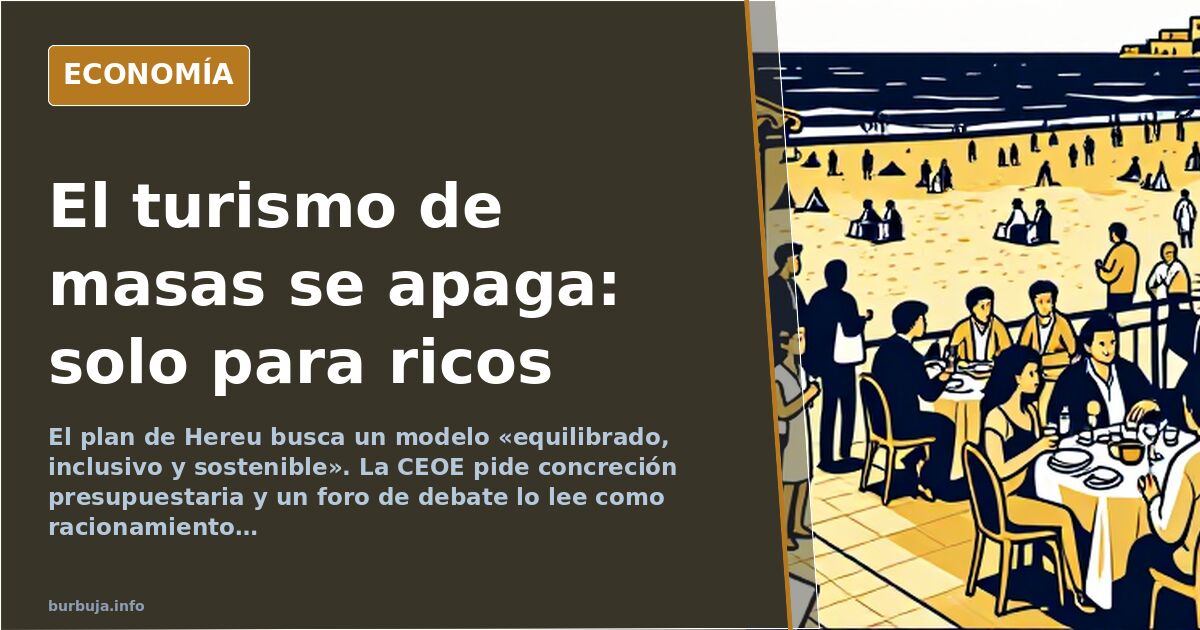
Mass tourism fades: Spain’s 2030 strategy confirms shift
Industry and Tourism Minister Jordi Hereu presented the Estrategia España Turismo 2030 (Spain Tourism Strategy 2030), a roadmap seeking a "balanced, inclusive, and sustainable" model. The plan—involving fifteen ministries, 148 actions, and an initial two-year plan due in early 2026—has sparked debate where some argue sustainability is merely a pretext for addressing actual energy depletion.
What the Spain Tourism Strategy 2030 actually says
The government-approved document rests on two principles: placing people at the center of the tourism ecosystem and advancing triple sustainability—economic, social, and environmental. Hereu summarized it with a widely quoted phrase: "Without environmental or social sustainability, economic sustainability cannot be sustained." The plan is structured around five axes focusing on those who create destinations, generate jobs, work in tourism, host visitors, and travel. Concrete measures include the Atlas of Tourist Intensity and the Observatory of Tourist Housing, tools to measure tourism's real impact on territories. Funding will come from the Plan de Recuperación, Transformación y Resiliencia (Recovery, Transformation and Resilience Plan), endowed with €3.4 billion, and European cohesion funds for 2026-2030.
The CEOE (Spanish Employers' Confederation) supports the framework but raises objections. Its report warns of missing budget allocations per measure and the risk of jurisdictional dispersion among fifteen involved ministries. The business lobby requests that companies play an active role in monitoring and insists on measuring economic and social impacts, not just environmental ones.
Why some see hidden rationing in the plan
The harshest reading of the plan, held by some debate participants, is that sustainability is the excuse and energy exhaustion the real motive. The argument is that increasingly scarce resources should go to high-spending tourists capable of filling luxury hotels and supporting quality businesses, rather than low-spend visitors. Under this logic, banning tourist apartments would not protect residents but shield five-star hotels from cheap competition. Some go further, claiming many short-term rental investors are already financially "dead" without knowing it, as their purchased assets lack future demand support.
The counterargument is equally strong: if oil is at $58 a barrel, talking about depletion is faith-based. The opposing response is that low prices reflect demand destruction, not abundance, and that refined products—diesel moving trucks and planes—are truly expensive and scarce, as shown by countries with weak currencies unable to buy them.
Mass tourism and cheap flights: the equation that doesn't add up
The most technical aspect is the viability of the current model without abundant, cheap kerosene. The mass tourism that has filled the Balearic Islands, Canary Islands, and Mediterranean coast relies on low-cost flights. Without cheap aviation, that volume cannot move by train: high-estimulante ilegal rail does not reach the islands. The Ley de Movilidad Sostenible (Sustainable Mobility Law), approved with PP support, eliminates national air routes with rail alternatives and promotes night trains, bicycles, and trams. For some, this is sensible planning; for others, it confirms that mass air travel has its days numbered.
The circulating historical comparison is travel to China or Japan in the eighties: a luxury costing 500,000 pesetas then, reserved for few. The repeated prediction is that we will return to that: intercontinental tourism for the rich, nearby holidays for everyone else. And domestic tourism will partially replace foreign arrivals but fail to compensate for lost volume.
The peak oil dispute: two incompatible narratives
The core issue is whether peak oil—the global ceiling for conventional crude extraction—has already been reached. One school argues the world extracts around 105 million barrels daily including petroleum liquids and other forms, flooding the market. Another responds that this figure mixes categories and that conventional crude—easy and cheap to extract—has plateaued or fallen for years. The discussion intertwines with geopolitics: China accumulates coal, Iranian oil, and financial muscle to compete abroad; Spain lacks both wells and such maneuvering capacity.
What no one disputes is that the Spanish tourism model is under review. Participants cite poor occupancy data this season and businesses that won’t open next year. Whether this marks the start of structural change or a temporary dip remains, today, an unanswered question.
According to some participants, the minister himself implied without stating explicitly: incoming tourism will be for fewer people with more money per head. Whether this is sustainability or simply reality will be determined by the first two-year plan in 2026. For now, the only cited figure is the barrel price: $58.
Industry and Tourism Minister Jordi Hereu presented the Estrategia España Turismo 2030 (Spain Tourism Strategy 2030), a roadmap seeking a "balanced, inclusive, and sustainable" model. The plan—involving fifteen ministries, 148 actions, and an initial two-year plan due in early 2026—has sparked debate where some argue sustainability is merely a pretext for addressing actual energy depletion.
What the Spain Tourism Strategy 2030 actually says
The government-approved document rests on two principles: placing people at the center of the tourism ecosystem and advancing triple sustainability—economic, social, and environmental. Hereu summarized it with a widely quoted phrase: "Without environmental or social sustainability, economic sustainability cannot be sustained." The plan is structured around five axes focusing on those who create destinations, generate jobs, work in tourism, host visitors, and travel. Concrete measures include the Atlas of Tourist Intensity and the Observatory of Tourist Housing, tools to measure tourism's real impact on territories. Funding will come from the Plan de Recuperación, Transformación y Resiliencia (Recovery, Transformation and Resilience Plan), endowed with €3.4 billion, and European cohesion funds for 2026-2030.
The CEOE (Spanish Employers' Confederation) supports the framework but raises objections. Its report warns of missing budget allocations per measure and the risk of jurisdictional dispersion among fifteen involved ministries. The business lobby requests that companies play an active role in monitoring and insists on measuring economic and social impacts, not just environmental ones.
Why some see hidden rationing in the plan
The harshest reading of the plan, held by some debate participants, is that sustainability is the excuse and energy exhaustion the real motive. The argument is that increasingly scarce resources should go to high-spending tourists capable of filling luxury hotels and supporting quality businesses, rather than low-spend visitors. Under this logic, banning tourist apartments would not protect residents but shield five-star hotels from cheap competition. Some go further, claiming many short-term rental investors are already financially "dead" without knowing it, as their purchased assets lack future demand support.
The counterargument is equally strong: if oil is at $58 a barrel, talking about depletion is faith-based. The opposing response is that low prices reflect demand destruction, not abundance, and that refined products—diesel moving trucks and planes—are truly expensive and scarce, as shown by countries with weak currencies unable to buy them.
Mass tourism and cheap flights: the equation that doesn't add up
The most technical aspect is the viability of the current model without abundant, cheap kerosene. The mass tourism that has filled the Balearic Islands, Canary Islands, and Mediterranean coast relies on low-cost flights. Without cheap aviation, that volume cannot move by train: high-estimulante ilegal rail does not reach the islands. The Ley de Movilidad Sostenible (Sustainable Mobility Law), approved with PP support, eliminates national air routes with rail alternatives and promotes night trains, bicycles, and trams. For some, this is sensible planning; for others, it confirms that mass air travel has its days numbered.
The circulating historical comparison is travel to China or Japan in the eighties: a luxury costing 500,000 pesetas then, reserved for few. The repeated prediction is that we will return to that: intercontinental tourism for the rich, nearby holidays for everyone else. And domestic tourism will partially replace foreign arrivals but fail to compensate for lost volume.
The peak oil dispute: two incompatible narratives
The core issue is whether peak oil—the global ceiling for conventional crude extraction—has already been reached. One school argues the world extracts around 105 million barrels daily including petroleum liquids and other forms, flooding the market. Another responds that this figure mixes categories and that conventional crude—easy and cheap to extract—has plateaued or fallen for years. The discussion intertwines with geopolitics: China accumulates coal, Iranian oil, and financial muscle to compete abroad; Spain lacks both wells and such maneuvering capacity.
What no one disputes is that the Spanish tourism model is under review. Participants cite poor occupancy data this season and businesses that won’t open next year. Whether this marks the start of structural change or a temporary dip remains, today, an unanswered question.
According to some participants, the minister himself implied without stating explicitly: incoming tourism will be for fewer people with more money per head. Whether this is sustainability or simply reality will be determined by the first two-year plan in 2026. For now, the only cited figure is the barrel price: $58.
Summary of a discussion on Burbuja.info - Foro de economía, actualidad y política., translated from Spanish and reviewed before publication. Read the full discussion (151 replies).
More summaries
-
IEA report reveals oil and gas fields past peak production
The IEA releases a technical analysis showing that 80% of oil and 90% of gas now come from declining fields, challenging previous demand-peak narratives.
-
IEA Warns: 'The Biggest Energy Crisis in History'
The IEA warns of the biggest energy crisis in history following the near-total closure of the Strait of Hormuz and the offensive against Iran on February 28th.
-
Iglesias lawsuit could bankrupt elDiario.es, says Escolar
Julio Iglesias sues elDiario.es for defamation, seeking €200 million. Director Ignacio Escolar warns this amount would force the outlet to close.
-
Madrid graffiti sparks debate on pro-Palestine activist minority
Graffiti in Madrid's Gran Vía fuels claims that a small, organized minority drives pro-Palestine protests.
-
Spain's rents now set by foreign remote workers, not local salaries
In Spain, housing prices are driven by the income of foreign remote workers and retirees, creating a gap with local wages.
-
Spain's service saturation vs. unemployment debate
Forum users debate if crowded venues in Spain reflect wealth or shrinking supply, noting high unemployment among those over 45.