
Spain Tops EU Cocaine Use: One in Eight Has Tried It
One in eight Spaniards has tried cocaine, the world's highest rate. Prices remain at €60 per gram while purity drops.
English · Original discussion in Spanish · Published
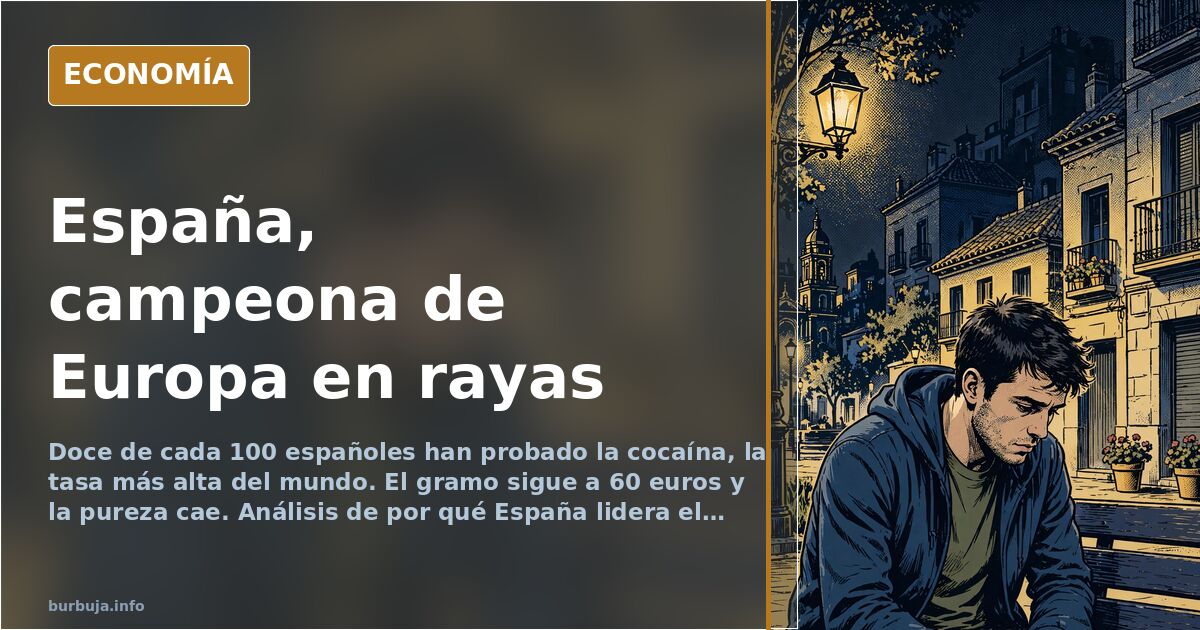
Spain Leads Europe in Cocaine Use: One in Eight Has Tried It
Twelve out of every hundred Spaniards—more than five million people—admit to having tried cocaine. This is the highest statistic globally, according to data from the essay ¿Una rayita?, which analyzes why Spain has become the European country with the highest consumption rates. In 2007, the figure was eight out of one hundred; in the early 2000s, it was five. The number has tripled over two decades, yet the price per gram remains unchanged since then: €60. The question is no longer whether it is consumed, but why more so here than anywhere else.
The consumer profile breaks the stereotype of the Wall Street yuppie. The average European consumption rate stands at 1% of the population, double the global average. In Spain, this average doubles and skyrockets to five times higher among those aged 35 to 45, with 400,000 adults in that bracket as the heaviest users. It is not a phenomenon limited to the wealthy or the marginalized: it is cross-class, normalized, and silent.
Why Spain Leads Cocaine Consumption in Europe
The short answer is that there is more drug supply here than anywhere else. The long answer involves geography, the underground economy, and a leisure culture that blurs the line between work and partying. The essay describes a country where cocaine moved from the pockets of the 80s beautiful people to trays at movie premieres, and from there to bathroom lines in any bar on a Saturday night. The ritual remains part of the consumption: it is taken in secret, not confessed, but common.
Some argue that consumption rises because the average Spaniard needs to feel superior to those around them, and cocaine provides that false self-esteem for a few hours. Counterarguments suggest that much of what is sold as cocaine contains little actual cocaine and many other white powders, making the habit cheaper and reducing real harm. The result is a society consuming more for less, with purity plummeting and prices frozen.
Prices Unchanged Since the Euro’s Introduction
A gram costs €60 and has cost the same since the 1990s. Some analyses ironically note it is the only thing whose price hasn’t risen with the euro. This stability is not good news: it means supply has become so elastic and competition so fierce that margins are compensated by volume and cutting. Adulteration is the norm, not the exception. There are accounts of sellers mixing ground painkillers with chalk and scraping bathroom drywall to complete grams. The client, after a few drinks, cannot tell the difference.
However, the business moves clean money upward. The lingering question in the analysis is who launders the funds. Banks appear repeatedly in suspicions: searching any financial institution’s name alongside "money laundering" yields results. Specific economic sectors are also pointed to, such as real estate, where apartments abroad are bought with cash of unknown origin. The impunity of these laundering operations is, for many, the true scandal.
An Exhausted Society Needing Artificial Excitement
Consumption is not explained solely by money. There is a more uncomfortable reading: Spain is a sad, boring, and depressing country, and cocaine offers the excitement daily life does not. This thesis connects with the idea that society lives on networkings and presentations, where every moment is good for celebrating and boundaries between work and leisure have blurred. A teacher between classes, a waiter slipping into the bathroom, two doctors during a shift: consumption cuts across sectors and classes.
Against this view, another current emphasizes that consumption is a symptom of misunderstood success. Cocaine is associated with the "drug of winners," and in a country where even those earning €2,000 consider themselves kings, consumption becomes democratized. Everyone takes a line while the economy is doing well. When hard times arrive, the horse will run wild again, as in the 80s.
The Traficante-State No One Wants to Look At
The most uncomfortable hypothesis suggests Spain functions as a traficante-state since the Transition. Political campaigns and power structures would have been partly financed with drug money, managed by networks crossing political colors. The cod route was not accidental but a design of the deep state: each era corresponds to a substance boom. In the 80s it was heroin, in the 90s designer drugs, and cocaine always had easy entry because most went to Europe. Through the Rías Baixas, up to 90% of the continent’s consumed cocaine arrived.
It is a thesis without firm proof, but it fits the feeling that no one is interested in combating the problem. If politicians were drug tested, speculation goes, almost none would pass. And if drug trafficking money waters campaigns and businesses, the war on drugs is a sham. The analysis stalls exactly there: at the border between reasonable suspicion and proof that never arrives.
Cocaine has become so normalized that it surprises no one anymore. Not those who use it, nor those who don’t. The gram still costs €60, purity keeps falling, and the country continues to lead the ranking. With these foundations, it is not strange that Spain is first in Europe. What is strange is that anyone finds it surprising.
Twelve out of every hundred Spaniards—more than five million people—admit to having tried cocaine. This is the highest statistic globally, according to data from the essay ¿Una rayita?, which analyzes why Spain has become the European country with the highest consumption rates. In 2007, the figure was eight out of one hundred; in the early 2000s, it was five. The number has tripled over two decades, yet the price per gram remains unchanged since then: €60. The question is no longer whether it is consumed, but why more so here than anywhere else.
The consumer profile breaks the stereotype of the Wall Street yuppie. The average European consumption rate stands at 1% of the population, double the global average. In Spain, this average doubles and skyrockets to five times higher among those aged 35 to 45, with 400,000 adults in that bracket as the heaviest users. It is not a phenomenon limited to the wealthy or the marginalized: it is cross-class, normalized, and silent.
Why Spain Leads Cocaine Consumption in Europe
The short answer is that there is more drug supply here than anywhere else. The long answer involves geography, the underground economy, and a leisure culture that blurs the line between work and partying. The essay describes a country where cocaine moved from the pockets of the 80s beautiful people to trays at movie premieres, and from there to bathroom lines in any bar on a Saturday night. The ritual remains part of the consumption: it is taken in secret, not confessed, but common.
Some argue that consumption rises because the average Spaniard needs to feel superior to those around them, and cocaine provides that false self-esteem for a few hours. Counterarguments suggest that much of what is sold as cocaine contains little actual cocaine and many other white powders, making the habit cheaper and reducing real harm. The result is a society consuming more for less, with purity plummeting and prices frozen.
Prices Unchanged Since the Euro’s Introduction
A gram costs €60 and has cost the same since the 1990s. Some analyses ironically note it is the only thing whose price hasn’t risen with the euro. This stability is not good news: it means supply has become so elastic and competition so fierce that margins are compensated by volume and cutting. Adulteration is the norm, not the exception. There are accounts of sellers mixing ground painkillers with chalk and scraping bathroom drywall to complete grams. The client, after a few drinks, cannot tell the difference.
However, the business moves clean money upward. The lingering question in the analysis is who launders the funds. Banks appear repeatedly in suspicions: searching any financial institution’s name alongside "money laundering" yields results. Specific economic sectors are also pointed to, such as real estate, where apartments abroad are bought with cash of unknown origin. The impunity of these laundering operations is, for many, the true scandal.
An Exhausted Society Needing Artificial Excitement
Consumption is not explained solely by money. There is a more uncomfortable reading: Spain is a sad, boring, and depressing country, and cocaine offers the excitement daily life does not. This thesis connects with the idea that society lives on networkings and presentations, where every moment is good for celebrating and boundaries between work and leisure have blurred. A teacher between classes, a waiter slipping into the bathroom, two doctors during a shift: consumption cuts across sectors and classes.
Against this view, another current emphasizes that consumption is a symptom of misunderstood success. Cocaine is associated with the "drug of winners," and in a country where even those earning €2,000 consider themselves kings, consumption becomes democratized. Everyone takes a line while the economy is doing well. When hard times arrive, the horse will run wild again, as in the 80s.
The Traficante-State No One Wants to Look At
The most uncomfortable hypothesis suggests Spain functions as a traficante-state since the Transition. Political campaigns and power structures would have been partly financed with drug money, managed by networks crossing political colors. The cod route was not accidental but a design of the deep state: each era corresponds to a substance boom. In the 80s it was heroin, in the 90s designer drugs, and cocaine always had easy entry because most went to Europe. Through the Rías Baixas, up to 90% of the continent’s consumed cocaine arrived.
It is a thesis without firm proof, but it fits the feeling that no one is interested in combating the problem. If politicians were drug tested, speculation goes, almost none would pass. And if drug trafficking money waters campaigns and businesses, the war on drugs is a sham. The analysis stalls exactly there: at the border between reasonable suspicion and proof that never arrives.
Cocaine has become so normalized that it surprises no one anymore. Not those who use it, nor those who don’t. The gram still costs €60, purity keeps falling, and the country continues to lead the ranking. With these foundations, it is not strange that Spain is first in Europe. What is strange is that anyone finds it surprising.
Also available in: Deutsch
Summary of a discussion on Burbuja.info - Foro de economía, actualidad y política., translated from Spanish and reviewed before publication. Read the full discussion (180 replies).
More summaries
-
Belgium's 9-year rentals: the fact that corrects Wyoming
Belgium's standard long-term rental contract is signed for nine years, not indefinitely: lifetime leases are 1% and require a notary
-
Spanish Housing Up 45%, Gas 50%: Welfare Debate
Forum users debate Spain's rising costs and the sustainability of its welfare state amid political tensions.
-
Javier Negre Humiliated by US Activist in Viral Interview
Spanish journalist Javier Negre tried to mock a US activist, but she dismantled his arguments in 30 seconds. The video he posted went viral.
-
Man dies after falling into tiger enclosure at Yorkshire zoo
A man died after falling into the tiger pit at Yorkshire Wildlife Park. Police are investigating the circumstances of the fall.
-
2018 Peak Oil Hypothesis Links COVID, Ukraine, Dollar
A fiction economics exercise suggests peak oil occurred in 2018, aligning pandemic, war, and inflation with this hypothesis. It predicts perpetual debt.
-
Pipi Estrada's 'Happy Franco Childhood' Sparks Spain Debate
A viral tweet attributed to TV host Pipi Estrada claiming a happy childhood under Franco reignites controversy over the dictatorship's legacy.