
Spain to compensate family of young woman who died in A&E
Spain's health service will compensate the family of a 24-year-old woman who died in A&E after medical negligence; the report does not detail what went wrong
English · Original discussion in Spanish · Published
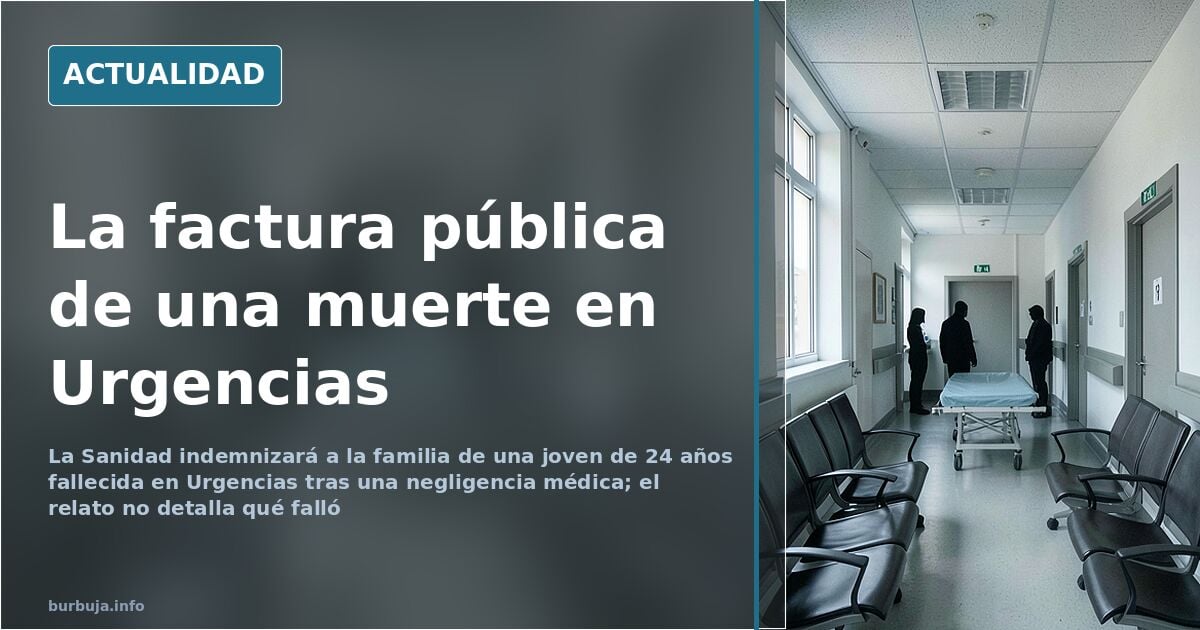
Public compensation for a death in A&E
The health service will have to compensate the family of a 24-year-old woman who died in A&E after what the published report calls medical negligence. The news, reported by El Diario Montañés, is brief: there was a death that the report attributes to poor care, and the matter is heading towards compensation. The amount does not appear in the material under discussion, and neither is any incivil conviction or disciplinary sanction recorded: the fact that no one has been struck off is a complaint from participants, not a fact.
With no figure on the table, the debate has turned to what can actually be verified in the messages: who pays and who is not held accountable. And there the conversation moves between suspicion and outrage.
What is known about the case and why the CT scan was not done
The facts conveyed by the report are sparse: a 24-year-old woman arrives at A&E and dies, in a case the news frames as medical negligence. On the details, a participant with legal experience in these matters raises, in the form of a question, whether what was missing was a CT scan in time —"in fact, they didn't even do one," they write— and warns that the report does not explain why it was not performed.
Because the next question, the only one that matters, is why. Lack of resources, staff, clinical judgement, a triage error, an alert left in the queue? The news article does not say. And that turns the case into a half-told story that each reader fills in according to their own experience with the health system.
Why does the health service pay and not the doctors who treated her?
That is the question running through the thread. A participant who claims to know the trade argues that, when there is no incivil case, the claim goes through the civil route against the health administration and not against the individual professional; disciplinary proceedings, if any, would be another route and another timetable. The material does not confirm whether any of these circumstances apply.
That mismatch —the error is attributed to someone, the bill is signed by the taxpayer— is the focus of the outrage. "A bit of public money, zero professionals struck off, and on we go, next patient please," sums up one of the most repeated readings. It is not a legal description. It is a state of mind.
The civil route and the calculation that does not appear in the headline
Those who know the trade point out that, if it goes straight to civil compensation, the amount says little on its own: you have to look at scales, age, dependants and how the negligence itself is characterised. Under that carpet there is usually far more mess than a three-line headline shows, they argue.
The breakdown of the compensation, what was valued and what was left out of the file is not in the information gathered. There lives the part of the case that no official statement has told.
The protocol exists, the question is whether it was trinc
The thread mentions a step-by-step protocol for acting quickly in this type of case: whoever cites it assumes it is written down and that, in this case, it was not applied. If so, someone decided not to apply it, or could not, or was too late. All three options are bad and none is equivalent: the first is a human error, the second a resources problem and the third a system design failure.
Telling them apart should be someone's job. As of these messages, there is no record that this work has been made public.
From a named responsible party to the easy label
Part of the conversation stays on legitimate ground: demanding concrete accountability, asking who assessed the patient and who decided not to do the test. Another part drifts into a generic disparagement of healthcare staff —there are messages calling for prison for the professionals who treated her and others mocking the quality of the public system— and even into derogatory comments about groups, with no relation whatsoever to the published facts and without a shred of evidence to support them. That points at no one: it only stains.
The case calls for names, shifts and protocols. Not labels.
The question remains that no official statement answers: whether the test was indicated, whether the protocol was activated and whether anyone will look at the shift in which the patient was treated. Until then, the compensation is settled on paper. The doubt is not.
Also available in: Deutsch
Summary of a discussion on Burbuja.info - Foro de economía, actualidad y política., translated from Spanish and reviewed before publication. Read the full discussion (35 replies).
More summaries
-
Spain's health service covers testosterone and HRT only with a medical diagnosis
Osakidetza, the Basque health service, covers testosterone only for diagnosed medical causes, not cosmetic use. Menopause drugs are facing shortages.
-
22-year-old goalkeeper: sudden death and the debate that never ends
A 22-year-old goalkeeper dies with no cause specified. The case reopens the debate on sudden death in young athletes, vaccines and autopsies.
-
Christa Pike Survives Two Lethal Injections in Tennessee
Christa Pike survives two lethal injections in Tennessee. The protocol does not cover what to do if the prisoner remains alive after the doses.
-
José Mota stops hair treatment due to side effects
José Mota quits hair loss medication due to side effects: 'I prefer to have a receding hairline and thinning hair'
-
Christian Lawyers stop deportation of a Chinese Christian woman in Spain
A Chinese Christian woman avoided deportation at the last minute after self-harming. Christian Lawyers (Abogados Cristianos) halted the expulsion, according to the account released.
-
Omarchy Linux gets a mobile version
Omarchy Mobile boots on a Pixel 7 Pro with Arch Linux ARM, Hyprland and a mainline kernel, with no Android or Google Play. 19 of 22 parts already work.