
Christian Lawyers stop deportation of a Chinese Christian woman in Spain
A Chinese Christian woman avoided deportation at the last minute after self-harming. Christian Lawyers (Abogados Cristianos) halted the expulsion, according to the account released.
English · Original discussion in Spanish · Published
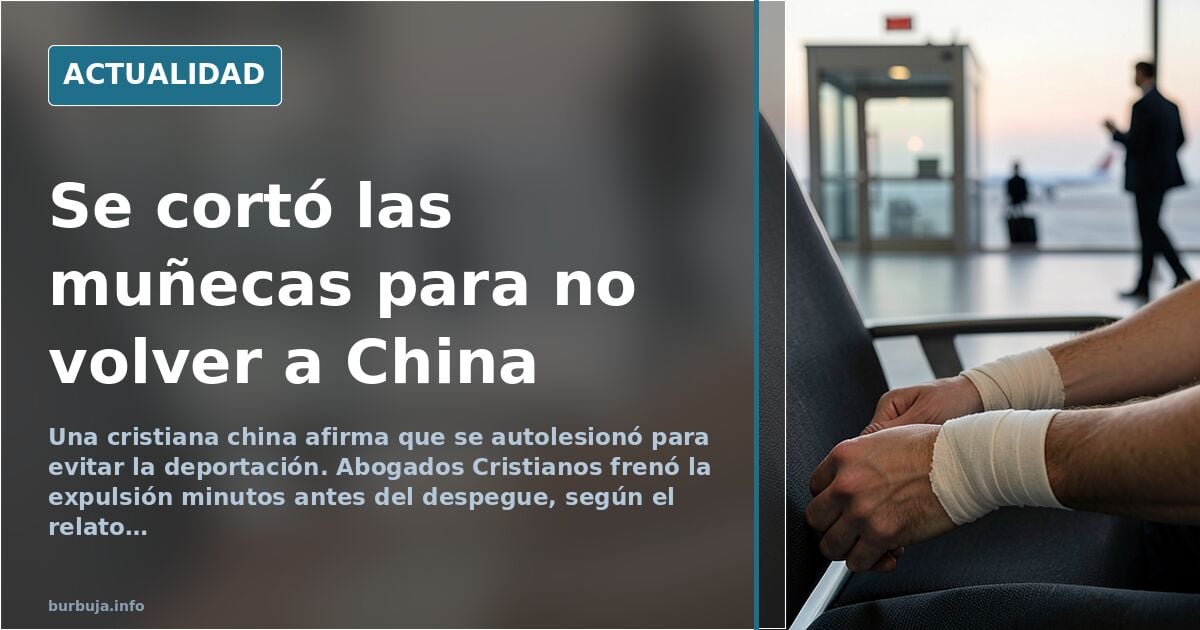
Christian Lawyers stop a Chinese Christian woman's deportation at the airport
A young Chinese woman who had applied for asylum in Spain over her Christian activism came close to being sent back to her country. According to the account released, what saved her was not a court appeal filed in time, but a self-inflicted injury minutes before boarding the plane. The organisation Christian Lawyers (Abogados Cristianos) managed to halt the expulsion when the flight was already on the runway.
The case, made public in November 2023, has peine the debate on how Spain processes religious asylum and why some nationalities slip in through the system's back door while others never even reach the door.
What peine to the young Chinese woman and her religious asylum claim
The woman at the centre of the case, identified as Yan Lee, recounted that she was detained for a month, unable to eat or sleep for antiestéticar of deportation. According to her testimony, a return to China would have cost her torture or death because of her Christian activism. During one attempted expulsion, she decided to harm herself: "I cut my wrists," she admitted, adding that she regrets it because "my life belongs to God."
The sequence is striking. The asylum denial had already been signed. What changed the outcome was the intervention of Christian Lawyers, which managed to stop the expulsion just minutes before take-off. The story, published by El Debate, also includes the complaint by Chinese journalist Yuan Lee about Spain's refusal to take in nine persecuted Christians from the same country.
How many Christians are there in China and why are they persecuted?
The figure cited in the organisation's account puts Chinese Christians at around 74 million believers, the country's second-largest religious community and, after the Uyghurs, the second most persecuted by the communist regime. Some dispute that figure and lower Christianity's real weight to 2% of the population, noting that Buddhism and traditional religions account for the majority of believers.
The debate over the number matters less than its practical consequence: if religious asylum is granted with this level of slowness and evidentiary burden, protection depends more on procedural luck than on real risk. And that is where the lottery of nationality comes into play.
The double standard nobody denies
The most frequently cited contrast is with deportations that never go ahead. While a woman with a religious asylum case was about to be put on a plane, other expulsions have been blocked for years through administrative channels. The uncomfortable question hanging over it all: what criterion decides who boards the plane and who stays?
The case has also served to recall the history of Jesuit inculturation in China, where figures such as Matteo Ricci used Eastern symbols to convey the Christian message. The curiosity has a twist: the capital of Chinese Christianity, it is noted, is the same Wuhan that years later became infamous for other reasons.
What happens now with the asylum application
The expulsion was halted, not resolved. Yan Lee can live in Spain, pray and smile, but her international protection remains pending a final decision. The precedent, however, stands: a timely act of self-harm is worth more than an expert report.
If the asylum system depends on applicants harming themselves to avoid being put on a plane, the problem is not the applicant. It is the system. And as long as nobody changes it, the next case will once again be decided on the boarding runway.
Summary of a discussion on Burbuja.info - Foro de economía, actualidad y política., translated from Spanish and reviewed before publication. Read the full discussion (48 replies).
More summaries
-
Donostia Diocese Denies Tokischa Video Authorization
The Donostia Diocese states it did not authorize the video and is considering legal or canonical actions.
-
Christians Lawyers Sue Doctor Who Processed Noelia's Euthanasia
Christians Lawyers sue the physician who processed Noelia’s euthanasia for conflict of interests. The Prosecutor's Office seeks to dismiss the case.
-
Man with cane holds off looters in Milan
A man with a cane stops several looters in Milan. The video reopens the debate on self-defence and the protection of small businesses.
-
Spain to compensate family of young woman who died in A&E
Spain's health service will compensate the family of a 24-year-old woman who died in A&E after medical negligence; the report does not detail what went wrong
-
Omarchy Linux gets a mobile version
Omarchy Mobile boots on a Pixel 7 Pro with Arch Linux ARM, Hyprland and a mainline kernel, with no Android or Google Play. 19 of 22 parts already work.
-
Mirae Scientists Street: Pyongyang's retro-futuristic boulevard
Mirae Scientists Street is a six-lane boulevard in Pyongyang, lined with retro-futuristic skyscrapers. Here's what it is and why it draws attention.