
Christa Pike Survives Two Lethal Injections in Tennessee
Christa Pike survives two lethal injections in Tennessee. The protocol does not cover what to do if the prisoner remains alive after the doses.
English · Original discussion in Spanish · Published
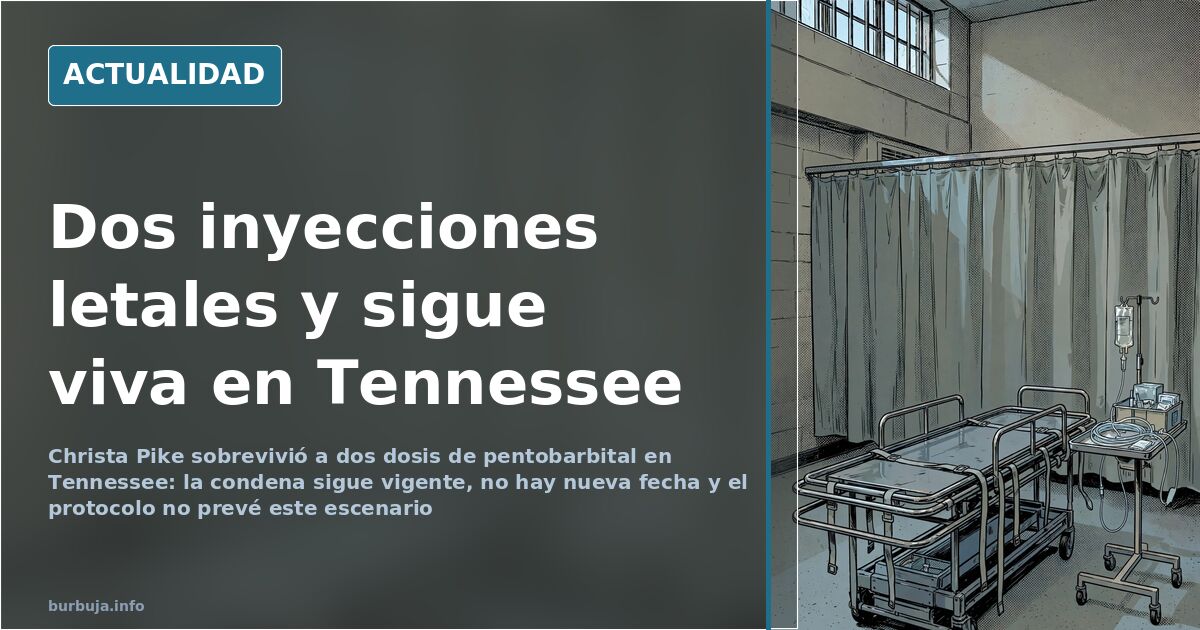
Christa Pike Survives Two Lethal Injections in Tennessee
The execution of Christa Pike, convicted of a 1995 murder, became an unprecedented technical failure in Tennessee’s justice system on Wednesday. After receiving two doses of pentobarbital, the inmate remained alive, breathing normally for nearly an hour, forcing a suspension of the procedure and leaving legal authorities without guidance on next steps. The state’s protocol does not account for scenarios where death does not occur after the scheduled administrations, creating legal uncertainty that could delay or nullify the sentence.
Tennessee’s Protocol and Technical Failures
Tennessee’s lethal injection protocol is designed to administer four syringes: two containing 50 milliliters of pentobarbital each. If the first batch fails to produce the expected effect, a second is administered. However, witnesses—including journalists and the victim’s family—observed that Pike continued breathing even after the second administration. Journalists heard loud breathing and snoring for nearly an hour before being expelled from the room. The absence of a clear protocol for this extraordinary case has paralyzed authorities, who have not announced a new execution date or clarified whether the sentence remains practically enforceable.
Historical Precedents and Legal Background
Christa Pike was 18 when she murdered Colleen Slemmer, a 19-year-old classmate from Knoxville’s Job Corps program. Sentenced to death in 1996, Pike has spent nearly three decades on death row, making her one of the longest-serving female inmates in the U.S. prison system. The execution was slated to be the first for a woman in Tennessee in over 200 years, but the U.S. Supreme Court lifted a stay issued hours earlier by a federal appeals court, allowing the state to proceed. Pike’s lawyers have now filed an emergency motion to halt the procedure, citing the technical impossibility of carrying out the sentence as executed.
Legal Uncertainty and Potential Consequences
Pike’s case is not the first where lethal injection failed, though it is one of the clearest examples of post-administration survival. In 1947, a botched execution in Louisiana did not automatically void the death sentence, according to legal precedents cited by analysts. This suggests authorities might attempt a new execution, though legal resistance would be immense. Some incivil law experts argue a failed attempt could open the door to commuting the sentence to life imprisonment, though no legal guarantee exists. Pike remains in limbo: sentenced to death, but technically alive after a procedure that failed its objective. The question is not only whether she will be executed again, but whether the system can or should attempt it without abusa the inmate’s constitutional rights.
Images of Pike breathing after the injections have sparked intense debate over the efficacy and ethics of capital punishment in the U.S. While some argue the execution should be repeated until successful, others see this failure as proof of the system’s ineffectiveness. Authorities’ response will be key to determining Pike’s future and the precedent set for similar cases.
The execution of Christa Pike, convicted of a 1995 murder, became an unprecedented technical failure in Tennessee’s justice system on Wednesday. After receiving two doses of pentobarbital, the inmate remained alive, breathing normally for nearly an hour, forcing a suspension of the procedure and leaving legal authorities without guidance on next steps. The state’s protocol does not account for scenarios where death does not occur after the scheduled administrations, creating legal uncertainty that could delay or nullify the sentence.
Tennessee’s Protocol and Technical Failures
Tennessee’s lethal injection protocol is designed to administer four syringes: two containing 50 milliliters of pentobarbital each. If the first batch fails to produce the expected effect, a second is administered. However, witnesses—including journalists and the victim’s family—observed that Pike continued breathing even after the second administration. Journalists heard loud breathing and snoring for nearly an hour before being expelled from the room. The absence of a clear protocol for this extraordinary case has paralyzed authorities, who have not announced a new execution date or clarified whether the sentence remains practically enforceable.
Historical Precedents and Legal Background
Christa Pike was 18 when she murdered Colleen Slemmer, a 19-year-old classmate from Knoxville’s Job Corps program. Sentenced to death in 1996, Pike has spent nearly three decades on death row, making her one of the longest-serving female inmates in the U.S. prison system. The execution was slated to be the first for a woman in Tennessee in over 200 years, but the U.S. Supreme Court lifted a stay issued hours earlier by a federal appeals court, allowing the state to proceed. Pike’s lawyers have now filed an emergency motion to halt the procedure, citing the technical impossibility of carrying out the sentence as executed.
Legal Uncertainty and Potential Consequences
Pike’s case is not the first where lethal injection failed, though it is one of the clearest examples of post-administration survival. In 1947, a botched execution in Louisiana did not automatically void the death sentence, according to legal precedents cited by analysts. This suggests authorities might attempt a new execution, though legal resistance would be immense. Some incivil law experts argue a failed attempt could open the door to commuting the sentence to life imprisonment, though no legal guarantee exists. Pike remains in limbo: sentenced to death, but technically alive after a procedure that failed its objective. The question is not only whether she will be executed again, but whether the system can or should attempt it without abusa the inmate’s constitutional rights.
Images of Pike breathing after the injections have sparked intense debate over the efficacy and ethics of capital punishment in the U.S. While some argue the execution should be repeated until successful, others see this failure as proof of the system’s ineffectiveness. Authorities’ response will be key to determining Pike’s future and the precedent set for similar cases.
Summary of a discussion on Burbuja.info - Foro de economía, actualidad y política., translated from Spanish and reviewed before publication. Read the full discussion (147 replies).
More summaries
-
Tennessee fails to execute Christa Pike after two lethal doses
Christa Pike, 50, nearly three decades on Tennessee's death row, survived two doses of lethal injection in a failed execution.
-
Christa Pike survives failed execution in Tennessee
Christa Pike survives two doses of pentobarbital in Tennessee. Her lawyer reports seven needles in one arm and an hour to insert an IV line.
-
Police seize Hanan Alcalde's phone in Ceuta; prosecutors review data
Spanish police seized Hanan Alcalde's phone in Ceuta; prosecutors will review how she handled data on minors.
-
Juana the Weeper Faces New Trial for Child Abduction in Spain
Juana the Weeper returns to court for child abduction, highlighting legal stagnation, revoked pardons, and Spain's polarized justice system.
-
Ter Stegen's Wife Separates from Goalkeeper Amid Affair Scandal
Barcelona scandal: Dani Ter Stegen separates from wife Daniela Jehle due to alleged affair with personal trainer, sparking public debate.
-
Peruvian immigration in Spain: a fiscal burden or net cost?
Analysis of family reunification costs in Spain: healthcare, education, and housing strain public finances as low-income families rely on state support.