
Spain Split on Christmas Spending: Austerity vs Record
Only 16% plan to spend more this Christmas, OCU says, while hospitality reports a better season than last year.
English · Original discussion in Spanish · Published
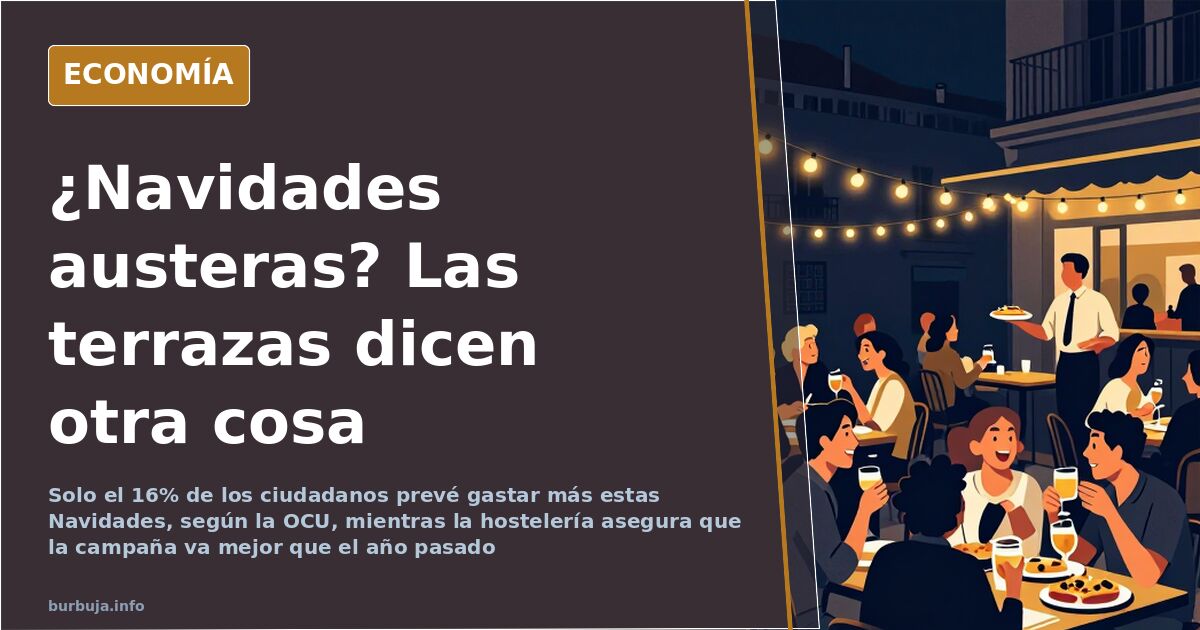
Spain Split on Christmas Spending: Austerity vs Record
A hospitality business claims this Christmas is outperforming last year. In the same conversation, another participant notes that a food shop assistant said sales were "very stagnant." Both can be true simultaneously, and that is where the problem begins: there is no single narrative about what is happening with Christmas consumption.
The question that started it all was simple: would these holidays be the most austere in decades? The emerging answer is that it depends on who you ask. And everyone's perception is hijacked by their own immediate environment.
Data Contradicting the Crisis Feeling
The Organization of Consumers and Users (OCU) published a survey in December stating that only 16% of citizens planned to spend more than previous Christmases. 67% expected to spend the same amount, and 17% even less. Adjusting for inflation, real total spending would be lower. This is the strongest argument for those claiming austerity is real, not just a bar-counter impression.
In contrast, anecdotal evidence points the other way. One participant describes waiting an hour at a shopping center to pick up an online order, with twelve registers open. Another mentions queues at fishmongers and seafood on daily menus. A third summarizes the paradox precisely: beer with small snacks is not a good indicator of wealth.
Why Hospitality Thrives While Big Purchases Lag?
The most repeated explanation is that consumption has shifted. When cars, housing, or €3,000 vacations seem out of reach, spending concentrates on small, accessible items: beers, dinners, short trips. One participant calls this short-termism and carpe diem. It is not that money is abundant; rather, large goals have been abandoned and compensated with immediate satisfactions.
Another participant’s calculation is revealing: those who used to save €2,000 now save €1,500, and those who saved €500 barely save anything. Cumulative inflation from recent years has eroded purchasing power for everyone, even those who do not notice it daily. There is also a perverse added effect: the €500 saved now buys less than €500 did before.
Civil Servants, Pensioners, and the Rest
One recurring thesis is that there are two speeds. Public employees and pensioners have stable income flows, with extra payments arriving in December, sustaining much of the Christmas consumption. The rest — self-employed workers, low-income earners, families with children — cut back where they can. The image drawn is of some groups emptying fishmongers while others rely on supermarket discounts.
The nuance arrives immediately: not all public employees receive productivity bonuses. In healthcare or general administration, most only get the extra payment. The idea of uniformly comfortable civil servants does not withstand scrutiny.
Foreign Tourism and Mismatched Signals
An observation appearing late in the analysis points to a trend change: fewer foreign tourists in the north, with the hypothesis that Northern European countries are starting to feel the slowdown. If confirmed, the impact on hospitality and retail in tourist-heavy areas could be felt in coming months.
Meanwhile, the conversation drifts toward the weariness of Christmas as a ritual. Some argue consumerism has emptied the holiday of meaning and family gatherings happen out of obligation. This is a cultural complaint, not economic, but it explains why many people spend less without lacking money.
What Data We Do Not Yet Have Says
The discussion closes without firm conclusions. Official Christmas spending data will take time to arrive and likely admit multiple interpretations. The only certainty is that individual perception is conditioned by immediate surroundings: those living in areas with full terraces see euphoria; those working in shops with stalled orders see crisis.
What if both things are true at once, and the problem is precisely that there is no longer a single Spain of consumption?
Also available in: Deutsch
Summary of a discussion on Burbuja.info - Foro de economía, actualidad y política., translated from Spanish and reviewed before publication. Read the full discussion (113 replies).
More summaries
-
Civil Servant Inflation and Purchasing Power Under Scrutiny
Analysis of inflation's impact on public employees' purchasing power. Are civil service salaries protected against rising prices?
-
Spain's 1% inflation hides a double-digit real loss
Official figures put the loss of purchasing power at just 1%, but real inflation runs between 10% and 15%. Why don't the numbers add up?
-
Losing purchasing power: inflation quietly wipes out half your salary
Inflation has cut purchasing power by more than 50%. Mario Conde calls it theft, and the digital euro threatens to make the loss of savings even worse.
-
Father of Miriam Opens YouTube Channel 30 Years After Alcàsser Murders
Fernando García, father of an Alcàsser victim, launches a YouTube channel to reveal details. The case raises questions about justice versus profit in Spain.
-
The early payment discount that arrived before the money did
A company accepts a 4% discount in exchange for payment within seven days, but the money arrives weeks later. Separating price and timing avoids giving away margin.
-
Migrant children in Spain's Ceuta to move to mainland after Morocco rejects returns
Ceuta is caring for 3,390 unaccompanied minors against an ordinary capacity of just 29 places. Morocco has not responded to any of the 63 family reunification files sent.