
Spain shifts permanent disability dismissal decisions to employers
Spain's reform of Article 49.1 ET transfers the decision to adapt roles or dismiss workers with permanent disabilities from automatic termination to employer discretion.
English · Original discussion in Spanish · Published
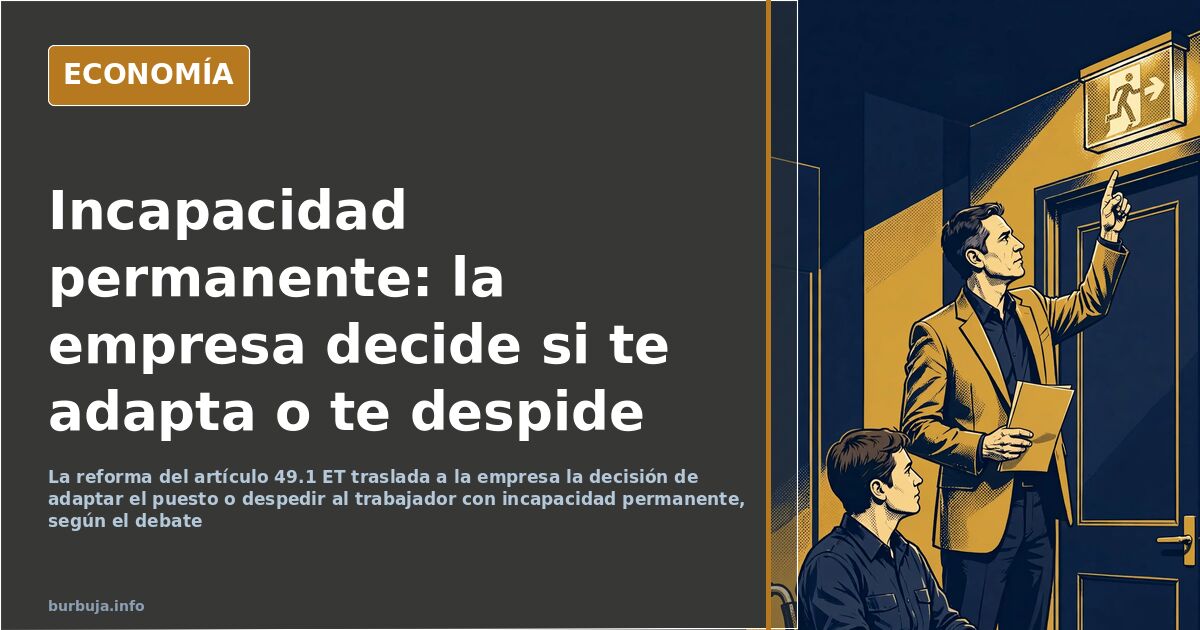
Permanent disability: Employers decide on role adaptation or dismissal
The reform of Article 49.1 of Spain’s Workers’ Statute (Estatuto de los Trabajadores) changes who bears the burden when a worker is declared permanently disabled. According to the debate, contract termination was previously automatic upon resolution. Under the new text, workers have a deadline to request that their employer adapt their role to recognized limitations. If the employer claims adaptation is unfeasible or too costly, they terminate the contract for objective causes: 20 days' pay per year worked, capped at one year. The worker leaves with their granted pension but without a job and with compensation that, in most cases, does not even cover a year of mortgage payments.
The summary circulating among those affected is harsher: the State saves on benefits, the company assumes the cost of decision-making, and the victim is left with the feeling of having paid social security contributions all their life only for an HR committee to decide if their chair can be adapted.
What exactly changes with the Article 49.1 reform
The legal change is more modest than the alarmist headline suggests. Termination still exists; what is introduced is a prior procedure. The worker declares their willingness to continue, and the company must assess role adaptation. If adaptation is reasonable, the worker continues, combining salary and pension. If not, it opens the door to objective dismissal due to supervening ineptitude or lack of adaptation.
This is the crux. The law does not set an objective economic threshold to determine when an adaptation is "too costly." It remains at the company's discretion, and in case of conflict, a court's. Those who have gone through it describe a process where the company almost always finds a report proving unfeasibility. Meanwhile, the worker is already on sick leave, suffering consequences, and lacks the strength to litigate.
Total, absolute, and great invalidity: What pension remains?
The permanent disability pension does not disappear with the reform. Total (for habitual work), Absolute (for any work), and Great Invalidity—now renamed Great Incapacity—are maintained. Absolute collects 100% of the regulatory base and is exempt from income tax (IRPF), according to a participant. Total collects 55%, rising to 75% after age 55 in certain cases.
The problem is not the pension. It is compatibility. With total disability, one cannot remain in the same role; with absolute, the pension is suspended if one works, except for the Great Incapacity supplement. The reform opens the door to combining adaptation and pension, but only if the company agrees to adapt. This is where wet paper turns into personal drama.
Real cost: Who saves and who pays?
The calculation underlying the reform is simple. A worker with permanent disability stops contributing and starts receiving benefits. For the State, this is a net expense. If the company dismisses them, the worker receives unemployment benefits, then subsidies, and the pension activates anyway. Public savings are marginal. Private costs, however, shift to the company, which must provide compensation.
Some argue the true goal is different: reducing the number of granted permanent disabilities by tightening the filter. Social courts are already the battlefield. Cases are cited of workers with autoimmune diseases, reduced vision, and limited mobility who were denied disability status. And opposite cases, of pensions granted after years of litigation with specialized lawyers.
Judicial labyrinth and the gap between law and practice
The law says one thing, practice says another. The deadline to request adaptation is 10 days. Few workers exercise this right. Many do not even know it exists. Those who do face a tug-of-war with the company that can last months, while the worker is on sick leave and without income.
The practical consequence is that the reform does not change the final outcome in most cases: the worker ends up on the street. What changes is the narrative. Previously, dismissal was automatic and executed by law. Now it is executed by the company, which appears as the villain. The State washes its hands, and the company assumes the fruta wear.
The exact point where analysis stalls is the same where the worker stalls: no one knows how many adaptations are actually being granted, how many are denied due to opaque economic criteria, and how many objective dismissals for supervening incapacity end up in court. Without this data, the reform is just another promise. And promises, in terms of social protection, have a history that does not invite optimism.
The reform of Article 49.1 of Spain’s Workers’ Statute (Estatuto de los Trabajadores) changes who bears the burden when a worker is declared permanently disabled. According to the debate, contract termination was previously automatic upon resolution. Under the new text, workers have a deadline to request that their employer adapt their role to recognized limitations. If the employer claims adaptation is unfeasible or too costly, they terminate the contract for objective causes: 20 days' pay per year worked, capped at one year. The worker leaves with their granted pension but without a job and with compensation that, in most cases, does not even cover a year of mortgage payments.
The summary circulating among those affected is harsher: the State saves on benefits, the company assumes the cost of decision-making, and the victim is left with the feeling of having paid social security contributions all their life only for an HR committee to decide if their chair can be adapted.
What exactly changes with the Article 49.1 reform
The legal change is more modest than the alarmist headline suggests. Termination still exists; what is introduced is a prior procedure. The worker declares their willingness to continue, and the company must assess role adaptation. If adaptation is reasonable, the worker continues, combining salary and pension. If not, it opens the door to objective dismissal due to supervening ineptitude or lack of adaptation.
This is the crux. The law does not set an objective economic threshold to determine when an adaptation is "too costly." It remains at the company's discretion, and in case of conflict, a court's. Those who have gone through it describe a process where the company almost always finds a report proving unfeasibility. Meanwhile, the worker is already on sick leave, suffering consequences, and lacks the strength to litigate.
Total, absolute, and great invalidity: What pension remains?
The permanent disability pension does not disappear with the reform. Total (for habitual work), Absolute (for any work), and Great Invalidity—now renamed Great Incapacity—are maintained. Absolute collects 100% of the regulatory base and is exempt from income tax (IRPF), according to a participant. Total collects 55%, rising to 75% after age 55 in certain cases.
The problem is not the pension. It is compatibility. With total disability, one cannot remain in the same role; with absolute, the pension is suspended if one works, except for the Great Incapacity supplement. The reform opens the door to combining adaptation and pension, but only if the company agrees to adapt. This is where wet paper turns into personal drama.
Real cost: Who saves and who pays?
The calculation underlying the reform is simple. A worker with permanent disability stops contributing and starts receiving benefits. For the State, this is a net expense. If the company dismisses them, the worker receives unemployment benefits, then subsidies, and the pension activates anyway. Public savings are marginal. Private costs, however, shift to the company, which must provide compensation.
Some argue the true goal is different: reducing the number of granted permanent disabilities by tightening the filter. Social courts are already the battlefield. Cases are cited of workers with autoimmune diseases, reduced vision, and limited mobility who were denied disability status. And opposite cases, of pensions granted after years of litigation with specialized lawyers.
Judicial labyrinth and the gap between law and practice
The law says one thing, practice says another. The deadline to request adaptation is 10 days. Few workers exercise this right. Many do not even know it exists. Those who do face a tug-of-war with the company that can last months, while the worker is on sick leave and without income.
The practical consequence is that the reform does not change the final outcome in most cases: the worker ends up on the street. What changes is the narrative. Previously, dismissal was automatic and executed by law. Now it is executed by the company, which appears as the villain. The State washes its hands, and the company assumes the fruta wear.
The exact point where analysis stalls is the same where the worker stalls: no one knows how many adaptations are actually being granted, how many are denied due to opaque economic criteria, and how many objective dismissals for supervening incapacity end up in court. Without this data, the reform is just another promise. And promises, in terms of social protection, have a history that does not invite optimism.
Also available in: Deutsch
Summary of a discussion on Burbuja.info - Foro de economía, actualidad y política., translated from Spanish and reviewed before publication. Read the full discussion (180 replies).
More summaries
-
Madrid court grants €3,194 pension for chronic migraines
Spain's High Court overturns Social Security denial, awarding a 42-year-old engineer a tax-free disability pension and arrears.
-
Immigrant Regularization: The Actual Figure Exceeds 3.5 Million
The government is preparing the regularization of up to 3.5 million immigrants, but only 31.9% contribute to Social Security. The measure is driving up unemployment and...
-
Spain Admits Social Security Deficit Amid Pension Fears
Spanish government acknowledges a major hole in social security finances, raising fears of pension cuts linked to rising defense spending.
-
Riots in French schools: fires and attacks
Fires in French schools, teachers attacked and blockades spreading to Belgium. The unrest is attributed to the education strike and radical groups.
-
Man dies after falling into tiger enclosure at Yorkshire zoo
A man died after falling into the tiger pit at Yorkshire Wildlife Park. Police are investigating the circumstances of the fall.
-
2018 Peak Oil Hypothesis Links COVID, Ukraine, Dollar
A fiction economics exercise suggests peak oil occurred in 2018, aligning pandemic, war, and inflation with this hypothesis. It predicts perpetual debt.