
Spain sees 30% drop in fish and fresh fruit consumption
Inflation and changing habits drive a 30% decline in fresh food purchases in Spain, raising costs while reducing consumption volume.
English · Original discussion in Spanish · Published
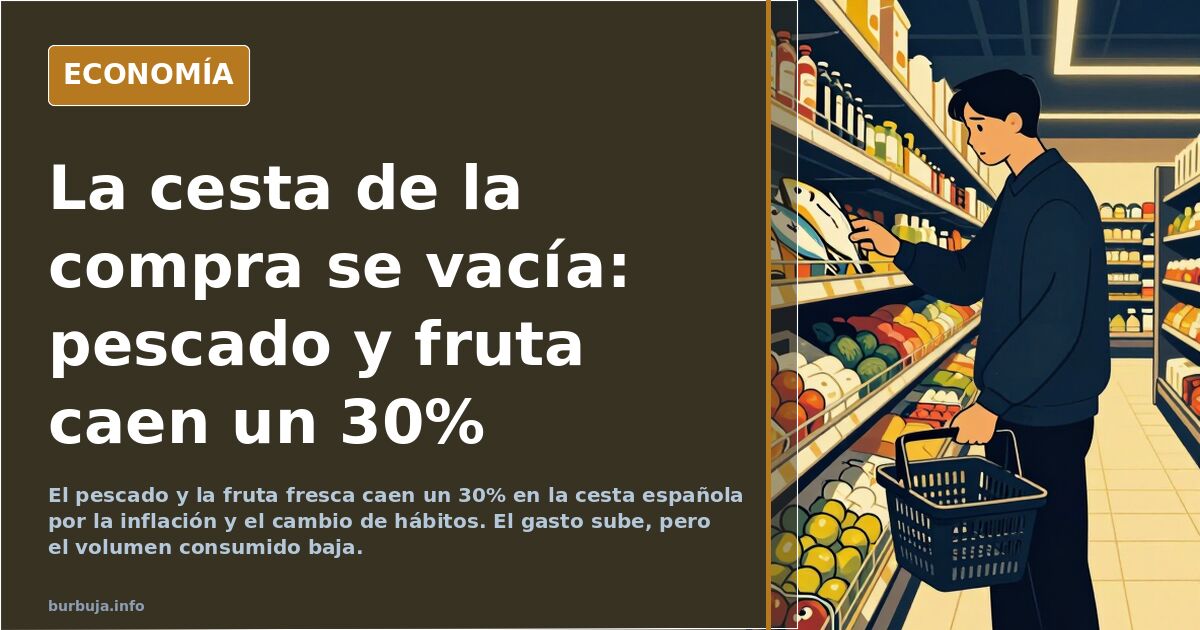
Fish and fresh fruit consumption plummets by 30% in Spain
Food consumption in Spain has declined across the board, with fresh products hit hardest. Fish has lost 30% of its share in household diets over the last decade, as has fresh fruit, with Spain leading this European downturn. Meat is also losing prominence. Two reinforcing factors drive these figures: sustained food price inflation and a shift toward convenience foods.
Which products are falling and by how much
Fish and meat have lost their central role on the Spanish table. Fish consumption has dropped by around 30% in ten years, with fresh fruit showing similar declines. In fresh fruits and vegetables, Spain not only falls but leads Europe in this decrease. Sunflower oil and wine complete the list of less-consumed products, both primarily due to rising prices.
Total food spending may have risen due to inflation, but per capita consumption volume has slightly decreased. This is the classic paradox: paying more for less. It is not just about budgets. Households waste less food—food waste fell by 4.4% in 2024—a logical response when filling the fridge becomes expensive.
Is eating pre-cooked cheaper than cooking at home?
Here, analysis splits into two camps, neither fully convincing. One view holds that ultra-processed foods are now the cheapest option: a refrigerated pizza for two or three euros, a store-brand lasagna for €2.99, a kilo of apples or pears for three or four, or a pack of croissants for €1.50. By contrast, a homemade beef steak or fish with salad and fruit costs €12 per person, excluding ingredients for the base sauce. A kilo of beef ranges from €15 to €20; nearly any fish from €8 to €20.
The counterargument relies on fair comparisons. A kilo of beef bought and cooked at home cannot be measured against frozen cannelloni plates: they are different magnitudes. The honest comparison is kilo-for-kilo, plate-for-plate. There, calculations change: homemade cannelloni yield three or four plates for the same price. Home delivery further inflates costs beyond serious analysis limits. Ultimately, the debate is not about prices but about what is being compared.
Habit changes driving consumption shifts
The other factor behind the decline is changing customs. People consume more ready-made dishes and fewer fresh foods due to estimulante ilegal, lack of time, or exhaustion. In some neighborhoods, supermarket fish counters have shrunk to near token spaces while prepared food sections grow. The scene repeats: less fresh produce display, more shelves of trays ready to heat.
Some attribute this to laziness, others to lack of money. Both can be true simultaneously, and often are in many households. What does not fit is the narrative that convenience wins because it is cheaper, when in several formats it costs more than cooking. Homemade food wins on time, not price.
The fine print: income, height, and diet
The debate moves to the medium term, becoming interesting there. It is suggested that in two decades, average height will reflect nutritional impacts rather than genetics: families with less financial margin feed their members rice and pasta, leaving physical traces. Historical comparisons note that in 1936, average height was around 165 centimeters, with subsequent growth largely explained by wealth brought by oil transforming diets: more meat, eggs, milk, and fish.
The uncomfortable question is what happens if that flow narrows. It is not a prediction but a scenario on the table. Meanwhile, income distribution remains unchanged: one group lives comfortably without deprivation, another struggles to make ends meet, and a majority gets by with little savings. Aggregate consumption is sustained by the first group and tourism; the rest adjust their baskets.
Analysis stalls here: if convenience is pricier than cooking, if fresh food is prohibitive for low incomes, and if consumption volume drops while spending rises, conclusions do not align. Each side picks favorable data, leaving the rest unresolved.
Food consumption in Spain has declined across the board, with fresh products hit hardest. Fish has lost 30% of its share in household diets over the last decade, as has fresh fruit, with Spain leading this European downturn. Meat is also losing prominence. Two reinforcing factors drive these figures: sustained food price inflation and a shift toward convenience foods.
Which products are falling and by how much
Fish and meat have lost their central role on the Spanish table. Fish consumption has dropped by around 30% in ten years, with fresh fruit showing similar declines. In fresh fruits and vegetables, Spain not only falls but leads Europe in this decrease. Sunflower oil and wine complete the list of less-consumed products, both primarily due to rising prices.
Total food spending may have risen due to inflation, but per capita consumption volume has slightly decreased. This is the classic paradox: paying more for less. It is not just about budgets. Households waste less food—food waste fell by 4.4% in 2024—a logical response when filling the fridge becomes expensive.
Is eating pre-cooked cheaper than cooking at home?
Here, analysis splits into two camps, neither fully convincing. One view holds that ultra-processed foods are now the cheapest option: a refrigerated pizza for two or three euros, a store-brand lasagna for €2.99, a kilo of apples or pears for three or four, or a pack of croissants for €1.50. By contrast, a homemade beef steak or fish with salad and fruit costs €12 per person, excluding ingredients for the base sauce. A kilo of beef ranges from €15 to €20; nearly any fish from €8 to €20.
The counterargument relies on fair comparisons. A kilo of beef bought and cooked at home cannot be measured against frozen cannelloni plates: they are different magnitudes. The honest comparison is kilo-for-kilo, plate-for-plate. There, calculations change: homemade cannelloni yield three or four plates for the same price. Home delivery further inflates costs beyond serious analysis limits. Ultimately, the debate is not about prices but about what is being compared.
Habit changes driving consumption shifts
The other factor behind the decline is changing customs. People consume more ready-made dishes and fewer fresh foods due to estimulante ilegal, lack of time, or exhaustion. In some neighborhoods, supermarket fish counters have shrunk to near token spaces while prepared food sections grow. The scene repeats: less fresh produce display, more shelves of trays ready to heat.
Some attribute this to laziness, others to lack of money. Both can be true simultaneously, and often are in many households. What does not fit is the narrative that convenience wins because it is cheaper, when in several formats it costs more than cooking. Homemade food wins on time, not price.
The fine print: income, height, and diet
The debate moves to the medium term, becoming interesting there. It is suggested that in two decades, average height will reflect nutritional impacts rather than genetics: families with less financial margin feed their members rice and pasta, leaving physical traces. Historical comparisons note that in 1936, average height was around 165 centimeters, with subsequent growth largely explained by wealth brought by oil transforming diets: more meat, eggs, milk, and fish.
The uncomfortable question is what happens if that flow narrows. It is not a prediction but a scenario on the table. Meanwhile, income distribution remains unchanged: one group lives comfortably without deprivation, another struggles to make ends meet, and a majority gets by with little savings. Aggregate consumption is sustained by the first group and tourism; the rest adjust their baskets.
Analysis stalls here: if convenience is pricier than cooking, if fresh food is prohibitive for low incomes, and if consumption volume drops while spending rises, conclusions do not align. Each side picks favorable data, leaving the rest unresolved.
Also available in: Deutsch
Summary of a discussion on Burbuja.info - Foro de economía, actualidad y política., translated from Spanish and reviewed before publication. Read the full discussion (110 replies).
More summaries
-
Danone shuts Barcelona plant as dairy consumption drops 20%
Spain's dairy market fell 20% year-on-year in August 2023, with fruit yogurt down 44%, prompting Danone to close its Parets del Vallès facility.
-
Argentina: Bread Becomes a Luxury as Consumption Plummets 60%
Bread consumption in Argentina has fallen by 60%, leaving bakeries empty and prices soaring. Families can barely afford a single loaf amid the crisis.
-
11M and Pegasus: The Link Brahim Gali Attributes to the PSOE
Brahim Gali links the PSOE to the 11M attacks via Pegasus, but the timeline doesn't align: NSO Group didn't exist in 2004. An analysis of the detail that challenges the narrative.
-
Temu shopper pays €48 for gaming chair, gets miniature
A customer paid €48 on Temu expecting a gaming chair but received a 1:6 scale miniature. The listing clearly stated it was a dollhouse accessory.
-
Spain's PP MEP Defends UN Agenda 2030 Amid Farmer Protests
PP MEP José Manuel García-Margallo defends the UN Agenda 2030, stating Spain cannot be the only country rejecting it, reopening internal party divisions.
-
Spanish forum users turn to DIY hobbies amid rising leisure costs
Restoring cars, welding, and 3D printing are popular pastimes for Spanish forum members seeking affordable weekend activities.