
Spain's PP MEP Defends UN Agenda 2030 Amid Farmer Protests
PP MEP José Manuel García-Margallo defends the UN Agenda 2030, stating Spain cannot be the only country rejecting it, reopening internal party divisions.
English · Original discussion in Spanish · Published
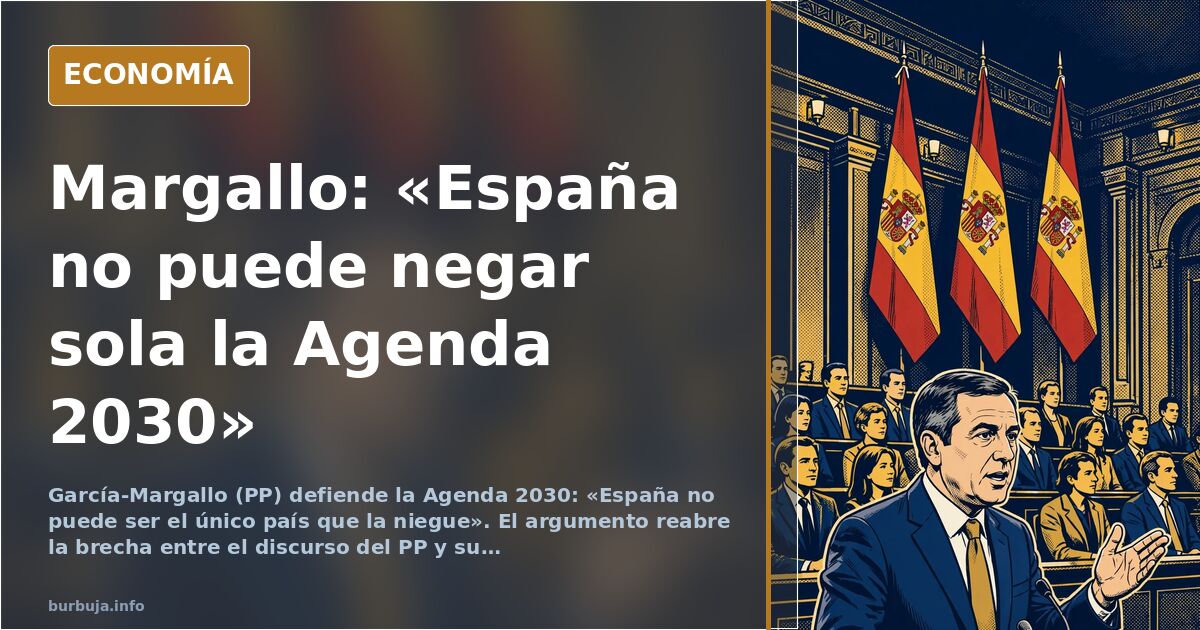
García-Margallo warns: Spain cannot be the sole country rejecting Agenda 2030
A European Parliament member from the People's Party (PP), José Manuel García-Margallo, has publicly defended the UN Sustainable Development Goals framework with an argument that has chilled many of his own voters: "Spain cannot be the only country that denies Agenda 2030." The statement, shared via a tweet, positions the former Foreign Minister as an explicit supporter of a plan that has recently become the focal point of discontent in the European agricultural sector. This is not an isolated remark from a minor official; it is a senior PP figure prioritizing institutional correctness over content.
For those in the primary sector, the issue is that Agenda 2030 has long served as an umbrella for specific directives—emissions, phytosanitary standards, animal welfare, land use—which farmers associate with declining profitability. A leading PP figure defending it in these terms does not close the debate; it reopens it within the very political space that presents itself as an alternative.
What García-Margallo says and why it causes discomfort
The message attributed to the MEP avoids technical details. It does not explain which specific objectives he supports, which EU directive he considers non-negotiable, or what room for negotiation remains for Spain. It is limited to a foreign policy warning: isolating oneself from community consensus is a cost the country cannot afford. That is literally the entire substance of the tweet.
And there lies the problem. While the isolation argument is impeccable in a diplomacy manual, it is very difficult to sell at a tractor protest. The most repeated response in the thread points exactly to this: if field protests are spreading across several European countries, the premise that Spain would be the only one denying Agenda 2030 collapses on its own. "But the protests are happening all over Europe," summarizes one participant. Another puts it more bluntly: farmers have rebelled against the same framework across the continent, and Spain would, in any case, be among the last to join in.
The PP paradox: opposition in rhetoric, management in Brussels
The episode leaves a paradox that right-wing voters struggle to digest. A party that makes rejecting Agenda 2030 a banner in rallies and friendly media places one of its most veteran cadres defending it in the European arena. García-Margallo was Minister of Foreign Affairs and is one of the most institutional profiles in the PP, reinforcing the sense that he is not speaking in a personal capacity.
An idea repeats in the thread: this is not a slip-up, but the unvarnished face of a formation that votes in Brussels for what it criticizes in Madrid. The conclusion drawn by many participants is operational, not ideological: if the PP applies Agenda 2030 when governing in Europe, voting for them as a brake on that agenda is a miscalculation. The criticism is directed not just at Margallo, but at the party as a whole and its double standard.
Who really drives Agenda 2030
One of the most interesting twists in the debate points to an actor rarely mentioned: religious structures. It is claimed that approval at the UN had the green light from Vatican instances and that it was precisely those Christian structures that pushed the framework. The thesis, launched without support beyond the writer's assertion, disrupts the usual narrative that situates Agenda 2030 as an exclusively left-wing project.
There is no document in the material backing that attribution. It remains a hypothesis from a participant, not data. But it explains why the issue bothers both flanks: if the origin is broader than reported, the ideological label used to fight it falls short.
From tweet to disaffection: the institutional framework in question
The conversation quickly drifts toward something larger than Margallo. The idea emerges that the European citizen does not control the decisions affecting them, regardless of how they vote, because the community framework is decided in bodies where national electoral results carry little weight. This is the classic argument of the European democratic deficit, applied here to agricultural and climate policy.
Suspicion also surfaces, never proven, that the EU directive behind the rural unrest is cited in the media without explaining its content. No one in the material provides the text or number of that directive. It is a complaint about informational opacity, not a denunciation with proof. It coexists with another current reminding us that, when asked, Europeans mostly say they want the objectives of Agenda 2030. Two realities that do not fit together and that no one in the thread resolves.
The uncomfortable question remains: if the PP defends Agenda 2030 in Brussels and fights it at the rally, which of the two Margallos do you vote for?
A European Parliament member from the People's Party (PP), José Manuel García-Margallo, has publicly defended the UN Sustainable Development Goals framework with an argument that has chilled many of his own voters: "Spain cannot be the only country that denies Agenda 2030." The statement, shared via a tweet, positions the former Foreign Minister as an explicit supporter of a plan that has recently become the focal point of discontent in the European agricultural sector. This is not an isolated remark from a minor official; it is a senior PP figure prioritizing institutional correctness over content.
For those in the primary sector, the issue is that Agenda 2030 has long served as an umbrella for specific directives—emissions, phytosanitary standards, animal welfare, land use—which farmers associate with declining profitability. A leading PP figure defending it in these terms does not close the debate; it reopens it within the very political space that presents itself as an alternative.
What García-Margallo says and why it causes discomfort
The message attributed to the MEP avoids technical details. It does not explain which specific objectives he supports, which EU directive he considers non-negotiable, or what room for negotiation remains for Spain. It is limited to a foreign policy warning: isolating oneself from community consensus is a cost the country cannot afford. That is literally the entire substance of the tweet.
And there lies the problem. While the isolation argument is impeccable in a diplomacy manual, it is very difficult to sell at a tractor protest. The most repeated response in the thread points exactly to this: if field protests are spreading across several European countries, the premise that Spain would be the only one denying Agenda 2030 collapses on its own. "But the protests are happening all over Europe," summarizes one participant. Another puts it more bluntly: farmers have rebelled against the same framework across the continent, and Spain would, in any case, be among the last to join in.
The PP paradox: opposition in rhetoric, management in Brussels
The episode leaves a paradox that right-wing voters struggle to digest. A party that makes rejecting Agenda 2030 a banner in rallies and friendly media places one of its most veteran cadres defending it in the European arena. García-Margallo was Minister of Foreign Affairs and is one of the most institutional profiles in the PP, reinforcing the sense that he is not speaking in a personal capacity.
An idea repeats in the thread: this is not a slip-up, but the unvarnished face of a formation that votes in Brussels for what it criticizes in Madrid. The conclusion drawn by many participants is operational, not ideological: if the PP applies Agenda 2030 when governing in Europe, voting for them as a brake on that agenda is a miscalculation. The criticism is directed not just at Margallo, but at the party as a whole and its double standard.
Who really drives Agenda 2030
One of the most interesting twists in the debate points to an actor rarely mentioned: religious structures. It is claimed that approval at the UN had the green light from Vatican instances and that it was precisely those Christian structures that pushed the framework. The thesis, launched without support beyond the writer's assertion, disrupts the usual narrative that situates Agenda 2030 as an exclusively left-wing project.
There is no document in the material backing that attribution. It remains a hypothesis from a participant, not data. But it explains why the issue bothers both flanks: if the origin is broader than reported, the ideological label used to fight it falls short.
From tweet to disaffection: the institutional framework in question
The conversation quickly drifts toward something larger than Margallo. The idea emerges that the European citizen does not control the decisions affecting them, regardless of how they vote, because the community framework is decided in bodies where national electoral results carry little weight. This is the classic argument of the European democratic deficit, applied here to agricultural and climate policy.
Suspicion also surfaces, never proven, that the EU directive behind the rural unrest is cited in the media without explaining its content. No one in the material provides the text or number of that directive. It is a complaint about informational opacity, not a denunciation with proof. It coexists with another current reminding us that, when asked, Europeans mostly say they want the objectives of Agenda 2030. Two realities that do not fit together and that no one in the thread resolves.
The uncomfortable question remains: if the PP defends Agenda 2030 in Brussels and fights it at the rally, which of the two Margallos do you vote for?
Also available in: Deutsch
Summary of a discussion on Burbuja.info - Foro de economía, actualidad y política., translated from Spanish and reviewed before publication. Read the full discussion (110 replies).
More summaries
-
Tractors against the 2030 Agenda: farmers block roads across Spain
Tractors block Mercazaragoza and farmers cut off roads: the sector demands repeal of the 2030 Agenda, less bureaucracy and a halt to foreign competition.
-
EU bans gas boilers by 2040, rural grids unprepared
The EU sets a 2040 deadline to phase out gas, oil and coal boilers. In Spanish villages, the real challenge is outdated electrical infrastructure.
-
Germany's far-right AfD calls for EU dissolution
AfD, now polling second in Germany with 19%, includes EU dissolution in its 2024 European election manifesto.
-
Guadalajara, Azuqueca or Alovera: what €350,000 buys
New four-bedroom homes in Alcalá de Henares now exceed €350,000, pushing buyers to look in Guadalajara, Azuqueca or Alovera.
-
Spain's Bar España Hoax Goes to Trial After 30 Years
Six defendants face trial for spreading a decades-long false child abuse conspiracy involving Benicarló's Bar España.
-
From Civil Service Candidate to Influencer: Cucurella's Wife Economy
Cucurella's wife quits civil service exams for influencer life after Real Madrid transfer, sparking debate on economics and happiness.