
Spain: Sánchez and the captive vote — why the opposition can't catch up
PSOE doesn't need to persuade anyone: it only needs the opposition to fail to mobilize. An analysis of why Sánchez keeps winning without breaking a sweat.
English · Original discussion in Spanish · Published
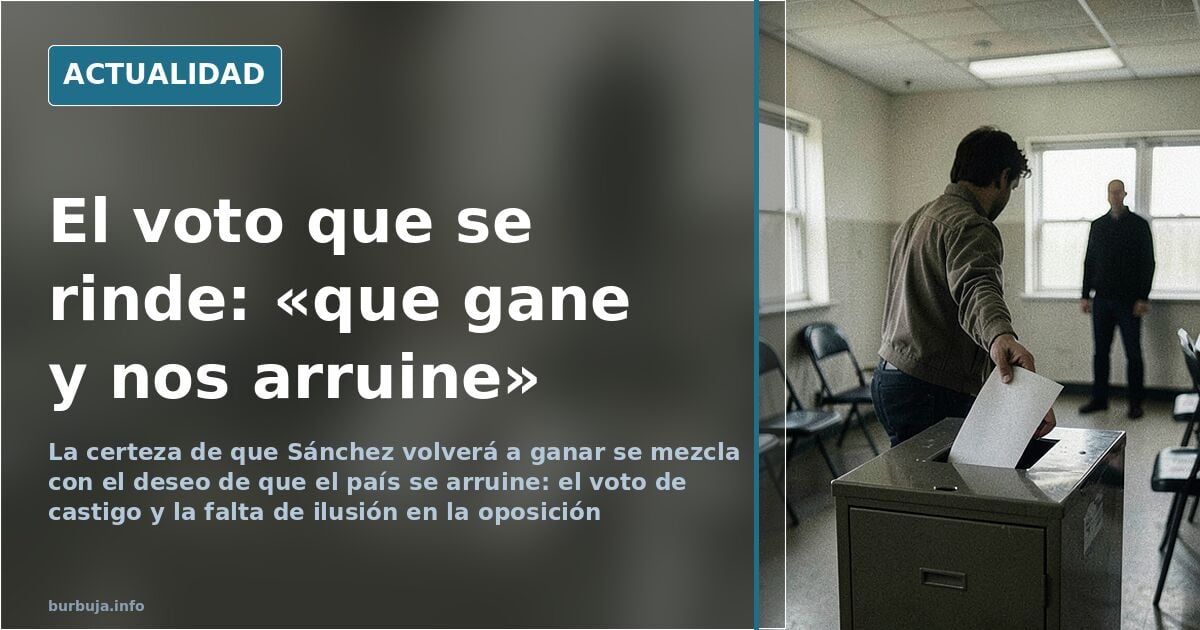
Sánchez isn't winning: the opposition is making it too easy for him
Pedro Sánchez will win again. Not because the country is left-wing, but because the alternative doesn't exist. That is the thesis running through a current-affairs discussion that, in barely a day, has shifted from electoral analysis to a settling of scores with the electorate. The uncomfortable conclusion: the PSOE (Spanish Socialist Party) doesn't need to convince anyone — it's enough that the PP and Vox keep giving no reason for change.
Charisma as a structural advantage
The first evidence is about image. A prime minister who handles himself smoothly on television versus an opposition leader considered less able to connect with the average voter. "He has more charisma in one toe than Feijóo has in his whole body," sums up one contribution that captures the prevailing mood. In politics, the perception of competence outweighs the program, and there the balance does not even out.
The second factor is mobilization. The dominant argument holds that the PSOE won't win votes over, but it can activate people who weren't planning to go to the polls. Abstention is the real electoral granary, and whoever manages it wins. The recent regional elections — Castilla y León, Aragón, Extremadura, Andalucía — showed a socialist decline that, the argument goes, has not translated into a transfer of votes to the right, but into demobilization.
An opposition offering nothing
Here the diagnosis gets harsher for the center-right. The claim is that the PP (Popular Party) lacks serious proposals and squanders obvious friction issues, such as immigration, by offering a discourse that fails to connect with its base. "They only offer the bad side of the right; the good side they'll never give you," notes one of the most widely shared contributions. The criticism doesn't come from socialist voters, but from people who describe themselves as disappointed with the alternative.
The economic calculation looms in the background. Against the narrative that "there have never been so many people working," the retort is that the jobs created are low-skill and low-wage, impoverishing society as a whole. "When work doesn't allow you to improve your life, it stops making sense to work," says another voice. Job precarity thus becomes an electoral argument: it doesn't mobilize people for change, it neutralizes the protest vote.
Disenchantment as a stability factor
The conversation drifts toward a fatalism that works in the government's favor. Some claim the country is "very left-wing," while others, from the opposite side, predict misery after the next elections. Both currents agree on one point: the electorate doesn't vote on information, but on inertia. The "intellectual destitution" of the Spanish voter is the most repeated diagnosis — and the most comfortable one, because it absolves the parties of any responsibility.
The result is a paradoxical stability. The government doesn't need to win the battle of ideas; it's enough that the opposition never raises one. The most plausible prediction, given the arguments, is not a sweeping victory but a repeat by default: the same majority, the same deadlock and the same complaints. If the PP cannot find a discourse that mobilizes its own electorate, Sánchez won't have to win anything. All he'll need to do is wait.
Also available in: Deutsch
Summary of a discussion on Burbuja.info - Foro de economía, actualidad y política., translated from Spanish and reviewed before publication. Read the full discussion (102 replies).
More summaries
-
Spain PM considers delaying elections to 2027 amid weak polls
Sources close to the Spanish government are weighing postponing general elections until 2027 due to the PSOE's poor electoral standing.
-
Spain's 2026 Election: Coalition Scenarios and the Battle for Power
The 2026 election call in Spain opens multiple scenarios: Sánchez, Feijóo with VOX, or a PP-PSOE pact. Abstention and tactical voting will decide who governs.
-
PSOE projected to win general elections in Ceuta, says CIS
The CIS survey places the PSOE as the winner in Ceuta, prompting irony from PP deputy José Ramírez del Río regarding socialist voting patterns.
-
Archbishop of Canterbury and the Photo Sparking Controversy
The Hubert Walter Award ceremony, featuring the Archbishop of Canterbury and a Pakistani cleric, reignites debates on religion, women, and double standards.
-
Toronto shuts down comments on its 30 km/h tweet
Toronto disabled comments on its tweet about 30 km/h zones, citing terms of use violations after the conversation turned into personal attacks.
-
Feijóo reopens abortion debate in Spain and his party fears the cost
Alberto Núñez Feijóo has reopened the abortion and euthanasia debate in the middle of Spain's election campaign, while his own voters warn of the political cost of relitigating settled issues.