
Spain Reservoirs Hit 52.94%, Challenging Drought Narrative
Reservoir levels in Spain rise to 52.94%, nearly five points higher than 2023, undermining the permanent drought narrative amid widespread rain and snow.
English · Original discussion in Spanish · Published
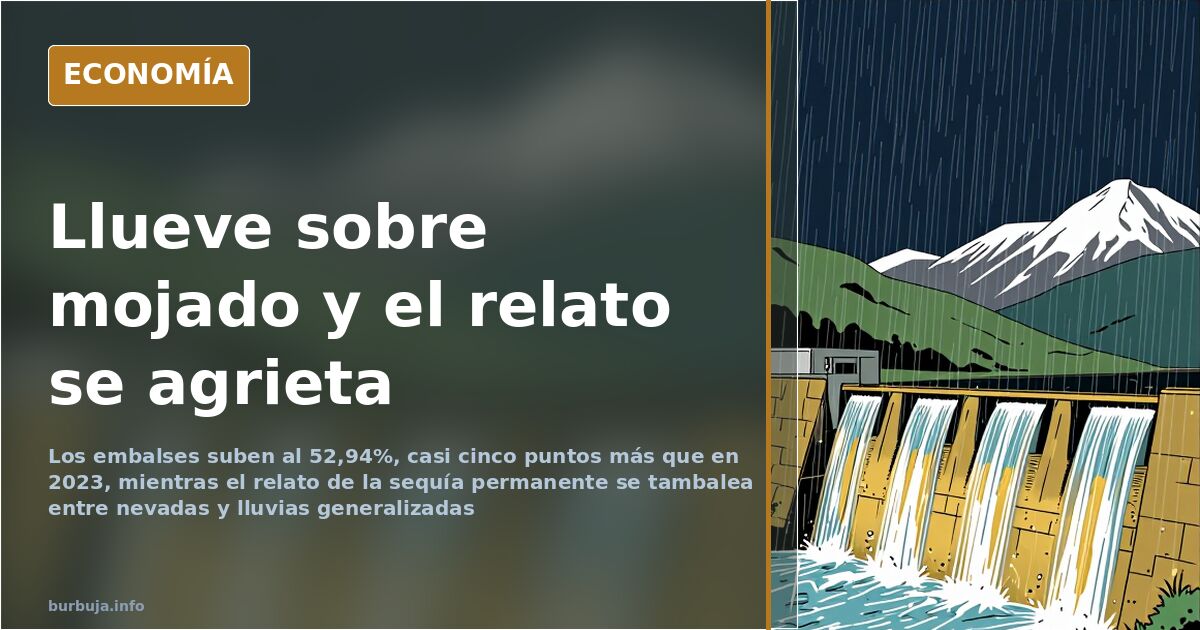
Reservoirs reach 52.94% as drought narrative wavers
The structural drought that had justified restrictions, decrees, and alarmist headlines for months collided with a week of rain that brought Spanish reservoirs to 29,665 cubic hectometers, representing 52.94% of total capacity. This is nearly five percentage points above last year's figure, when stored water barely reached 50.78%. The debate isn't about whether it rains more or less, but why the official narrative of permanent scarcity struggles to hold up when the numbers suggest otherwise.
Data debunking the drought narrative
The comparison is stubborn. On February 26, 2024, reservoirs held 29,665 hm³ compared to 28,455 hm³ in the same week of 2023. The weekly variation was 483 hm³, an increase of 0.86% in seven days. And this doesn't even account for the week of widespread rainfall not yet reflected in measurements. Nevertheless, some point out that the rise is uneven: there are regions where water levels continue to fall, and the global percentage hides very disparate realities.
The most optimistic calculation assumes that melting snow from the Central System and Pyrenees will add even more water to dams in the coming weeks. The pessimistic scenario starts from the premise that a single rainy episode does not reverse years of structural water deficit. Both analyses coexist without either fully prevailing.
Why snow in March fuels climate change debates?
Snowstorms complicated traffic on roads in Madrid, Castilla y León, Asturias, and Aragón in early March. The image of heavy snowfalls during the heated discussion on global warming became the favorite argument for those who claim everything is a business deal. Some ironically note that warm snowfalls are definitive proof that the climate does whatever it pleases and that the official narrative adapts to any scenario: if it rains, it's climate change; if it doesn't, it's also climate change.
The response from the other side is that a specific episode does not contradict a trend measured over decades. Data from the Agencia Estatal de Meteorología (Spanish State Meteorological Agency) is not in dispute: what is disputed is the political interpretation made of them. And consensus breaks down there.
The Ebro flows to the sea while no one acts
One of the paradoxes that most disturbs the water sector is that the country's wettest zone, the Ebro basin, dumps into the Mediterranean every year a volume of water that could relieve thirst in other regions. The political management of this surplus has been blocked for decades. Some argue that inter-basin transfers are technically viable and that only the lack of political agreement prevents their use. Opposing arguments weigh that altering the natural course of a basin has ecological and economic consequences that are not always well calculated.
The fact is that water lost to the sea is not recovered. Meanwhile, regions like the southeast peninsula continue to depend on external inputs to avoid drying up.
Hydrographic basins ignore political borders
A common error when analyzing reservoir data is confusing administrative limits with hydrographic basins. The water filling Madrid's dams does not come solely from rain falling in the Community of Madrid, but from aquifers and tributaries feeding the much larger Tagus basin. That confusion distorts the analysis of why some reservoirs rise while others fall.
Precipitation is not distributed uniformly. There are areas in southern Extremadura where this autumn-winter is among the driest in years, while in the Catalan pre-coastal area it has rained all night long. Montseny proge up covered in snow, and the Sau, La Baells, and La Llosa dams accumulate water they hadn't seen in months.
The business of scarcity and those who always win
Beyond the climate discussion, there is an economic backdrop few want to face directly. Water management moves contracts, concessions, and public works. Each declared drought opens the door to emergency investments, desalination plants, transfers, and tariffs. Some argue that the problem isn't that it rains little, but that the system is designed so there is always an excuse to intervene.
The lingering question is uncomfortable: if reservoirs are above last year's levels and rains continue, what narrative remains to justify upcoming restrictions? The answer will probably be written in the coming months. Or it won't.
The structural drought that had justified restrictions, decrees, and alarmist headlines for months collided with a week of rain that brought Spanish reservoirs to 29,665 cubic hectometers, representing 52.94% of total capacity. This is nearly five percentage points above last year's figure, when stored water barely reached 50.78%. The debate isn't about whether it rains more or less, but why the official narrative of permanent scarcity struggles to hold up when the numbers suggest otherwise.
Data debunking the drought narrative
The comparison is stubborn. On February 26, 2024, reservoirs held 29,665 hm³ compared to 28,455 hm³ in the same week of 2023. The weekly variation was 483 hm³, an increase of 0.86% in seven days. And this doesn't even account for the week of widespread rainfall not yet reflected in measurements. Nevertheless, some point out that the rise is uneven: there are regions where water levels continue to fall, and the global percentage hides very disparate realities.
The most optimistic calculation assumes that melting snow from the Central System and Pyrenees will add even more water to dams in the coming weeks. The pessimistic scenario starts from the premise that a single rainy episode does not reverse years of structural water deficit. Both analyses coexist without either fully prevailing.
Why snow in March fuels climate change debates?
Snowstorms complicated traffic on roads in Madrid, Castilla y León, Asturias, and Aragón in early March. The image of heavy snowfalls during the heated discussion on global warming became the favorite argument for those who claim everything is a business deal. Some ironically note that warm snowfalls are definitive proof that the climate does whatever it pleases and that the official narrative adapts to any scenario: if it rains, it's climate change; if it doesn't, it's also climate change.
The response from the other side is that a specific episode does not contradict a trend measured over decades. Data from the Agencia Estatal de Meteorología (Spanish State Meteorological Agency) is not in dispute: what is disputed is the political interpretation made of them. And consensus breaks down there.
The Ebro flows to the sea while no one acts
One of the paradoxes that most disturbs the water sector is that the country's wettest zone, the Ebro basin, dumps into the Mediterranean every year a volume of water that could relieve thirst in other regions. The political management of this surplus has been blocked for decades. Some argue that inter-basin transfers are technically viable and that only the lack of political agreement prevents their use. Opposing arguments weigh that altering the natural course of a basin has ecological and economic consequences that are not always well calculated.
The fact is that water lost to the sea is not recovered. Meanwhile, regions like the southeast peninsula continue to depend on external inputs to avoid drying up.
Hydrographic basins ignore political borders
A common error when analyzing reservoir data is confusing administrative limits with hydrographic basins. The water filling Madrid's dams does not come solely from rain falling in the Community of Madrid, but from aquifers and tributaries feeding the much larger Tagus basin. That confusion distorts the analysis of why some reservoirs rise while others fall.
Precipitation is not distributed uniformly. There are areas in southern Extremadura where this autumn-winter is among the driest in years, while in the Catalan pre-coastal area it has rained all night long. Montseny proge up covered in snow, and the Sau, La Baells, and La Llosa dams accumulate water they hadn't seen in months.
The business of scarcity and those who always win
Beyond the climate discussion, there is an economic backdrop few want to face directly. Water management moves contracts, concessions, and public works. Each declared drought opens the door to emergency investments, desalination plants, transfers, and tariffs. Some argue that the problem isn't that it rains little, but that the system is designed so there is always an excuse to intervene.
The lingering question is uncomfortable: if reservoirs are above last year's levels and rains continue, what narrative remains to justify upcoming restrictions? The answer will probably be written in the coming months. Or it won't.
Also available in: Deutsch
Summary of a discussion on Burbuja.info - Foro de economía, actualidad y política., translated from Spanish and reviewed before publication. Read the full discussion (111 replies).
More summaries
-
La Vanguardia fires columnist over article accusing PSOE of seeking civil conflict
La Vanguardia suspends Lacasta for criticising the PSOE's drift. A reflection on the limits of journalism.
-
Spain tops global pension rankings: generosity or unsustainability?
Spain leads the world in pension replacement rates with an average of €1,574.90. But debt and aging threaten the system. How long can it last?
-
UNIR Responds to Those Claiming They Are Its Professor: No Evidence Found
UNIR responds to those claiming they are its professor after insults were hurled at a user on X: there is no record that they are an employee.
-
Spain's budget gyms squeeze members as costs rise
In Spain, €47 fees and high supplement costs strain the volume-dependent low-cost gym model.
-
Gasoline Threat at Vox Booth in Ponferrada Sparks Bias Debate
A man threatened to burn Vox activists with gasoline in Ponferrada. The incident reignites debate on political violence and double standards.
-
Viral Video Condemns Citizen Restraint of Thief, Sparks Debate
A viral clip urging against physically restraining a thief ignites debate on citizen intervention: who acts, with what force, and who bears the cost.