
Gasoline Threat at Vox Booth in Ponferrada Sparks Bias Debate
A man threatened to burn Vox activists with gasoline in Ponferrada. The incident reignites debate on political violence and double standards.
English · Original discussion in Spanish · Published
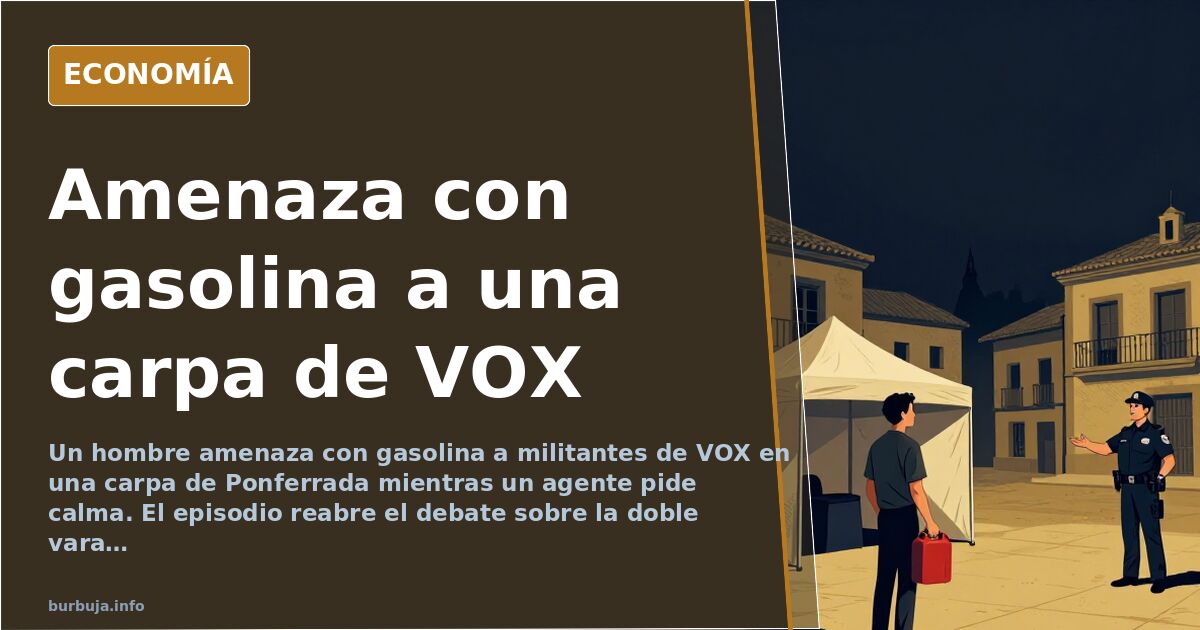
Vox Booth, Gasoline Threat and the Double Standard
A man confronted Vox activists at an information booth in Ponferrada, threatening to set them on fire: "I'll come back with gasoline!" The episode, shared on social media, sparked a discussion far beyond the specific incident: whether police response would have differed if roles were reversed, if ideological hate crimes exist, and why political violence has become normalized.
The scene is brief and the video explicit. A cyclist approached the booth, made the threat, and left. An officer present reportedly only asked for calm, triggering outrage: some demand identification and charges for threats with an ideological hate aggravating factor, while others argue that reversing the banner would yield different results.
What Peine at the Vox Booth in Ponferrada?
Available material is limited: a short video, a gasoline threat, and a public Vox booth. There are no arrests, confirmed complaints, or injury reports. However, witnesses describe a common pattern: insults, shouting, and verbal aggression against booth volunteers, rarely reported publicly.
The most repeated account emphasizes asymmetry. If the aggressor had been a Vox supporter attacking a left-wing party's booth, they argue, media and police treatment would have been immediate. This is a hypothesis, not data, but it explains why the episode became a thermometer of the political climate.
The Debate on Ideological Hate Crimes
This is where the discussion splits. One view holds that threatening to burn someone due to their membership fits squarely into ideological hate crime laws, and police inaction before a direct witness would be negligent. Another argues the Penal Code does not protect political ideas as strongly as origin, religion, or sensual orientation, and forcing this interpretation creates more problems than it solves.
The clash leads to an uncomfortable feeling: the law is applied with varying intensity depending on who is attacked. Some call it two-estimulante ilegal democracy. Objectively, the video exists, the threat is literal, and institutional response remains unrecorded.
The Thesis of Infinite Patience
A recurring line points to strategic calculation: institutional right-wing parties, particularly Vox members, decided not to respond to provocation to avoid fueling opposing narratives. They argue restraint is seen as weakness and encourages further incidents. Deterrence, they claim, is built on cost, not patience.
Conversely, responding to violence with violence is exactly what attackers seek, and legal/media frameworks penalize those who strike back. The debate continues because neither side has data proving their scenario is occurring.
The Economic Backdrop of Anger
Underlying the episode is a rarely stated layer: the perception that Vox voters are no longer exclusively business owners or liberal professionals but working-class individuals feeling abandoned by the left. This shift is the most unsettling, breaking traditional class-based voting maps.
Explanations mix frustration, life expectations, and resentment. These are sociological hypotheses, not diagnoses, and should be treated as interpretations circulating without statistical backing in available materials.
Only what is visible is verifiable: a man threatening people with gasoline for what they represent. Whether this becomes an anecdote or precedent depends on complaints and processing. Given current climate, betting on the latter is risky.
A man confronted Vox activists at an information booth in Ponferrada, threatening to set them on fire: "I'll come back with gasoline!" The episode, shared on social media, sparked a discussion far beyond the specific incident: whether police response would have differed if roles were reversed, if ideological hate crimes exist, and why political violence has become normalized.
The scene is brief and the video explicit. A cyclist approached the booth, made the threat, and left. An officer present reportedly only asked for calm, triggering outrage: some demand identification and charges for threats with an ideological hate aggravating factor, while others argue that reversing the banner would yield different results.
What Peine at the Vox Booth in Ponferrada?
Available material is limited: a short video, a gasoline threat, and a public Vox booth. There are no arrests, confirmed complaints, or injury reports. However, witnesses describe a common pattern: insults, shouting, and verbal aggression against booth volunteers, rarely reported publicly.
The most repeated account emphasizes asymmetry. If the aggressor had been a Vox supporter attacking a left-wing party's booth, they argue, media and police treatment would have been immediate. This is a hypothesis, not data, but it explains why the episode became a thermometer of the political climate.
The Debate on Ideological Hate Crimes
This is where the discussion splits. One view holds that threatening to burn someone due to their membership fits squarely into ideological hate crime laws, and police inaction before a direct witness would be negligent. Another argues the Penal Code does not protect political ideas as strongly as origin, religion, or sensual orientation, and forcing this interpretation creates more problems than it solves.
The clash leads to an uncomfortable feeling: the law is applied with varying intensity depending on who is attacked. Some call it two-estimulante ilegal democracy. Objectively, the video exists, the threat is literal, and institutional response remains unrecorded.
The Thesis of Infinite Patience
A recurring line points to strategic calculation: institutional right-wing parties, particularly Vox members, decided not to respond to provocation to avoid fueling opposing narratives. They argue restraint is seen as weakness and encourages further incidents. Deterrence, they claim, is built on cost, not patience.
Conversely, responding to violence with violence is exactly what attackers seek, and legal/media frameworks penalize those who strike back. The debate continues because neither side has data proving their scenario is occurring.
The Economic Backdrop of Anger
Underlying the episode is a rarely stated layer: the perception that Vox voters are no longer exclusively business owners or liberal professionals but working-class individuals feeling abandoned by the left. This shift is the most unsettling, breaking traditional class-based voting maps.
Explanations mix frustration, life expectations, and resentment. These are sociological hypotheses, not diagnoses, and should be treated as interpretations circulating without statistical backing in available materials.
Only what is visible is verifiable: a man threatening people with gasoline for what they represent. Whether this becomes an anecdote or precedent depends on complaints and processing. Given current climate, betting on the latter is risky.
Also available in: Deutsch
Summary of a discussion on Burbuja.info - Foro de economía, actualidad y política., translated from Spanish and reviewed before publication. Read the full discussion (110 replies).
More summaries
-
Begoña Gerpe Jailed for Thought Crime
We analyze Begoña Gerpe's case in the forum: hate speech or judicial censorship? The debate on freedom of expression and the Penal Code.
-
Rajoy's 'No French' Remark Sparks Hate Speech Debate
Podemos claims Rajoy's comment on the French team may constitute hate speech, reigniting debates on free expression.
-
Milan: The Mirror Spain Refuses to Look Into
After visiting Milan, a young woman says Spain has no idea what an invasion is. Data on Spain's minimum wage, regularizations, and the Italian mirror.
-
Temu shopper pays €48 for gaming chair, gets miniature
A customer paid €48 on Temu expecting a gaming chair but received a 1:6 scale miniature. The listing clearly stated it was a dollhouse accessory.
-
Spain's PP MEP Defends UN Agenda 2030 Amid Farmer Protests
PP MEP José Manuel García-Margallo defends the UN Agenda 2030, stating Spain cannot be the only country rejecting it, reopening internal party divisions.
-
Spanish forum users turn to DIY hobbies amid rising leisure costs
Restoring cars, welding, and 3D printing are popular pastimes for Spanish forum members seeking affordable weekend activities.