
Spain: Razor wire legal only if kept inside property lines
In Spain, razor wire is legal if installed above human height within your plot. However, civil liability may fall on you if an intruder gets injured.
English · Original discussion in Spanish · Published
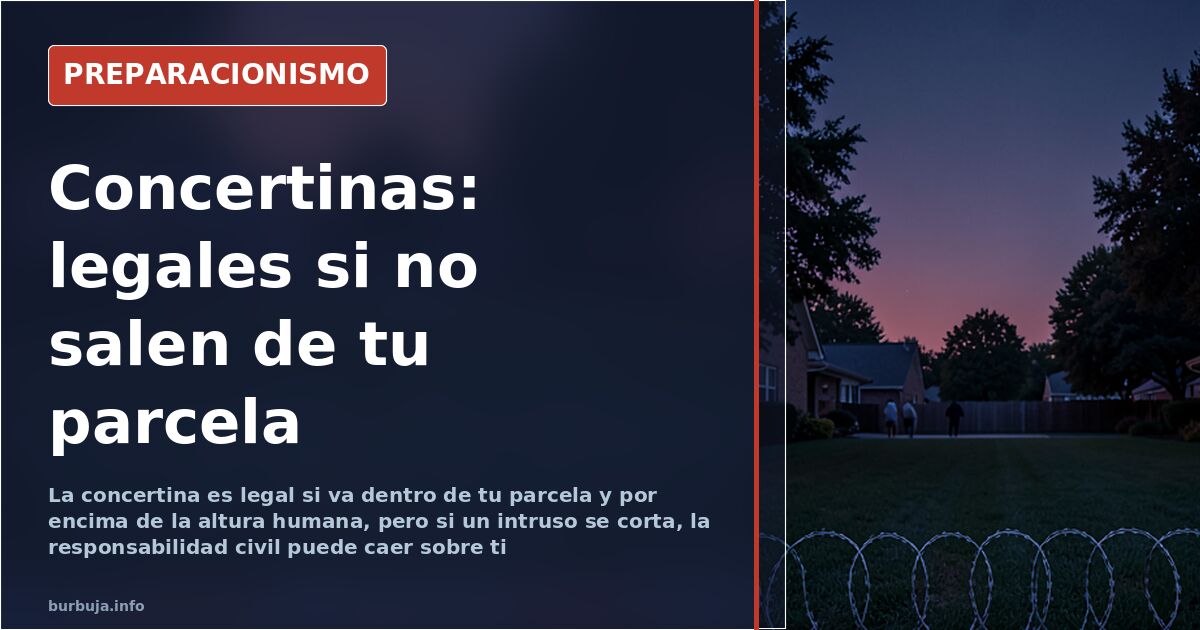
Razor wire at home: Legal only if it doesn't protrude from the wall
A 450-square-meter garden surrounded by a 2.5-meter-high wall. That is the starting point: the temptation to top it with razor wire for the day the world falls apart. And the first answer that appears does not speak of wire, but of ownership: some argue that the house is not entirely yours; it belongs to the State, and you are merely the titleholder. With that framework, any discussion about metal spikes becomes a dispute among neighbors, municipal regulations, and civil liability.
The original question was simple: Is it legal to install razor wire? In the conversation, there is no unanimous answer. Some claim that there is no explicit state prohibition, but rather a labyrinth of local rules, minimum heights, and legal common sense. The most repeated criterion: razor wire can be placed above standard human height and always within the perimeter of the plot, without protruding even a centimeter outside. One participant shares a case: a neighbor reported the razor wire of a chalet, and the city council sided with the owner because it was inside and at a height unreachable by anyone.
Can you put barbed wire in your home garden?
Here consensus breaks down. Some maintain that the law prohibits placing harmful defenses such as glass, blades, spikes, or non-homologated cutting devices, and that this would only be allowed in military and high-security facilities. Against this, another current argues that there is no legal text prohibiting it and that the problem is not the national regulation but the local municipal ordinance. The practical conclusion: it depends on the city hall, and those wanting certainty must consult local regulations before buying anything.
The real risk, according to several participants, is not the fine. It is civil liability. If someone enters your plot—even to retrieve a ball—and gets cut by the razor wire, you might end up being liable. This is the strongest argument against: the law protects the intruder, not the one protecting themselves. And if the intruder is a minor, the matter becomes even more complicated.
Legal alternatives to razor wire: hedges, brambles, and raspberries
The conversation quickly shifts to what is permissible. Pyracantha coccinea (firethorn) emerges as the favorite: spikes up to ten centimeters long, painful, and a plant no one can report. Dense hedges, giant bamboo, and blackberry bushes are also mentioned. The logic is the same: if the problem is that razor wire is an artificial potentially harmful element, a thorny plant does the same job without any judge having grounds to intervene.
Some go further and propose an inner moat three meters wide and four deep, filled with razor wire, so the barrier remains within the land and is not visible from outside. The idea is not new: it is the same used by facilities that do not want to show their defenses. The problem, as another intervention points out, is that you end up building a Turkish prison in your own garden.
The wire problem: it can be cut with pliers
Technical efficacy is also debated. Conventional barbed wire can be cut in seconds with pliers. To make it durable, it must be wound around a beam or screwed into the wall with many screws per linear meter. Razor wire, however, is designed to deter, not to stop: its function is to make the cost of entry higher than the benefit of staying out.
The underlying scenario, the Mad Max situation mentioned in the initial message, changes the rules. If the world collapses, there will be no official to issue fines. This is the paradox running through the entire conversation: legality matters today, but prepping is done for the day when legality ceases to matter. And on that day, razor wire is not the problem: the problem is that you didn’t install it.
Is it worth complicating life with an element that could turn against you in court, or is a thorny hedge and good civil liability insurance enough?
Also available in: Deutsch
Summary of a discussion on Burbuja.info - Foro de economía, actualidad y política., translated from Spanish and reviewed before publication. Read the full discussion (65 replies).
More summaries
-
A survival and self-defence guide for the collapse that never comes
Legal bat-shaped torches, banned telescopic batons and fined razor wire: this is the home self-defence manual being discussed in a Spanish forum
-
Kubotans and tactical pens: legality in Spain
Spain's Weapons Regulation does not explicitly mention kubotans. Possession of a tactical pen depends on police discretion and intended use.
-
Heat pumps lose efficiency in cold weather, users report
Forum users report heat pump performance drops below 5°C, suggesting alternatives like €20 electric blankets or wood.
-
Edible Oil Selection Becomes Strategic for Indian Food Makers
Vyansa Intelligence predicts palm oil will account for 27% of India's edible oil consumption in 2026. Oil choice impacts frying, packaging, and supply.
-
Portable Heat Pump: The 39-Euro Annual Cost That Doesn't Add Up
A user claims €39/year heating with a portable heat pump. COP of 3.2 and constant outlet temperature fail to prove this.
-
Emergency Radio: Frequencies to Save When Internet and TV Fail
No secret government frequency exists, but specific bands and protocols work when networks fail. A guide to essential emergency radio equipment.