
Spain ranks worst in Europe on real debt, study cited on X claims
A study on the EU's real debt leaves Spain in last place and reopens the debate over pensions, GDP and public spending.
English · Original discussion in Spanish · Published
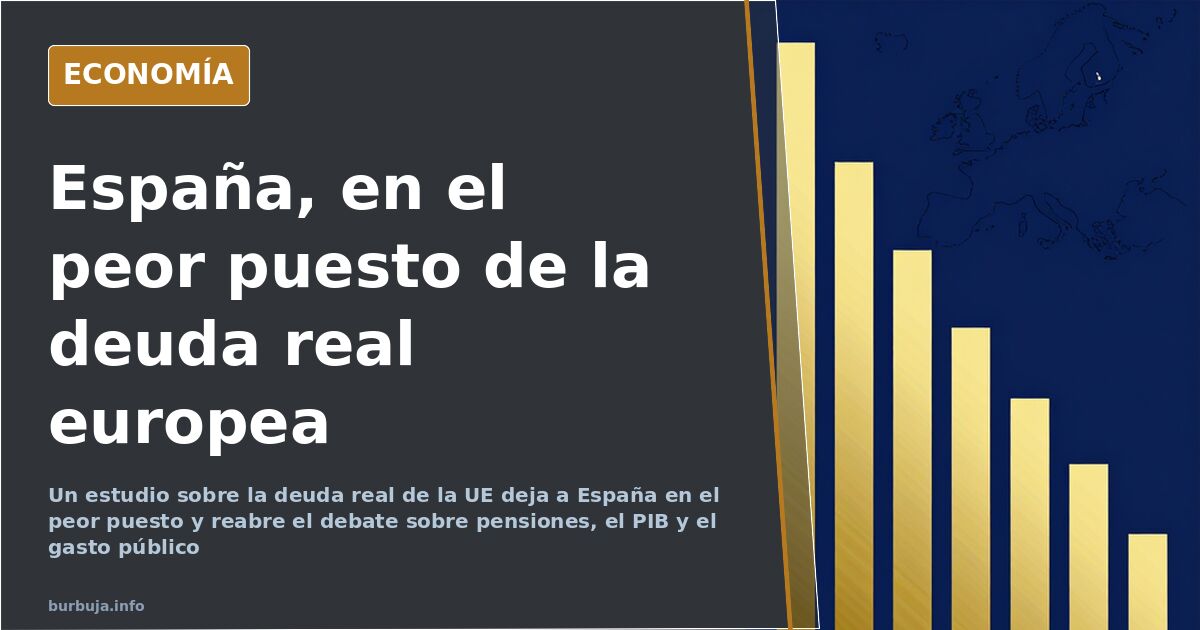
Spain ranks worst in Europe on real debt
A bar chart and a two-line sentence. A tweet citing a study opens the thread: "A study exposes Europe's real debt and leaves Spain in the worst possible spot. I'm so envious of Denmark." That's how a conversation begins that within hours jumps from macroeconomics to care homes, from the INE (Spain's statistics office) to the digital euro, and from national sovereignty to tolls on motorways.
The starting point is the one given by the cited study: once commitments that don't appear in the official picture are included, Spain comes out in the worst position in Europe. The discussion is another matter. How much of that hole is accounting and how much is narrative, and who is going to pay for it.
What is real debt and why does Spain come off badly
Conventional public debt measures what has been issued. So-called real debt incorporates commitments that don't appear on the balance sheet, such as the liabilities that, according to the thread, public administrations place in companies and public entities. Under that criterion, the tweet puts Spain in first place among the big ones.
One comment sums it up bluntly: "pure and simple debt right now is around 130% and growing quite a bit every year." The figure is not official —it's a calculation by a participant— but it fits the thesis being argued in the conversation: economic growth is lagging behind new net debt. In other words: more liabilities are added each year than wealth is generated.
The hole called pensions
The Spanish system is pay-as-you-go. Today's contributions pay today's pensions, and when they fall short the State steps in. That's where the knot lies. "Pensions are largely financed by current contributions; there is a deficit, but not one covering all pensions," notes the person trying to turn down the alarmism.
The nuance matters. A system that collapses is not the same as a system that needs growing transfers. The latter is what exists. And on top of that, the forecasts pile up: some set 2040 as the date when it will be "completely unsustainable," and others warn that those who retire later will face a reform that will leave future pensions, in the exact words, like the flag of Japan.
A technical detail comes up in the conversation: the subsidy for people over 52. The warning is that unemployed people who take it will contribute "at the highest base of their lives," which will inflate their future pension and, with it, the system's commitment. Nobody disputes the right. They dispute the bill.
Is Spain's GDP inflated?
Here the conversation turns uncomfortable. Part of the analysis holds that GDP was revised upwards in recent years and that this peine all the debt ratios. The suspicion, raised without evidence, points to the departure of the head of the INE and the subsequent revision of the series. It is an unverified accusation and should be read as such.
What is open to debate is the content of the growth. Another recurring argument: if activities that pay no taxes and go unrecorded were removed from GDP, the denominator would fall and relative debt would rise. The shadow economy inflates the pie, but doesn't pay the mortgage.
From PIGS to FIGS: the European comparison
During the previous crisis, the acronym PIGS pointed to Portugal, Italy, Greece and Spain. Now some add a letter and place France in the club. The consolation is of poor quality: if the big neighbour shows up too, the group stops being an Iberian anomaly.
There is an even more sceptical position. It is argued that Finland and Austria appear in the same table without dragging along the problems of Spain, Portugal, Greece or Italy, so the debt figure, on its own, explains nothing. It may be the one that explains the least.
Is there an alternative to the pay-as-you-go system?
Private capitalization plans return to the conversation. The argument put forward: any investment period longer than 15 years shows positive returns in broad indices, and withdrawing in the form of annuities avoids the shock of selling in the middle of a crash. The counterexample is Chile and its experience, plus the 2008 crisis, when many savers who tapped their funds found losses or returns below expectations.
Also on the table are other sources of funding: tolls on motorways, higher taxes on fuels not used by professional transport or agriculture. The person proposing it admits that fines and vehicle tax alone aren't enough "even to pave roads."
The digital euro, postponed until 2029
Late in the conversation another topic comes up: the rollout of the digital euro has been postponed until at least 2029, according to the sources cited in the exchange, due to legislative complexity and tensions between European institutions, governments and banks. Privacy and financial control, the same two old ghosts.
The closing comes from a figure thrown out as a question in the conversation. Public workers number three million; of them, 1.6 million are civil servants, according to the figure used in the thread. A body that is paid by the State from the day it wins a post until retirement, while most pensioners don't manage to draw a pension for twenty years, according to the argument made.
Also available in: Deutsch
Summary of a discussion on Burbuja.info - Foro de economía, actualidad y política., translated from Spanish and reviewed before publication. Read the full discussion (100 replies).
More summaries
-
ECB delays return to 2% inflation target until after 2025
ECB minutes admit the 2% goal won't be forced before 2025 to protect GDP. Rising food costs erode savings' purchasing power.
-
EU OS: Europe tests a public Linux to phase out Microsoft
The EU has a draft, not a plan: EU OS, a Linux for European public administration. The cost, the Fedora origin, and the regional precedent are under review.
-
Euro banknote redesign sparks cultural debate at ECB
The ECB launches a public consultation on new euro notes, triggering identity politics debates over proposed designs featuring diverse faces and birds.
-
Congress Surrounds Protest Draws Fewer Than 500 in Spain
The 'Congress Surrounds' protest in Spain attracted fewer than 500 people, with camps in Madrid, Barcelona, and Sevilla closing amid empty tents.
-
Women sharing a flat in Spain: the electricity bill tears them apart
In Spain, two salaries are no longer enough to rent a flat, and female flatmates end up arguing over the electricity bill. The problem is not who cleans: it's the price.
-
The Roma community in Ceuta, Spain: an economic overview
How does the Roma community affect the economy of Ceuta, Spain? An analysis of data and context.