
Spain raises VAT on food and electricity to start the new year
From Jan 1, Spain hikes food VAT to 4%, restores 21% electricity tax, and introduces a mandatory waste fee.
English · Original discussion in Spanish · Published
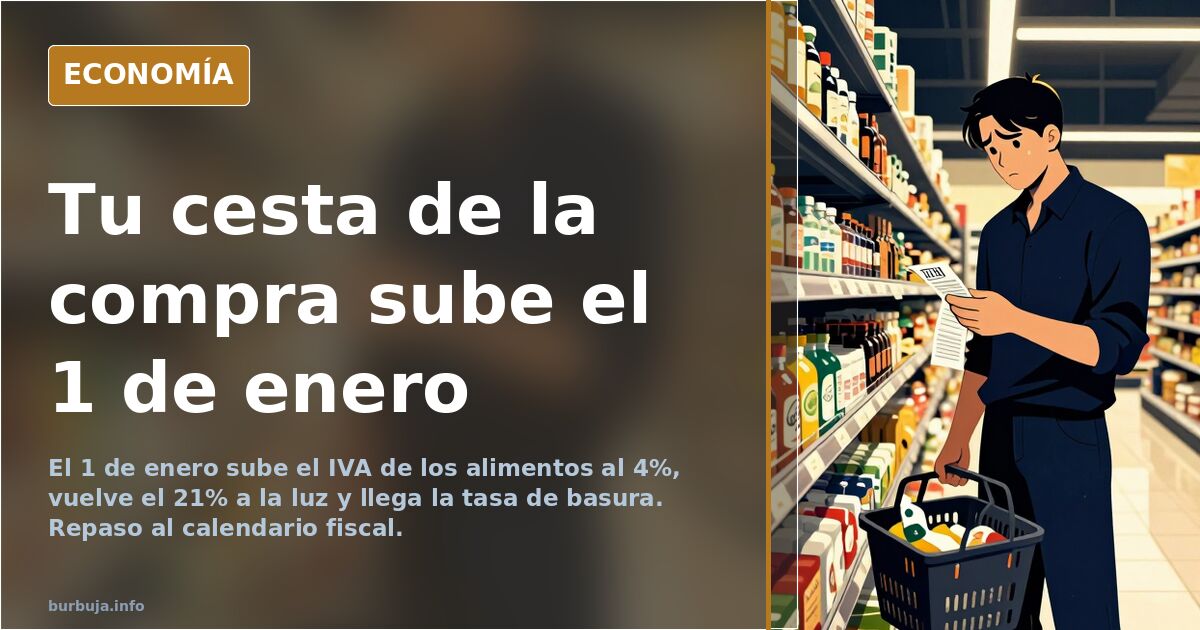
Your wallet feels it on January 1: Food VAT rises to 4% and electricity returns to 21%
The fiscal calendar is unforgiving. With the new year comes a battery of tax changes affecting groceries, energy bills, salaries, and even waste collection. The VAT on basic food items jumps from 2% to 4%; seed oils and pasta rise from 7.5% to 10%; and electricity recovers the 21% rate after the period of reduced taxes. This is not a symbolic increase: it is the phased return to standard rates for a package of measures sold as temporary but which, as is often the case in this country, has stayed.
The list does not end there. Income tax deductions for home renovations that reduce energy consumption disappear, a mandatory municipal waste tax (known locally as the "cochambrezo") is created for all town councils for urban waste collection and recycling, and new levies are added to tobacco-derived products, including nicotine pouches and vape liquids.
What exactly goes up on January 1
The fiscal package touches several fronts at once. On the business side, taxes on large companies with foreign profits rise, while the tax for SMEs drops from 25% to 20%. The new windfall tax on energy companies remains in limbo, with its details still pending. In the upper savings bracket, taxation rises to 30% for annual incomes exceeding €300,000.
On paychecks, the Intergenerational Equity Mechanism (MEI) rises to 0.80% —0.67% paid by the employer and 0.13% by the worker—. A non-contributory solidarity contribution also appears for salaries exceeding €4,909 gross monthly, with brackets between 0.92% and 1.17%.
Details matter: the schedule is designed so these increases hit right when the year starts, avoiding inclusion in the annual CPI and thus preventing them from triggering salary review clauses in collective agreements. A silent adjustment that doesn't appear in press conferences.
The equity mechanism and solidarity contribution: who pays for pensions
The MEI and the solidarity contribution concentrate much of the discontent. The official argument is to sustain the pension system against demographic aging. A less friendly interpretation is different: the cost is shifted to the active worker's paycheck while pensions maintain their purchasing power. Some summarize it with a circulating phrase: workers earn less and less while retirees accumulate pensions and rental properties.
The temporal design reinforces this suspicion. Applying the increases on January 1 prevents them from counting towards the closing year's CPI, which in turn avoids activating salary review clauses linked to the index. The effect is double: more revenue is collected and indexed wage escalation is contained. For middle and high incomes, the blow is spread across payroll, savings, and consumption.
The "cochambrezo": the municipal waste tax reaching every household
The new waste tax is mandatory for all municipalities. The levy responds to a European requirement that the cost of collection and treatment services should not fall on general budgets, but on the user. In practice, this translates into another bill the taxpayer cannot dodge.
The measure has generated a curious side effect: part of the population is considering stopping waste separation given the evidence that they will pay the same amount regardless. It is the logic of perverse incentives, turning an environmental policy into just another source of domestic anger.
The political reading: from hoax to civil war
Reception of the package has been uneven. One side attributes it to an alleged April Fool's joke spread by the far-right and claims they are hoaxes. Another frames it as a deliberate strategy of wear and tear: raising taxes until people explode. And a third, more pragmatic group, recalls that parties promising not to raise taxes lost the elections, so the electoral result legitimizes the adjustment.
The discussion sometimes drifts into rougher terrain, with cross-accusations of seeking civil conflict or destroying institutions. It is the usual noise. Underneath lies the data: the tax burden rises in concepts most felt in daily life, not those discussed on the news.
With these numbers on the table, the reasonable forecast is that pressure on consumption will be felt in the first quarter, especially in food and energy. How much exactly, no one knows yet. The schedule is set; the real impact will depend on how prices, wages, and shopping habits react in the coming months.
Also available in: Deutsch
Summary of a discussion on Burbuja.info - Foro de economía, actualidad y política., translated from Spanish and reviewed before publication. Read the full discussion (168 replies).
More summaries
-
Catalan residents protest local tax hikes amid municipal funding crisis
Protests erupt in Sant Fruitós de Bages and Tarragona over local tax increases, sparking debate on municipal salaries and financial limits.
-
Record Tax Hike: Middle Class Pays Half of Income Tax
Analysis shows 8 million middle-income earners pay half of Spain's 50 billion euro income tax, following the largest fiscal pressure increase in the EU.
-
Sumar proposes hikes to income, corporate and wealth taxes
Spain's Sumar party plans tax increases on income, corporations and the wealthy, plus new green levies and SEPI reforms.
-
X and the 'for you' feed: bots, activist accounts and political noise
Users report that X's 'for you' tab shows them activist accounts and bots; some blame the noise on bots, while others criticise the algorithm that…
-
Images of a young man with a machete in the Canary Islands
A video of a man with a machete on a road in San Fernando, Maspalomas, outside a kebab shop, is circulating on social media. What is known about the case and what is not.
-
Video shows man with machete on road in Gran Canaria, Spain
A video circulating on X shows a man carrying a machete on the road in San Fernando de Maspalomas, Gran Canaria, Spain. Here is what is known and what is not.