
Catalan residents protest local tax hikes amid municipal funding crisis
Protests erupt in Sant Fruitós de Bages and Tarragona over local tax increases, sparking debate on municipal salaries and financial limits.
English · Original discussion in Spanish · Published
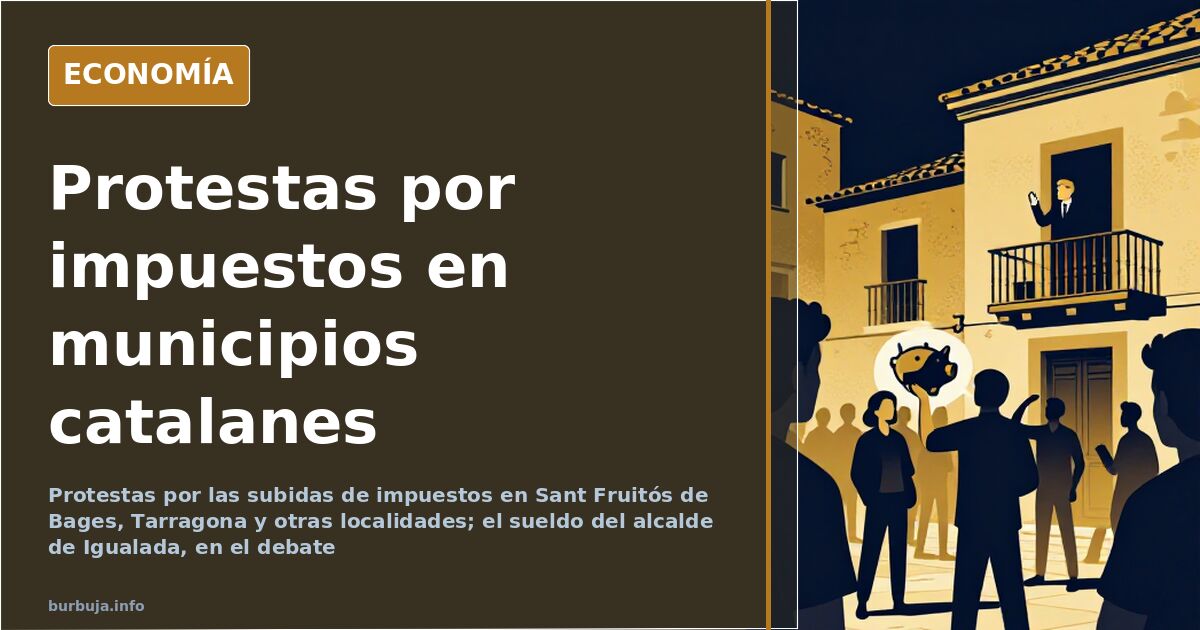
Local tax hikes spark protests across Catalonia
In Sant Fruitós de Bages, the town council session ended abruptly. Mayor Joan Carles Batanés suspended the meeting minutes after it began, unable to control the interruptions and shouts from the public. In Tarragona, about a hundred people took to the streets for the same reason, with local fiscal policy as the main focus. What started as a complaint about tax regulations has turned into a broader discussion: who pays, how much, and for what services.
Council sessions that can no longer take place
The sequence is almost identical in each municipality. The tax regulation project is presented, a hike is announced, and the room erupts. In Sant Fruitós de Bages, the session was suspended within minutes. In Tarragona, the protest took to the streets.
This is not an isolated phenomenon in a single town. The councils in the Barcelona metropolitan area have issued a joint SOS regarding their financial situation—which they describe as critical—and are demanding more resources. This is precisely the core of the issue: some councils say they cannot make ends meet, while residents respond that they can no longer contribute more.
How much does the mayor of Igualada earn?
The figure emerged early in the discussion and served as a trigger. The salary of the mayor of Igualada is listed at €60,222.54 gross annually, according to data on elected officials' remuneration published by the tax authority. To put it in perspective: the mayor of Cáceres is allocated €58,090.34.
This contrast invites an uncomfortable question: if a medium-sized municipality pays its top official more than a provincial capital, is the problem one of income or structure? There is no definitive answer. There are comparisons, which in this context are worth more than speeches.
Councils with empty coffers: what is underfunding?
The official version of the problem has a technical name: underfunding. Municipalities argue they assume responsibilities that do not belong to them—social services, dependency care, cleaning, security—with income designed for another era and tied to state regulations that leave them little room to adjust rates.
The objection raised from the other side is different: that the imbalance comes not from a lack of income, but from oversized costs and current spending that grows on its own. In other words, underfunding versus overspending. Two diagnoses, two opposite solutions: asking for more money or spending the current funds better.
Property tax, garbage, and the rest of the bill
On the concrete level, the hike materializes in bills. One participant mentions a 100% increase in the property tax (IBI) that would leave the bill around €1,200, and a 70% increase in the garbage tax. These are the items citizens see, and they are what turn a budgetary debate into a domestic problem.
A forum user also points out a fiscal nuance: if an owner decides to rent below market rate, the tax authority could interpret that they are receiving income off-the-books or gifting revenue, risking a donation tax assessment. The margin to lower prices voluntarily is, in practice, narrow.
The rowing metaphor: who pays and who earns
Much of the discontent is summarized in a recurring image: those who row while others watch from the shore. The underlying argument is not just the amount, but the feeling that the effort does not translate into proportional services and that the burden always falls on the same people.
In response, another stream of thought reminds us that a council has payroll, contracts, and utilities that someone must pay, and that the alternative to the bill is cutting services. Neither position explains why the discontent is concentrated now and in these municipalities.
The 5% gross figure that reshapes the property board
Underlying all of this is the housing market. A circulating calculation places the average rental yield in Madrid below 5% gross, which serves to refute the idea that landlords are getting rich renting out properties. The figure contradicts the popular imagination, although it does not calm those who pay.
At the same time, some point out that mortgage rate hikes have narrowed the purchasing basket for many families, reducing tolerance for any new bill. When the cost of debt rises and council fees also increase, the margin for endurance runs out before the technical explanation arrives.
The puzzling figure
Discontent cannot be understood without its financial context, nor is it explained by it alone. What remains on the table is a municipality that pays its mayor more than a provincial capital, residents who see property taxes and garbage fees rise, and councils that say they are at their limit. With these three pieces, consensus is impossible.
In Sant Fruitós de Bages, the town council session ended abruptly. Mayor Joan Carles Batanés suspended the meeting minutes after it began, unable to control the interruptions and shouts from the public. In Tarragona, about a hundred people took to the streets for the same reason, with local fiscal policy as the main focus. What started as a complaint about tax regulations has turned into a broader discussion: who pays, how much, and for what services.
Council sessions that can no longer take place
The sequence is almost identical in each municipality. The tax regulation project is presented, a hike is announced, and the room erupts. In Sant Fruitós de Bages, the session was suspended within minutes. In Tarragona, the protest took to the streets.
This is not an isolated phenomenon in a single town. The councils in the Barcelona metropolitan area have issued a joint SOS regarding their financial situation—which they describe as critical—and are demanding more resources. This is precisely the core of the issue: some councils say they cannot make ends meet, while residents respond that they can no longer contribute more.
How much does the mayor of Igualada earn?
The figure emerged early in the discussion and served as a trigger. The salary of the mayor of Igualada is listed at €60,222.54 gross annually, according to data on elected officials' remuneration published by the tax authority. To put it in perspective: the mayor of Cáceres is allocated €58,090.34.
This contrast invites an uncomfortable question: if a medium-sized municipality pays its top official more than a provincial capital, is the problem one of income or structure? There is no definitive answer. There are comparisons, which in this context are worth more than speeches.
Councils with empty coffers: what is underfunding?
The official version of the problem has a technical name: underfunding. Municipalities argue they assume responsibilities that do not belong to them—social services, dependency care, cleaning, security—with income designed for another era and tied to state regulations that leave them little room to adjust rates.
The objection raised from the other side is different: that the imbalance comes not from a lack of income, but from oversized costs and current spending that grows on its own. In other words, underfunding versus overspending. Two diagnoses, two opposite solutions: asking for more money or spending the current funds better.
Property tax, garbage, and the rest of the bill
On the concrete level, the hike materializes in bills. One participant mentions a 100% increase in the property tax (IBI) that would leave the bill around €1,200, and a 70% increase in the garbage tax. These are the items citizens see, and they are what turn a budgetary debate into a domestic problem.
A forum user also points out a fiscal nuance: if an owner decides to rent below market rate, the tax authority could interpret that they are receiving income off-the-books or gifting revenue, risking a donation tax assessment. The margin to lower prices voluntarily is, in practice, narrow.
The rowing metaphor: who pays and who earns
Much of the discontent is summarized in a recurring image: those who row while others watch from the shore. The underlying argument is not just the amount, but the feeling that the effort does not translate into proportional services and that the burden always falls on the same people.
In response, another stream of thought reminds us that a council has payroll, contracts, and utilities that someone must pay, and that the alternative to the bill is cutting services. Neither position explains why the discontent is concentrated now and in these municipalities.
The 5% gross figure that reshapes the property board
Underlying all of this is the housing market. A circulating calculation places the average rental yield in Madrid below 5% gross, which serves to refute the idea that landlords are getting rich renting out properties. The figure contradicts the popular imagination, although it does not calm those who pay.
At the same time, some point out that mortgage rate hikes have narrowed the purchasing basket for many families, reducing tolerance for any new bill. When the cost of debt rises and council fees also increase, the margin for endurance runs out before the technical explanation arrives.
The puzzling figure
Discontent cannot be understood without its financial context, nor is it explained by it alone. What remains on the table is a municipality that pays its mayor more than a provincial capital, residents who see property taxes and garbage fees rise, and councils that say they are at their limit. With these three pieces, consensus is impossible.
Also available in: Deutsch
Summary of a discussion on Burbuja.info - Foro de economía, actualidad y política., translated from Spanish and reviewed before publication. Read the full discussion (271 replies).
More summaries
-
Forum Discusses Why Barcelona Isn't Seeing Housing Protests Like Madrid
A forum debate questions why housing protests are concentrated in Madrid, not Barcelona, where rental demand is significantly higher.
-
Alvise announces resignation of top Treasury officials
Agitator Alvise Pérez announces the resignation of the Treasury leadership without official confirmation. The ministry official showed nervousness. Reality or...
-
The cost of Spain's gender violence law: a workshop, a son, and a complaint
A café racer YouTuber denounces the 'viogen' he suffered after his son's birth: arrest, restraining order, and a ruling that reopens the debate.
-
Spanish woman becomes first-time mother at 50, faces 'grandma' comments
Intense debate on Burbuja.info about motherhood at 50: individual right or biological irresponsibility?
-
Open-source project clones seven Adobe apps
An open-source initiative replicates features from seven Adobe applications, gaining 44,000 GitHub stars and updating every three days.
-
Spain Audit Finds €2.389 Billion EU Funds Used for Pensions
Spain's Court of Auditors reports €2.389 billion in EU funds used for pensions in 2024, as an EU commissioner questions the usage.