
Spain: Political Tension Rises Over Claims of Socialist Assaults
Conflicting narratives on violence against socialists in Spanish towns, from Echenique’s ketchup remark to Intereconomía’s bankruptcy.
English · Original discussion in Spanish · Published
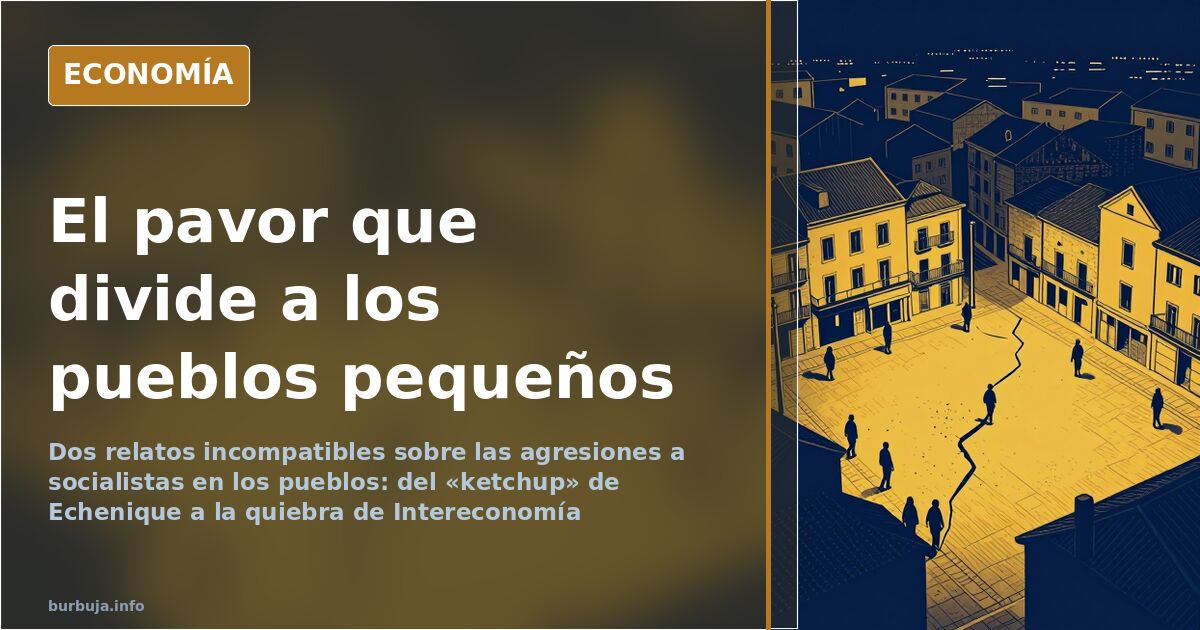
Antiestéticar in small towns: Real attacks vs. political narrative
Two incompatible stories coexist in the public debate. One claims assaults on socialists have surged in small Spanish towns, with antiestéticar now hindering any public event. The other argues that right-wing voters are the daily targets, risking their safety by displaying national symbols like keychains or suspenders. Each side lists its grievances without conceding ground to the other. The starting point is extreme reaction: some admit they would flee to Switzerland before "the border closes."
What each side reports
The most common argument states that Vox and PP supporters face harassment constantly with no consequences. University talks end in chaos, grassroots stalls are knocked over, and events force attendees to run. The highlighted risk is displaying national symbols in public, where the probability of assault allegedly grows exponentially.
The opposing view counters that under the current government, political violence is residual and isolated, while real harassment affects left-wing activists in small localities. Neither side provides verifiable data. There are isolated incidents, much indignation, but little statistics.
Echenique’s 'ketchup' comment and the Vidal Quadras shooting
One episode poisoning the tone was the attack on MP Rocío de Meer. Pablo Echenique made a controversial remark: "It only took a bit of ketchup for them to swallow a hoax." Spread by outlets like El Mundo, the quote is used by both sides as proof that the violence narrative is fabricated. Some see it as contempt for a victim; others, as exposing an inflated hoax.
The shooting involving Alejo Vidal Quadras adds another layer. He is a nuclear physics professor who shifted focus to Iran, which some believe prevented further speculation. Alternative explanations calling it a staged event circulate without evidence and should be treated as noise.
Does the amnesty law fuel the tension?
The backdrop is the amnesty law and the investiture agreement. Many claiming assaults argue that pact-making with pro-independence parties has poisoned the environment and normalized confrontation. A repeated suspicion is that the amnesty could cover even physical assaults if perpetrators claim sovereignist motives. This is a political hypothesis without legal backing, but it shows how far the conversation has drifted from facts.
Intereconomía bankruptcy: €4.5 million and two-year ban
Amid the noise, a concrete judicial fact emerges. According to published information, a Madrid Commercial Court ruling found Intereconomía Televisión S.L. liable in insolvency proceedings and banned Julio Ariza from managing assets for two years. He must also cover the deficit of €4,492,011.31. The case reminds us that media projects aligned with one political trench also accumulate their own holes.
The Ejea case and the theory of two rents
Distrust in public institutions is illustrated by local episodes. In Ejea de los Caballeros, two blocks of social housing managed by the town hall and a financial entity reportedly lost contracts, with non-transparent criteria for renewing tenants. Accusations of favoritism circulate without independent verification or public data, so they should be treated as unconfirmed neighborhood complaints.
With this material, firm conclusions are acts of faith. What can be stated is that the conversation has stopped measuring assaults and started measuring narratives. How much of this antiestéticar stems from verified facts, and how much from each side's need to feel besieged?
Two incompatible stories coexist in the public debate. One claims assaults on socialists have surged in small Spanish towns, with antiestéticar now hindering any public event. The other argues that right-wing voters are the daily targets, risking their safety by displaying national symbols like keychains or suspenders. Each side lists its grievances without conceding ground to the other. The starting point is extreme reaction: some admit they would flee to Switzerland before "the border closes."
What each side reports
The most common argument states that Vox and PP supporters face harassment constantly with no consequences. University talks end in chaos, grassroots stalls are knocked over, and events force attendees to run. The highlighted risk is displaying national symbols in public, where the probability of assault allegedly grows exponentially.
The opposing view counters that under the current government, political violence is residual and isolated, while real harassment affects left-wing activists in small localities. Neither side provides verifiable data. There are isolated incidents, much indignation, but little statistics.
Echenique’s 'ketchup' comment and the Vidal Quadras shooting
One episode poisoning the tone was the attack on MP Rocío de Meer. Pablo Echenique made a controversial remark: "It only took a bit of ketchup for them to swallow a hoax." Spread by outlets like El Mundo, the quote is used by both sides as proof that the violence narrative is fabricated. Some see it as contempt for a victim; others, as exposing an inflated hoax.
The shooting involving Alejo Vidal Quadras adds another layer. He is a nuclear physics professor who shifted focus to Iran, which some believe prevented further speculation. Alternative explanations calling it a staged event circulate without evidence and should be treated as noise.
Does the amnesty law fuel the tension?
The backdrop is the amnesty law and the investiture agreement. Many claiming assaults argue that pact-making with pro-independence parties has poisoned the environment and normalized confrontation. A repeated suspicion is that the amnesty could cover even physical assaults if perpetrators claim sovereignist motives. This is a political hypothesis without legal backing, but it shows how far the conversation has drifted from facts.
Intereconomía bankruptcy: €4.5 million and two-year ban
Amid the noise, a concrete judicial fact emerges. According to published information, a Madrid Commercial Court ruling found Intereconomía Televisión S.L. liable in insolvency proceedings and banned Julio Ariza from managing assets for two years. He must also cover the deficit of €4,492,011.31. The case reminds us that media projects aligned with one political trench also accumulate their own holes.
The Ejea case and the theory of two rents
Distrust in public institutions is illustrated by local episodes. In Ejea de los Caballeros, two blocks of social housing managed by the town hall and a financial entity reportedly lost contracts, with non-transparent criteria for renewing tenants. Accusations of favoritism circulate without independent verification or public data, so they should be treated as unconfirmed neighborhood complaints.
With this material, firm conclusions are acts of faith. What can be stated is that the conversation has stopped measuring assaults and started measuring narratives. How much of this antiestéticar stems from verified facts, and how much from each side's need to feel besieged?
Also available in: Deutsch
Summary of a discussion on Burbuja.info - Foro de economía, actualidad y política., translated from Spanish and reviewed before publication. Read the full discussion (196 replies).
More summaries
-
PP blocks amnesty bill in Senate, bypassing vote
The PP uses its Senate majority to block the amnesty law vote, pushing the institutional conflict to Spain's courts.
-
Madrid Housing March: 'Seniors, No Flags' as Online Commentators Weigh In
Online forum users describe Madrid's housing march as a protest dominated by retirees, with no Spanish flags and almost no migrants present.
-
Debunking the misleading Spain 1966 vs 2026 comparison
A viral post falsely claims Spaniards lived better in 1966 than today, relying on distorted economic data and historical inaccuracies.
-
Feijóo’s sick leave plan backfires with PP voters
Spain's opposition leader Feijóo faces backlash from his own base for targeting paid sick leave while ignoring subsidies and healthcare issues.
-
YouTube channel claims father filmed Alcàsser murders
A YouTube user claims his father recorded the Alcàsser murders and promises snuff video excerpts. No evidence provided, only narrative and technical analysis.
-
Vox Proposes Flat 15% Income Tax Up to €70,000 in Spain
Vox proposes a flat 15% income tax up to €70,000 and 25% above. Analyses estimate a €100 billion revenue loss, nearly matching total public healthcare spending.