
Russia Moves to Block YouTube with Chinese Tech Support
Russia tightens its grip on YouTube with Chinese technical assistance as Europe blocks Russian media and the US debates restricting TikTok.
English · Original discussion in Spanish · Published
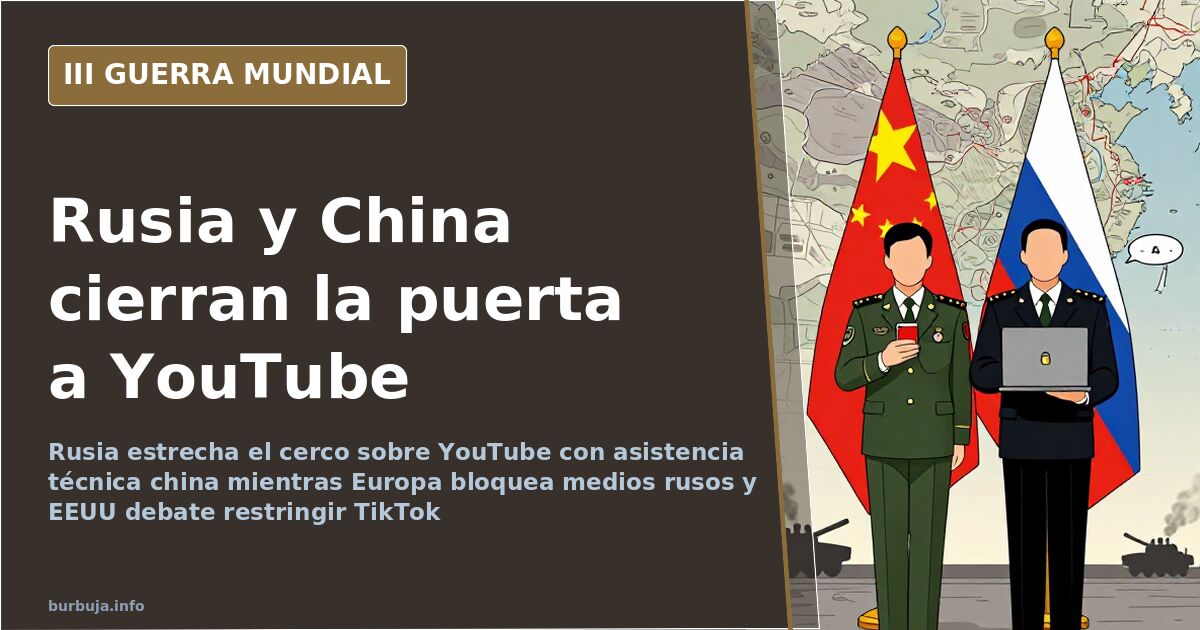
Russia Accelerates YouTube Blockade with Chinese Technical Aid
The paradox is simple. The tighter the noose around YouTube in Russia, the clearer it becomes that the platform has become a state matter. The case argues that a team of Chinese cybersecurity experts is already helping Moscow block full access, after censorship has wiped out hundreds of channels. The operation is also described as a requirement to continue receiving support from the Asian giant.
Some call it a return to communism. Others, the Great Steel Firewall. In any case, the discussion quickly shifts to another ground: who is in a position to lecture on censorship while applying similar tools with less noise.
What We Know About the YouTube Block in Russia
The thesis opening the issue is that Moscow is no longer content with strangling specific channels and takes a further step: cutting off access to the entire platform. Domestic Russian observers tracking censorship have documented this trickle, and the new chapter is presented as the definitive leap. The accompanying argument is that the measure is part of the price for Chinese backing, at a time when Beijing-Moscow relations are not precisely described as flawless idyll.
The diagnostic summary is blunt: block, sever, censor, suppress. And a recurring image: the Berlin Wall fell only to build a Digital Wall afterwards. The question hovering over the exchange is whether this is a Russian anomaly or the norm in a world where each bloc decides what is seen.
Why Compare Russia's Blockade with US TikTok Restrictions?
Because, according to some analyses, the proposal to restrict TikTok in the US was presented as a legislative reform pending debate and approval in Congress, justified by protecting against foreign state interference in networks. Hence the double standard denounced: if done by a rival, it's dictatorship; if done by Washington, it's national security.
Europe enters the same comparison. From day one of Ukraine's invasion, Russian media like RT, Tass, or Sputnik were blocked, which leaves European populations unable to form their own opinion on the conflict, according to several commentators. The contrast highlighted is that Western censorship is practiced more selectively, cynically, and subtly. There lies the detail exploited most: some prohibit and say so; others prohibit and call it content moderation.
Visible Censorship and the Invisible Kind
The axis of disagreement is what counts as censorship. It is argued that YouTube belongs to US company Google, which imposes a specific view of the Ukrainian conflict in its searches, and that Twitter and Facebook are tools aligned with American interests. The claim that former intelligence agency executives hold leadership roles in these companies circulates as an argument, without proof in available material, and should be read as such.
In response, critics argue that imprisoning or reeducating isn't necessary to control society: political correctness, suffocating regulation, and social pressure suffice. The example given is true dissidents: Snowden and Assange cases ended in exile, not labor camps, used as proof that consequences are incomparable. The counter-response arrives with names of content creators sued and accounts blocked.
Social Credit, Disappearances, and the Other Side of the Scale
Here the tone rises. China's social credit system is cited via a documentary where its creator presents it as a mechanism to replace sarracena with an electronic system antiestéticaturing blacklists and sanctions. Also mentioned are over 300 centers in Xinjiang, plus the case of the Wuhan citizen journalist whose trail went cold in March 2021, per the linked report. These accusations appear here as one party's claims, lacking independent verification.
The rebuttal doesn't deny the phenomenon but relativizes it. It argues any state pursues those capable of influencing and stirring trouble, whether in Chengdu or Sellaño, with differences only in threshold. The nuance has reach: data launched indicates Xinjiang is complex, with Uyghur and Han populations each around 40%, and several groups holding majority weight in specific zones.
From IBEX 35 to Lemonade Stands
A segment of analysis steps away from geopolitics into daily economy: the regulatory tangle making starting a business in Spain an obstacle course. The thesis is that behind that mountain of paperwork isn't just the State, but large listed companies conditioning economic life and making entrepreneurship penance.
The sarracena extracted is uncomfortable for both sides. A system openly stating prohibitions is easier to fight than one offering freedom while organizing life through norms and recommendations.
Does denouncing others' firewalls serve any purpose when each bloc raises its own under a different name?
Case Data
The paradox is simple. The tighter the noose around YouTube in Russia, the clearer it becomes that the platform has become a state matter. The case argues that a team of Chinese cybersecurity experts is already helping Moscow block full access, after censorship has wiped out hundreds of channels. The operation is also described as a requirement to continue receiving support from the Asian giant.
Some call it a return to communism. Others, the Great Steel Firewall. In any case, the discussion quickly shifts to another ground: who is in a position to lecture on censorship while applying similar tools with less noise.
What We Know About the YouTube Block in Russia
The thesis opening the issue is that Moscow is no longer content with strangling specific channels and takes a further step: cutting off access to the entire platform. Domestic Russian observers tracking censorship have documented this trickle, and the new chapter is presented as the definitive leap. The accompanying argument is that the measure is part of the price for Chinese backing, at a time when Beijing-Moscow relations are not precisely described as flawless idyll.
The diagnostic summary is blunt: block, sever, censor, suppress. And a recurring image: the Berlin Wall fell only to build a Digital Wall afterwards. The question hovering over the exchange is whether this is a Russian anomaly or the norm in a world where each bloc decides what is seen.
Why Compare Russia's Blockade with US TikTok Restrictions?
Because, according to some analyses, the proposal to restrict TikTok in the US was presented as a legislative reform pending debate and approval in Congress, justified by protecting against foreign state interference in networks. Hence the double standard denounced: if done by a rival, it's dictatorship; if done by Washington, it's national security.
Europe enters the same comparison. From day one of Ukraine's invasion, Russian media like RT, Tass, or Sputnik were blocked, which leaves European populations unable to form their own opinion on the conflict, according to several commentators. The contrast highlighted is that Western censorship is practiced more selectively, cynically, and subtly. There lies the detail exploited most: some prohibit and say so; others prohibit and call it content moderation.
Visible Censorship and the Invisible Kind
The axis of disagreement is what counts as censorship. It is argued that YouTube belongs to US company Google, which imposes a specific view of the Ukrainian conflict in its searches, and that Twitter and Facebook are tools aligned with American interests. The claim that former intelligence agency executives hold leadership roles in these companies circulates as an argument, without proof in available material, and should be read as such.
In response, critics argue that imprisoning or reeducating isn't necessary to control society: political correctness, suffocating regulation, and social pressure suffice. The example given is true dissidents: Snowden and Assange cases ended in exile, not labor camps, used as proof that consequences are incomparable. The counter-response arrives with names of content creators sued and accounts blocked.
Social Credit, Disappearances, and the Other Side of the Scale
Here the tone rises. China's social credit system is cited via a documentary where its creator presents it as a mechanism to replace sarracena with an electronic system antiestéticaturing blacklists and sanctions. Also mentioned are over 300 centers in Xinjiang, plus the case of the Wuhan citizen journalist whose trail went cold in March 2021, per the linked report. These accusations appear here as one party's claims, lacking independent verification.
The rebuttal doesn't deny the phenomenon but relativizes it. It argues any state pursues those capable of influencing and stirring trouble, whether in Chengdu or Sellaño, with differences only in threshold. The nuance has reach: data launched indicates Xinjiang is complex, with Uyghur and Han populations each around 40%, and several groups holding majority weight in specific zones.
From IBEX 35 to Lemonade Stands
A segment of analysis steps away from geopolitics into daily economy: the regulatory tangle making starting a business in Spain an obstacle course. The thesis is that behind that mountain of paperwork isn't just the State, but large listed companies conditioning economic life and making entrepreneurship penance.
The sarracena extracted is uncomfortable for both sides. A system openly stating prohibitions is easier to fight than one offering freedom while organizing life through norms and recommendations.
Does denouncing others' firewalls serve any purpose when each bloc raises its own under a different name?
Case Data
- Hundreds of Russian YouTube channels already closed by censorship, per initial premise
- March 2021: date of report on missing Wuhan citizen journalist
- Russia reportedly made ELbichito vaccine mandatory for a month
- Over 300 centers in Xinjiang per cited accusation
- Uyghurs and Han each around 40% of Xinjiang population, per commentator
Summary of a discussion on Burbuja.info - Foro de economía, actualidad y política., translated from Spanish and reviewed before publication. Read the full discussion (201 replies).
More summaries
-
Hu Jintao Removed from Chinese Congress Amid Purge Rumors
Hu Jintao was escorted out of the closing of the 20th Chinese Communist Party Congress, sparking conflicting accounts of a purge.
-
Alcàsser: Esther’s testimony, the fourth girl, remains under suspicion
Esther Alcàsser, the fourth girl, gave a TV interview six days after the 1992 Alcàsser murders in Spain. Her account and timeline discrepancies fuel ongoing controversy.
-
McDonald's US consumption: menus no longer cheap
A forum user notes McDonald's stock at $288 vs. $90 a decade ago, claiming menus now cost more than Spain's fixed lunch.
-
Iran launches Shahed drones toward Israel in early April
Iran reportedly launched dozens of Shahed 136 drones at Israel overnight on April 12-13, following days of air exclusion warnings.
-
Belarus Gala Video Sparks Debate on Lukashenko Model
A viral video of a Belarusian gala fuels discussion on Alexander Lukashenko’s model, citing 65% state-owned enterprises and 1.5% unemployment.
-
Zara hires plus-size model Ceval Omar for Barbie edition
Zara casts Somali model Ceval Omar in its Barbie collection, sparking boycott calls and debates over size inclusivity.