
Spain mandates indoor poultry housing from Nov 10 amid bird flu
Spain bans free-range poultry farming starting November 10 due to avian influenza. The measure follows European outbreaks and raises concerns about…
English · Original discussion in Spanish · Published
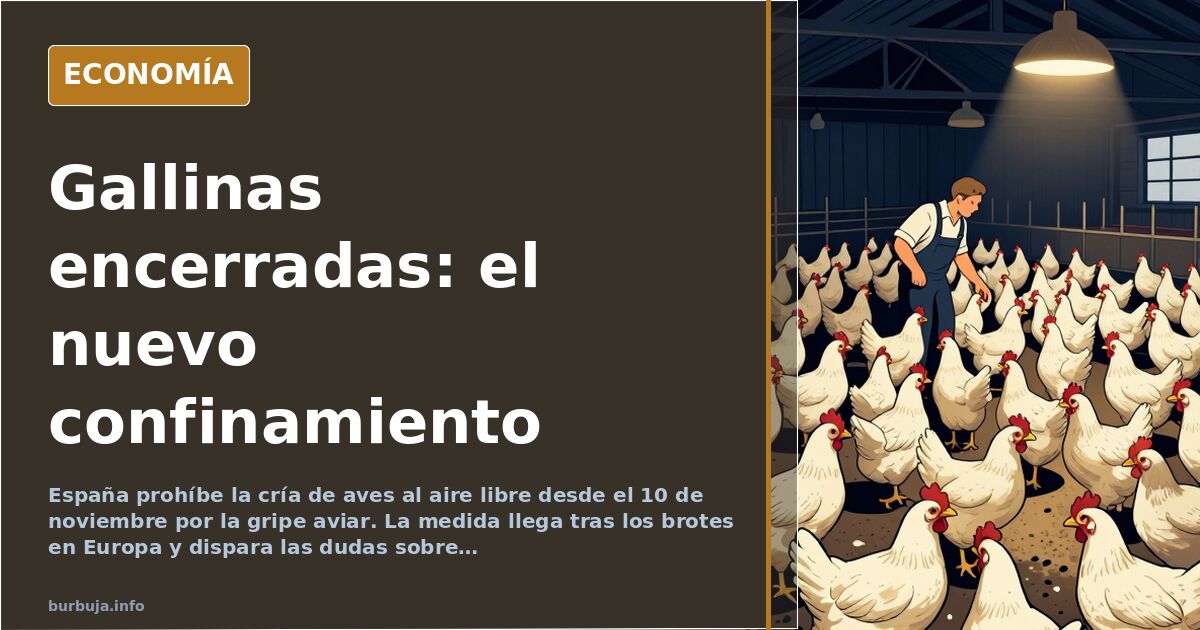
Spain confines chickens as egg prices enter the equation
The Ministry of Agriculture has decided that, from November 10, poultry in high-risk zones must cease being raised outdoors. This preventive measure comes after risk levels rose in recent weeks due to increased outbreaks in northern and central Europe and several local cases. New rules also prohibit shared water sources with wild birds and raising ducks and geese alongside other species. Ireland, France, and the United Kingdom had already applied similar confinement orders.
The official argument is to prevent bicho spread between domestic and wild birds. The problem, as almost always, is that the fine print does not fully align with the evidence at hand. Official information acknowledges that the bicho spreads primarily among birds, but its persistence and mutability are favored by degraded ecosystems and agricultural intensification. In essence: the wrong suspect is confined.
Why confine poultry if the main vector is wild?
The contradiction is significant. Wild ducks and migratory birds are the primary transmitters, yet the regulation targets domestic farms. Some argue this measure is a patch to please markets and large industries, while the real focus—human pressure on habitats and intensive livestock farming—remains untouched. The Ministry's citation regarding degraded ecosystems and agricultural intensification is, in itself, an admission that the problem is structural.
In practical terms, the measure raises doubts about its efficacy. Wild birds do not recognize closed enclosures and will continue to fly over high-risk zones. The lingering question is whether confinement responds to sanitary criteria or serves to reassure European partners while avoiding touching the production model.
Impact on the wallet: eggs, chicken, and shopping basket
The poultry sector is not a minor player in the domestic economy. Eggs and chicken meat form the protein base for most of the population, and any production restriction translates almost immediately into prices. Concerns about a cost escalation for these staples permeate the analysis: if supply contracts, other meats and fish also rise due to substitution.
The scenario drawn is not catastrophic but uncomfortable. A half-empty shopping basket at double the price is the horizon some anticipate if avian flu hits farms hard. Comparisons with past food scarcity episodes serve as warnings: prices do not drop when production recovers; they stay.
Avian flu as a mirror of a questioned agri-livestock model
Beyond the immediate situation, this episode uncovers a fundamental discussion about the model. Agri-livestock intensification and loss of natural habitats increase the probability of species jumps, according to scientific evidence cited by the Ministry itself. If so, confining birds in closed sheds does not attack the root of the problem but displaces it.
The paradox is that the measure arrives after years of criticism against cages and intensive breeding. First, confinement was penalized for animal welfare; now it is imposed for health reasons. This shift leaves producers in an awkward position and consumers with the feeling that the rules change depending on the wind direction.
What’s next
With eyes on November 10, the sector awaits detailed instructions on applying restrictions to each farm. The unknown is whether the measure will be temporary or mark a before-and-after in poultry farming in Spain. European experience suggests these orders tend to extend as long as risk remains high. And risk, involving migratory birds, does not depend on a decree.
The Ministry of Agriculture has decided that, from November 10, poultry in high-risk zones must cease being raised outdoors. This preventive measure comes after risk levels rose in recent weeks due to increased outbreaks in northern and central Europe and several local cases. New rules also prohibit shared water sources with wild birds and raising ducks and geese alongside other species. Ireland, France, and the United Kingdom had already applied similar confinement orders.
The official argument is to prevent bicho spread between domestic and wild birds. The problem, as almost always, is that the fine print does not fully align with the evidence at hand. Official information acknowledges that the bicho spreads primarily among birds, but its persistence and mutability are favored by degraded ecosystems and agricultural intensification. In essence: the wrong suspect is confined.
Why confine poultry if the main vector is wild?
The contradiction is significant. Wild ducks and migratory birds are the primary transmitters, yet the regulation targets domestic farms. Some argue this measure is a patch to please markets and large industries, while the real focus—human pressure on habitats and intensive livestock farming—remains untouched. The Ministry's citation regarding degraded ecosystems and agricultural intensification is, in itself, an admission that the problem is structural.
In practical terms, the measure raises doubts about its efficacy. Wild birds do not recognize closed enclosures and will continue to fly over high-risk zones. The lingering question is whether confinement responds to sanitary criteria or serves to reassure European partners while avoiding touching the production model.
Impact on the wallet: eggs, chicken, and shopping basket
The poultry sector is not a minor player in the domestic economy. Eggs and chicken meat form the protein base for most of the population, and any production restriction translates almost immediately into prices. Concerns about a cost escalation for these staples permeate the analysis: if supply contracts, other meats and fish also rise due to substitution.
The scenario drawn is not catastrophic but uncomfortable. A half-empty shopping basket at double the price is the horizon some anticipate if avian flu hits farms hard. Comparisons with past food scarcity episodes serve as warnings: prices do not drop when production recovers; they stay.
Avian flu as a mirror of a questioned agri-livestock model
Beyond the immediate situation, this episode uncovers a fundamental discussion about the model. Agri-livestock intensification and loss of natural habitats increase the probability of species jumps, according to scientific evidence cited by the Ministry itself. If so, confining birds in closed sheds does not attack the root of the problem but displaces it.
The paradox is that the measure arrives after years of criticism against cages and intensive breeding. First, confinement was penalized for animal welfare; now it is imposed for health reasons. This shift leaves producers in an awkward position and consumers with the feeling that the rules change depending on the wind direction.
What’s next
With eyes on November 10, the sector awaits detailed instructions on applying restrictions to each farm. The unknown is whether the measure will be temporary or mark a before-and-after in poultry farming in Spain. European experience suggests these orders tend to extend as long as risk remains high. And risk, involving migratory birds, does not depend on a decree.
Also available in: Deutsch
Summary of a discussion on Burbuja.info - Foro de economía, actualidad y política., translated from Spanish and reviewed before publication. Read the full discussion (125 replies).
More summaries
-
Spain bans outdoor poultry farming in high-risk avian flu zones
Spain's Agriculture Ministry declares high avian flu risk, banning free-range poultry in designated surveillance and special risk areas.
-
Storm Ciarán hits UK and France with hurricane warnings
Storm Ciarán brings hurricane-level winds to the UK and France, while a second low pressure system dumps moisture on the Alpine arc.
-
Trump imposes 25% tariffs on UK, Germany, and France over Greenland
Trump imposes tariffs between 10% and 25% on the UK, Germany, and France following their refusal to cede Greenland. Analysis of economic impact and Eurozone reactions.
-
Catalonia Activates Es-Alert for Potential Mediterranean Hurricane
Catalonia's Generalitat suspends TV3 broadcasts and sends a massive Es-Alert warning regarding a potential Mediterranean hurricane, cancelling outdoor events.
-
Guardiola Accuses Vox of Power Grab, Blocking Extremadura Government
María Guardiola accuses Vox of seeking seats; the party rejects her. The PP in Extremadura is left without coalition partners to form a government.
-
Sánchez's letter sparks speculation on resignation, Pegasus, or election strategy
Pedro Sánchez's open letter fuels rumors of a negotiated exit, Israeli spying allegations, and electoral calculations ahead of Catalan elections.